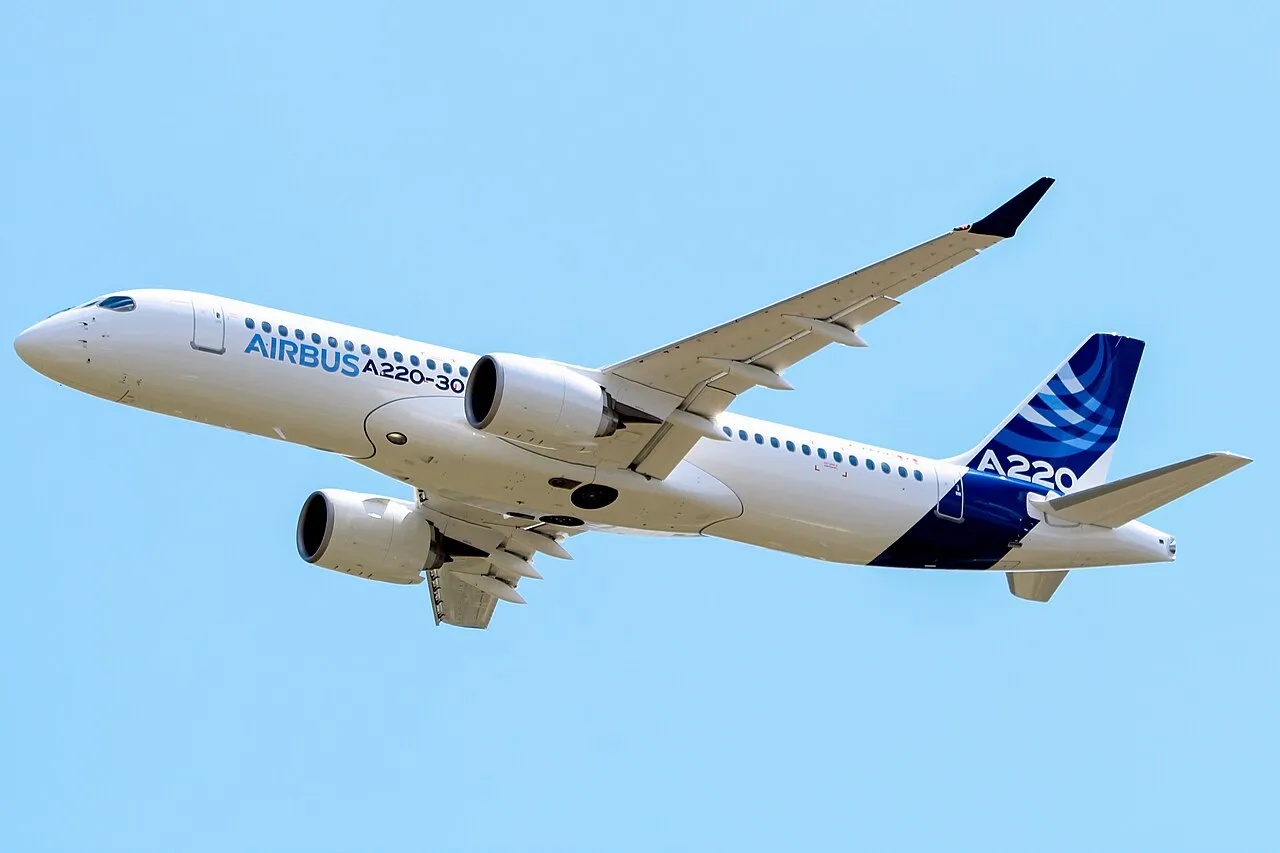
The Airbus A220 is a small single-aisle airliner seating up to 150 passengers in typical two-class layout, originally designed and built by Bombardier as the C Series1. It is manufactured by Airbus Canada Limited Partnership, which took majority control of the programme from Bombardier in 2018 and renamed it. Airlines use it mainly on short- and medium-haul routes, including thinner routes that larger narrowbodies cannot fill profitably, and the type remains in service2 in growing numbers.
Design and development
The aircraft began as Bombardier’s C Series, a clean-sheet design rather than a derivative of an older type, built around the twin aims of lower trip costs and a wider, more comfortable cabin than the regional jets it was meant to succeed. The smaller A220-100, then called the CS100, made its first flight on 16 September 2013; the larger A220-300 (CS300) followed with its first flight on 27 February 2015. Development cost overruns and slow early sales put heavy financial pressure on Bombardier, and in 2018 Airbus took a majority stake in the programme1; the type was renamed A220 and the two variants became the A220-100 and A220-300. The rebranding placed the aircraft alongside the larger A320 family in Airbus’s single-aisle lineup, giving Airbus a product at the smaller end of the narrowbody market that it had not previously offered from its own factories.
Specifications
The A220 comes in two lengths sharing the same wing. The A220-300, the larger and more common variant, is 38.7 m long; the shorter A220-100 is 35 m long. Both share a wingspan of 35.1 m1. Maximum take-off weight is 70,900 kg for the A220-300, against 63,700 kg for the A220-1002.
Range differs between the variants in the opposite direction from weight: the A220-300 flies about 3,400 nmi (6,297 km), while the A220-100 has a longer reach of about 3,600 nmi (roughly 6,668 km)2. Typical two-class seating is 120 to 150 on the A220-300 and 100 to 120 on the smaller A220-100; in a maximum, high-density single-class layout the figures rise to 160 and 135 seats respectively. The type is powered by two Pratt & Whitney PW1500G geared turbofans, cruises typically at Mach 0.78, about 829 km/h, at 41,000 ft, with a maximum speed of Mach 0.82. It is flown by two pilots1.
Variants
The family has two members, both sharing the same wing and engines. The A220-100 is the original, shorter variant, seating around 100 to 120 passengers in typical two-class configuration and offering a slightly longer range than its larger sibling, which makes it attractive for thinner routes with comparatively low passenger demand. The A220-3001 stretches the fuselage for up to 150 seats in typical configuration and has become the more widely ordered of the two.
Operators and service
As of August 2026, 542 A220s had been delivered against 1,110 ordered1, and the type is in service2 with airlines worldwide. Launch and major customers have used it on domestic and regional routes as well as some longer thin international links that would not fill a larger jet profitably. The gap between the two variants’ seating and range, set out above, lets an airline match the A220-100 or the A220-300 to a route’s demand rather than operating one size across a whole network, and the backlog of orders still outstanding against deliveries so far points to years of further deliveries ahead.
Similar aircraft
- Embraer E190-E2 / E195-E2: a Brazilian-built family of similar size and seating that competes directly with the A220 on short- and medium-haul routes, built around the same idea of a small, efficient single-aisle jet rather than a shrunk widebody or a stretched regional jet.
- Boeing 737 MAX 7: the smallest member of the Boeing 737 family, overlapping with the A220-300 in seating capacity but derived from a much older airframe rather than designed from a blank sheet.
- Bombardier CRJ900 / CRJ1000: the regional jets the A220 was conceived to succeed, smaller and shorter-ranged, built on an older design that the A220’s clean-sheet cabin and engines were meant to leave behind.