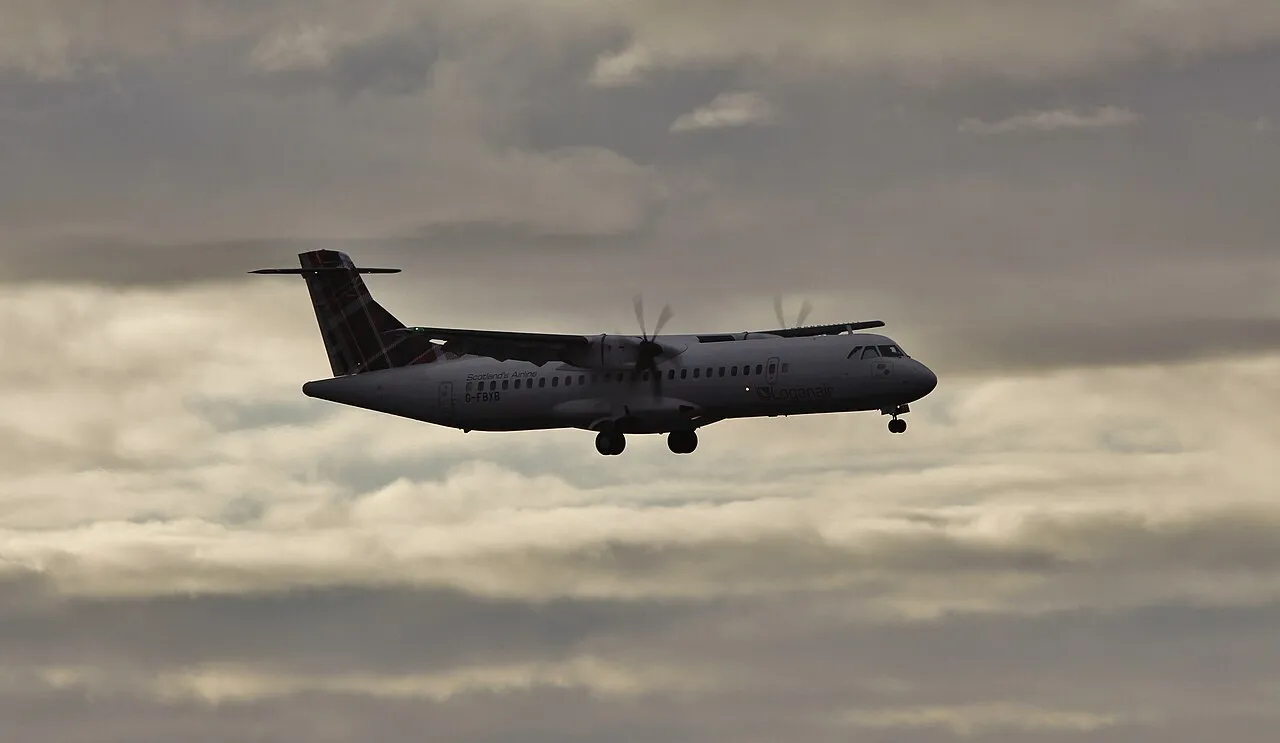
The ATR 72 is a twin-engine turboprop airliner built by ATR (Avions de Transport Régional), a joint venture of Airbus (France) and Leonardo (Italy). It is a stretched version of the ATR 42, designed for short regional routes where its turboprop engines and relatively low operating costs suit lower-density, shorter-haul flying. Since its first flight on 27 October 19881, the type has become one of the most widely used regional airliners in the world, still in production and in service2 today.
Design and development
ATR developed the 72 by stretching the fuselage of its smaller ATR 42 to add more seats while keeping the same wings, engines and systems, a common approach for regional turboprop families aiming to cover several route lengths at a shared development cost. The aircraft has gone through several sub-versions since its 1988 debut, most recently the ATR 72-600, which carries updated avionics and the latest engine options2 while keeping the same basic airframe. The type’s production run stretches from 1988 to the present day, with more than 1,200 aircraft built3.
Specifications
The current production version, the ATR 72-600, is 27.17 m long with a wingspan of 27.05 m, figures close enough to give the aircraft a near-square profile when seen from above. Its maximum take-off weight is 23,000 kg, and it is powered by two Pratt & Whitney Canada PW127 series turboprops, either the PW127M or the PW127XT on the latest -600 aircraft2. It cruises at around 517 km/h (279 knots)3.
Seating on the -600 typically ranges from 44 to 78 passengers depending on configuration, with 72 seats at 29-inch pitch as the standard layout and up to 78 at a tighter 28-inch pitch. With a maximum passenger load, the aircraft’s range is about 1,370 km (740 nautical miles)2, reflecting its design for short regional hops rather than long sectors. ATR’s list price for the -600 was about $26.8 million as of September 2018. The aircraft has a crew of four3.
Variants
The -600 is the current production standard, following earlier -200, -210 and -500 versions as ATR progressively updated the type’s engines and avionics over more than three decades of production. Each generation kept the same basic airframe and layout while improving the flight deck, engines and systems, letting operators of older models upgrade without retraining crews on a different aircraft. Cargo and combi conversions have also been built alongside the standard passenger layout, extending the aircraft’s use beyond scheduled regional passenger service into freight and express-delivery work.
Operators and service
The ATR 72 is flown by a wide range of regional airlines around the world, chosen for its ability to serve short routes and smaller airports that larger jets cannot use economically. Its turboprop engines and shorter runway requirements make it a common choice for island-hopping routes and feeder services connecting smaller cities to larger hubs. ATR describes the type as in production and in service2 today, following its first flight in 1988.
Similar aircraft
- ATR 42: the shorter, smaller-capacity aircraft from which the ATR 72 was developed, sharing the same wings, engines and systems.
- Bombardier Dash 8: a competing twin-turboprop regional airliner built for similar short-haul routes.
- Embraer EMB 120 Brasilia: an older twin-turboprop regional airliner that served a similar market segment.
_(2185550037)_Tf5rg.webp)