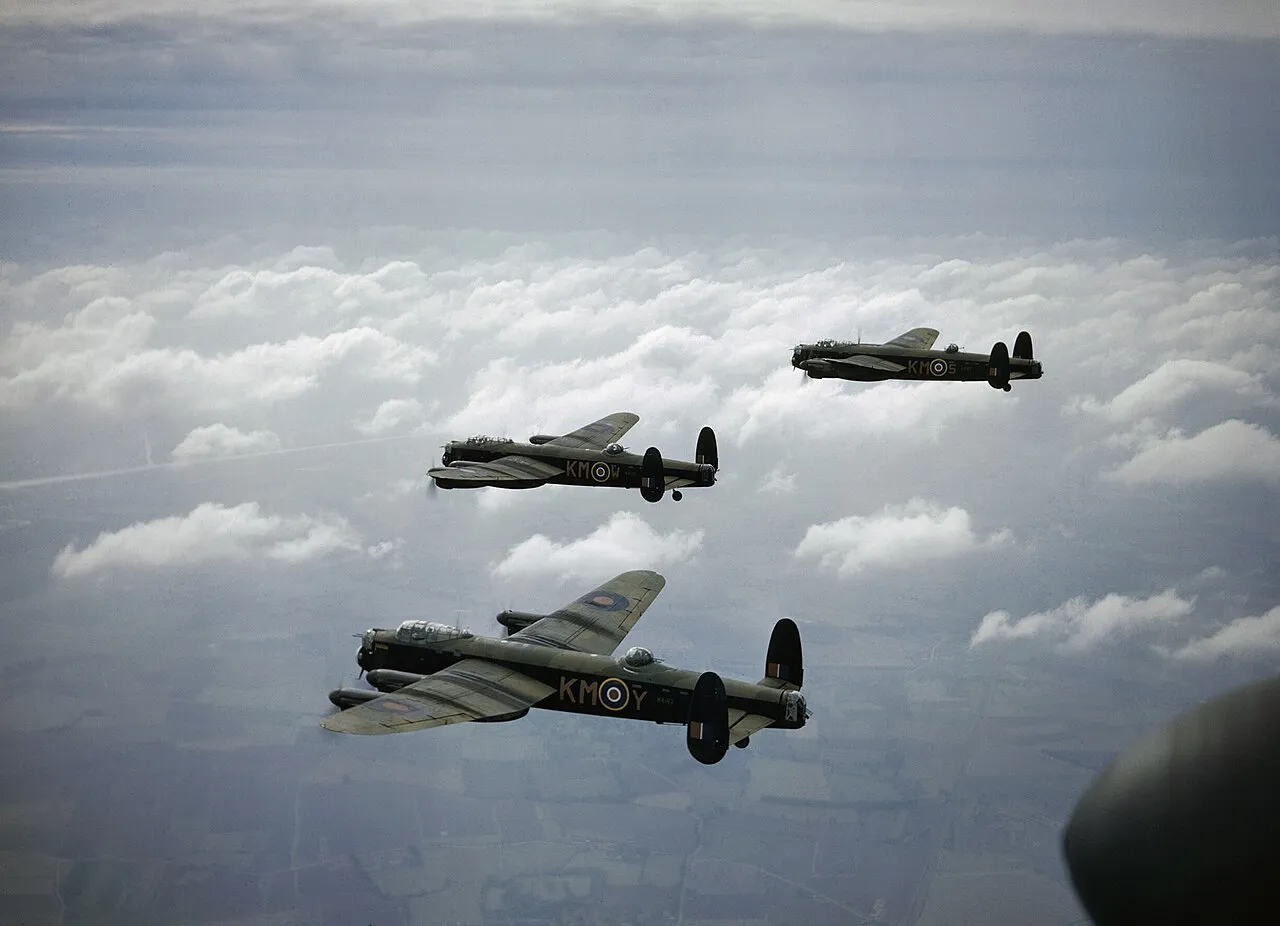
The Avro Lancaster is a four-engine heavy bomber built by Avro for the Royal Air Force. It first flew on 9 January 1941 and went on to become the most widely used of the RAF’s heavy bombers in the Second World War1, carrying the night bombing campaign against Germany and occupied Europe and flying some of the war’s best-known precision raids.
Design and development
The Lancaster grew out of a troubled predecessor. Avro’s twin-engine Manchester had suffered from unreliable Rolls-Royce Vulture engines, and the company’s chief designer, Roy Chadwick, reworked the airframe to take four Rolls-Royce Merlin engines instead. The resulting aircraft kept the Manchester’s fuselage and twin-tail layout but added a longer wing to carry the extra engines1, and the new type was found to be far more capable and reliable than the aircraft it replaced.
The design’s deep, unobstructed bomb bay turned out to be one of its greatest strengths. It let the Lancaster carry heavier bomb loads than other wartime heavy bombers, including Britain’s own Short Stirling and Handley Page Halifax, and the specialised “Grand Slam” and “Tallboy” deep-penetration bombs that no other aircraft of the time could lift1.
Specifications
The production Lancaster was 21.13 m long with a wingspan of 31.09 m and a maximum take-off weight of 30,845 kg. It was powered by four Rolls-Royce Merlin XX V-12 liquid-cooled piston engines, giving it a cruise speed of about 322 km/h and a range of about 4,072 km. A crew of seven flew the aircraft on operations: pilot, flight engineer, navigator, bomb aimer, wireless operator, mid-upper gunner and rear gunner1, the gunners manning power-operated turrets to defend against night fighters.
Variants
Avro and its subcontractors built 7,377 Lancasters between 1941 and February 1946, most of them to the original Lancaster I and the externally similar Lancaster III, which used US-built Packard Merlin engines to ease pressure on British engine production. Demand was high enough that, besides Avro’s own plants, Armstrong Whitworth, Austin Motors, Metropolitan-Vickers and Vickers-Armstrongs all built the type under licence in Britain, and Victory Aircraft produced the Lancaster B X in Ontario, Canada. A dedicated version, the Lancaster B.I Special, was stripped of its turrets and had its bomb bay enlarged to carry the 22,000 lb Grand Slam bomb1. After the war the design was developed into the civilian Avro Lancastrian airliner and the maritime-patrol Avro Shackleton, both derived directly from the Lancaster airframe.
Operators and service
The Lancaster entered squadron service with the RAF’s No. 44 Squadron in early 1942 and flew its first bombing operation, against Essen, on 10 March that year. It became the main heavy bomber of RAF Bomber Command’s night offensive against German industry and cities, and squadrons of the Royal Canadian Air Force and other Commonwealth air forces flew it alongside the RAF. The type’s defensive armament originally comprised four hydraulically operated turrets in the nose, tail, mid-upper and underside positions, each armed with Browning .303 machine guns1, though the underside turret was later removed as it proved of little use.
The type carried out some of the war’s most famous raids. On the night of 16–17 May 1943, nineteen Lancasters of No. 617 Squadron attacked the Möhne, Eder, Sorpe and Ennepe dams in the Ruhr valley with specially designed “Upkeep” bouncing bombs1, an attack later known as the Dambusters raid. On 12 November 1944, 32 Lancasters of No. 9 and No. 617 Squadrons sank the German battleship Tirpitz with Tallboy bombs in Operation Catechism2.
After the war the Royal Canadian Air Force kept Lancasters in service longest, retiring its last examples on 1 April 1964. Today the type is retired from military use, and one aircraft, PA474, remains airworthy with the RAF Battle of Britain Memorial Flight1.
Similar aircraft
- Boeing B-17 Flying Fortress: the American four-engine heavy bomber flown by daylight over Europe in the same war, see its page.
- Handley Page Halifax: the RAF’s other four-engine heavy bomber of the war, built alongside the Lancaster for the same night campaign.