Contents
The Bayraktar TB2 is a medium-altitude, long-endurance uncrewed aerial vehicle built by the Turkish company Baykar for intelligence, surveillance and precision strike missions. It flies with no one on board, controlled from a ground station, and Baykar calls it the world’s most actively deployed UAV. Since entering service it has been exported to at least 31 countries2 and flown in conflicts from Libya and Syria to Nagorno-Karabakh and Ukraine, with Baykar describing it as a combat-proven Medium Altitude Long Endurance platform1.
Design and development
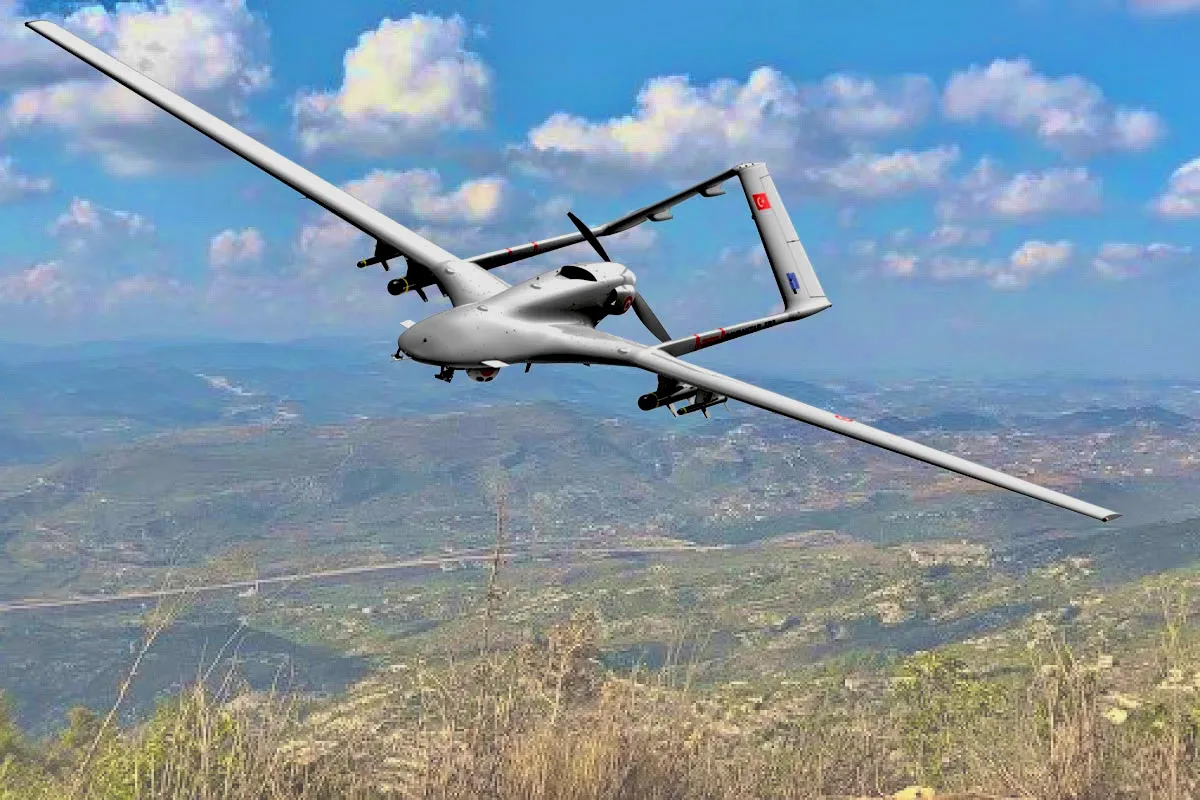
Baykar developed the TB2 after the United States refused to export armed drones to Turkey, fearing they would be used against Kurdish armed groups, building on experience from the earlier Bayraktar TB1. The design first flew3 in August 2014. The airframe is a blended wing body with an inverted V-tail2, built from carbon-fibre composites and driven by a pusher propeller. Baykar says the aircraft flies with a triple-redundant autopilot capable of fully autonomous taxi, take-off, cruise and landing1, and can navigate with internal sensor fusion when GPS is denied.
Specifications
The TB2 is 6.4 metres long with a 12-metre wingspan and a maximum take-off weight of 700 kg, of which it can carry up to 150 kg of payload. It is powered by a single 100 hp engine, either Baykar’s own TM100 or a Rotax 912-iS, giving a maximum speed of 167–204 km/h (90–110 knots). Baykar does not publish a range figure in kilometres; instead it sets an endurance record of 27 hours and 3 minutes, flying at an operational altitude around 16,000 feet and a service ceiling of 20,000 feet. No one flies on board; each aircraft is flown from a ground control station, crewed by three operators. Its four hardpoints carry laser-guided MAM-L and MAM-C munitions, the L-UMTAS missile and Roketsan’s Cirit rockets2, aimed with an electro-optical, infrared and laser-designator payload, or swapped for a surveillance radar1.
Variants
Baykar’s TB2S, introduced in 2020, adds a satellite-communication link that extends control beyond the base model’s 150–300 km line-of-sight range. A newer TB2T-AI variant, announced for 20252, pairs revised aerodynamics with onboard AI computers for a claimed top speed around 300 km/h and a 30,000-foot ceiling.
Operators and service
Turkey was the first operator and remains the largest, flying more than 200 TB2s across its armed forces. As of September 2023 Baykar had exported the type to 31 countries, including Ukraine from 2019 and Azerbaijan from 2020, and Poland, which ordered 24 aircraft in 2021 to become the first NATO and EU buyer. Baykar’s own history records the type’s first demonstration firing munitions in 20153. The TB2 has flown in several conflicts: Turkish forces used it heavily during Operation Spring Shield in Syria in 2020, Azerbaijan deployed it against Armenian armour in the 2020 Nagorno-Karabakh war, and Ukraine flew it against Russian forces after the 2022 invasion, reportedly expanding its fleet to more than 50 aircraft by that June. Baykar says the worldwide fleet has logged more than 1 million flight hours, and more than 800 had been built2. The type remains in service1.
Safety record
The TB2 has suffered combat losses. Azerbaijan lost two during the Nagorno-Karabakh fighting, and Russia claimed to have shot down more than 100 Ukrainian-operated TB2s by 20232.
Similar aircraft
- General Atomics MQ-9 Reaper: a larger American strike drone built around a Honeywell TPE331-10 turboprop engine and flown by the US Air Force and UK, Italian, French and Spanish forces4, plus the US Department of Homeland Security and NASA.
- CAIG Wing Loong II: a Chinese-built medium-altitude strike drone from the Chengdu Aircraft Industry Group, with up to 480 kg of external stores on its hardpoints5.
- IAI Heron: an older, long-serving Israeli airframe built by Israel Aerospace Industries and designed for strategic reconnaissance and surveillance missions only, with a longer quoted endurance of around 45 hours6 but without the strike role the TB2’s hardpoints give it.