Contents
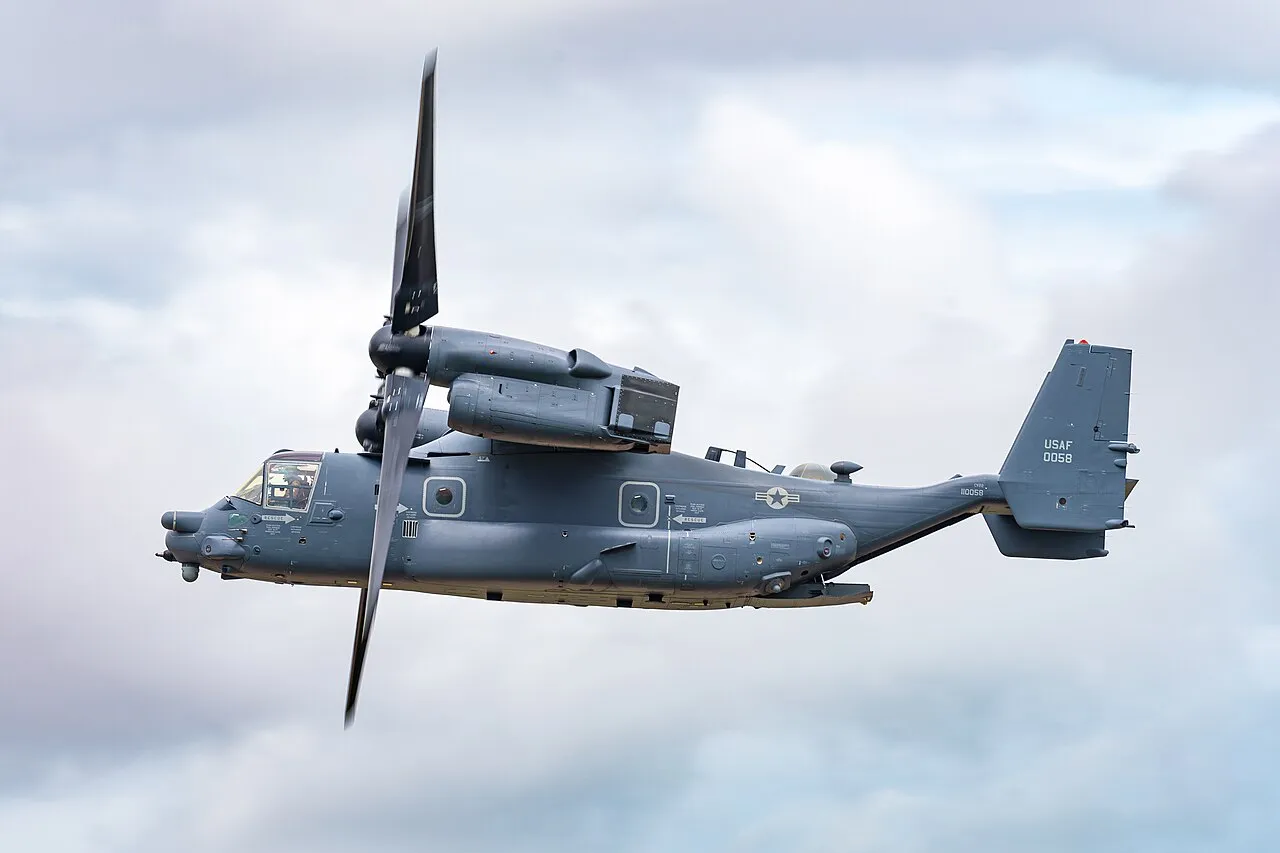
The Bell–Boeing V-22 Osprey is a military tiltrotor built by Bell Helicopter and Boeing Defense, Space & Security1. Two wingtip rotors swivel so the aircraft can take off and land vertically like a helicopter, then tilt forward to cruise like a turboprop2. It carries troops and cargo for the US Marine Corps, Air Force and Navy, and for Japan’s Self-Defense Forces, combining a helicopter’s ability to use small, unprepared landing spots with a fixed-wing aircraft’s speed and range over long distances.
Design and development
The V-22 was built jointly by Bell Helicopter and Boeing Defense, Space & Security1 as a tiltrotor combining helicopter and fixed-wing flight in one aircraft. The first prototype made its first flight on 19 March 19893, well over a decade before the type reached frontline squadrons, reflecting the scale of the engineering challenge in making the tilting-rotor layout work reliably.
Specifications
The Osprey’s fuselage is 17.47 m long, and with its rotors folded for shipboard stowage it shrinks to about 19.2 m in overall footprint on deck. Its wing spans 14 m, with each of the two rotors measuring 11.6 m in diameter2. Maximum take-off weight is 23,859 kg taking off vertically, rising to 25,855 kg when it uses a short rolling take-off instead. It is powered by two Rolls-Royce T406-AD-400 (AE 1107C) turboshaft engines rated at 6,150 shp each1, driving the rotors through a cross-link shaft so one engine can keep both turning if the other fails.
Combat range is about 722 km, but the aircraft can self-deploy over roughly 4,130 km with aerial refuelling, far beyond what a comparable transport helicopter manages without being broken down and airlifted. A standard crew is three to four: a pilot, copilot, and one or two flight engineers, crew chiefs, loadmasters or gunners, and the cabin carries up to 24 seated troops, or 32 if they stand on the floor2.
Variants
Three variants are in service: the MV-22B, flown by the US Marine Corps for medium-lift transport, troop insertion and casualty evacuation; the CV-22B, flown by the US Air Force for long-range special-operations transport and combat search and rescue support; and the CMV-22B, flown by the US Navy for carrier onboard delivery between ships. Japan’s Ground Self-Defense Force also flies the MV-22B2.
Operators and service
Over 400 Ospreys had been built as of 20203, and the type is in service1 with the US Marine Corps, Air Force and Navy, and with Japan’s Self-Defense Forces, the only export customer so far. Average procurement cost, including development spread across the planned 458-aircraft buy, was about $110 million per aircraft in 2005, while the incremental flyaway cost of an individual aircraft was about $67 million in 20082.
Safety record
Early testing was costly: two fatal crashes in 2000 killed a total of 23 marines and led the Marine Corps to ground the fleet. The type’s record later improved; a 2011 assessment by the Lexington Institute, cited by Wikipedia, found that the Osprey’s average mishap rate per flight hour over the preceding decade was the lowest of any Marine Corps rotorcraft, about half the average fleet accident rate, and by October 2019 the fleet had passed 500,000 flight hours. Accidents have continued since: a crash off Japan on 29 November 2023 killed all eight airmen aboard and prompted US and Japanese forces to ground their Osprey fleets temporarily2.
Similar aircraft
- Boeing CH-47 Chinook: a tandem-rotor helicopter that overlaps with the Osprey in heavy troop and cargo transport, though it cannot match its cruise speed or range.
- Sikorsky CH-53: a heavy-lift helicopter that the Marine Corps flies alongside the Osprey for missions needing more lift than speed.
_ZlJakE.webp)