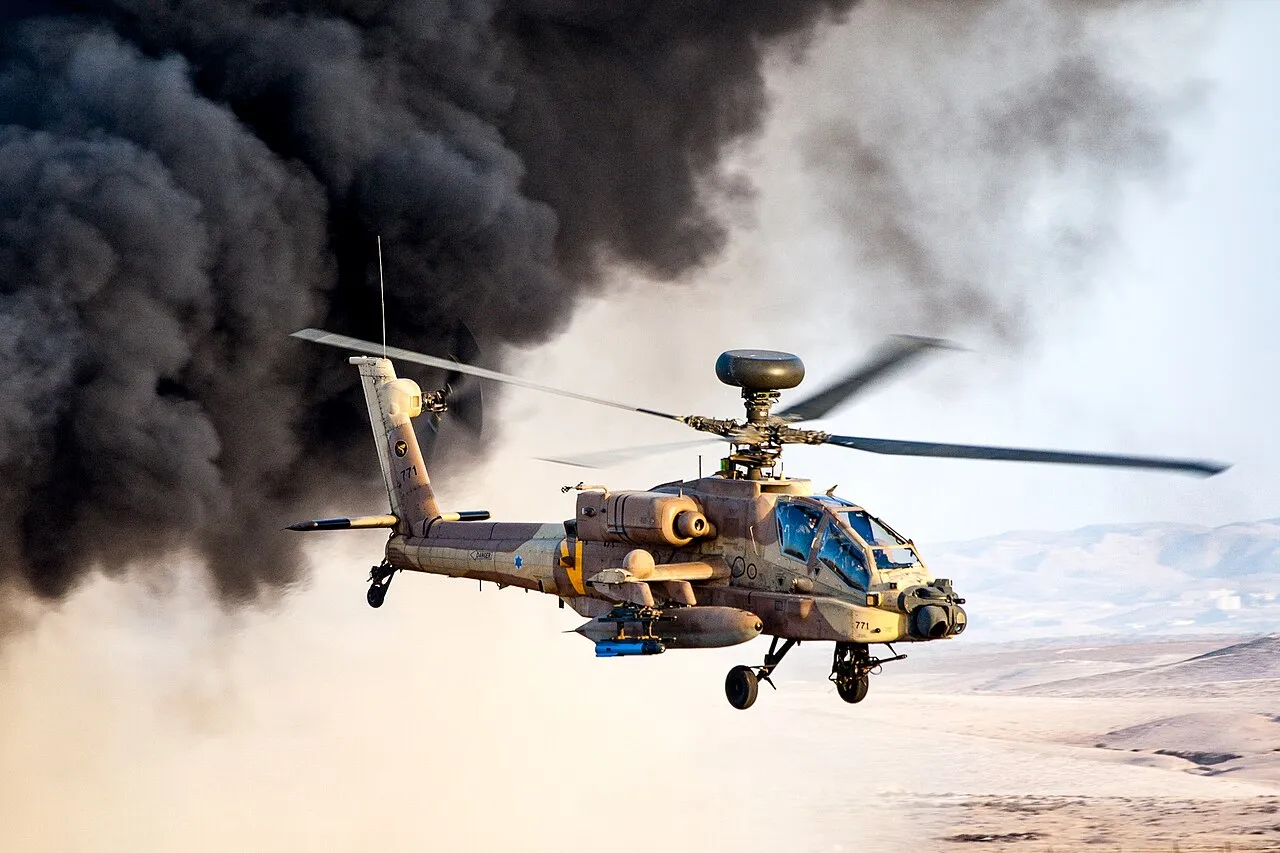
The AH-64 Apache is a twin-turboshaft attack helicopter built originally by Hughes Helicopters, then McDonnell Douglas from 1984 and Boeing Defense, Space & Security from the 1997 Boeing-McDonnell Douglas merger. It flies with a crew of two, a pilot and a co-pilot/gunner seated in tandem1, and serves the US Army and more than a dozen other air forces as their primary dedicated attack helicopter. Boeing continues to market the current AH-64E Guardian version to new and existing operators2.
Design and development
The Apache was designed for the US Army’s Advanced Attack Helicopter program, and the prototype first flew on 30 September 1975. Hughes Helicopters won the competition over a rival Bell design, and the Army named the aircraft “Apache” in late 1981, following its tradition of naming helicopters after Native American tribes, before approving the type for full-scale production in 1982. Production and support of the type passed through several owners as the US helicopter industry consolidated: Hughes Helicopters built it from 1975, McDonnell Douglas acquired Hughes’s helicopter business in 1984, and Boeing took over the program through its 1997 merger with McDonnell Douglas1.
The airframe carries its two crew members in a tandem cockpit, the pilot behind and above the co-pilot/gunner, who aims the helicopter’s sensors and weapons. Stub wings mounted on the fuselage carry the Apache’s weapons and external fuel rather than providing lift, and the airframe and rotor system were built to survive hits from rounds up to 23 mm1.
Target acquisition originally relied on the Target Acquisition and Designation System and Pilot Night Vision System (TADS/PNVS), which later gave way on modernised aircraft to Lockheed Martin’s Arrowhead targeting system. Either crew member can slew the helicopter’s 30 mm M230 chain gun to track their own head movements via a helmet sight. Alongside the chain gun, the Apache’s stub wings typically carry AGM-114 Hellfire anti-tank missiles and unguided 70 mm Hydra rockets1, giving it both precision anti-armour firepower and area suppression.
Specifications
The Apache is 17.73 m long overall with the rotors turning, with a fuselage of 15.06 m on its own, and its four-blade main rotor spans 14.63 m. It has a maximum take-off weight of 10,433 kg, confirmed by Boeing’s own type page2. Two General Electric T700-GE-701C turboshaft engines power it to a cruise speed of about 265 km/h. Fitted with external fuel tanks it has a ferry range of about 1,896 km, though its combat radius on internal fuel is closer to 480 km1.
The type has never been cheap to build or buy. The average unit cost of an AH-64A ran to about $13.9 million in 19861, a figure that would be considerably higher for the more capable AH-64E built today.
Variants
The AH-64A was the original production version, delivered from 1984. The AH-64D Apache Longbow added the distinctive mast-mounted Longbow fire-control radar above the main rotor along with upgraded avionics and engines, and most surviving AH-64As were remanufactured to AH-64D standard rather than built new. The current production model, the AH-64E Guardian, introduced more powerful engines, a strengthened drivetrain, composite rotor blades and improved joint-network connectivity, and first entered US Army service in 20131.
Operators and service
More than 2,700 Apaches have been delivered to the US Army and 18 international partners and allies, as of March 2024, and Boeing continues to build the AH-64E for new and existing customers2. Beyond the United States, operators include Israel, Egypt, Saudi Arabia, the United Kingdom, Japan, South Korea, Singapore, Taiwan, India and the Netherlands, among others, each flying it as its principal attack helicopter. The type remains in service1, with production of the AH-64E ongoing for both new airframes and remanufactured older aircraft.
US Army Apaches flew combat missions in the 1989 invasion of Panama and the 1991 Gulf War, where they were credited with destroying large numbers of Iraqi tanks and armoured vehicles. The type has since flown in the Balkans, Afghanistan and Iraq, and Israeli AH-64s have seen repeated combat use over Gaza, Lebanon and the West Bank1.
Similar aircraft
- Mil Mi-28: Russia’s comparable dedicated attack helicopter, built around a similar tandem-cockpit, stub-wing layout.
- Eurocopter Tiger: a lighter twin-engine attack helicopter developed jointly by France and Germany, flown by several European air forces instead of the Apache.
- Bell AH-1 Cobra: the earlier US Army attack helicopter the Apache was designed to replace in the frontline attack role.