Contents
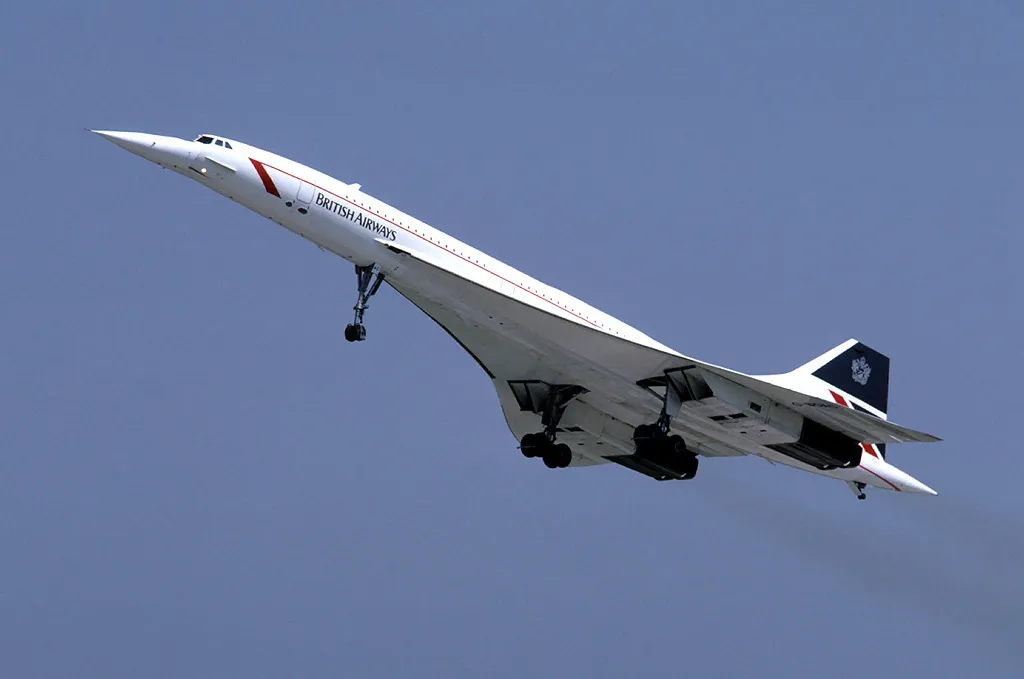
Concorde is a supersonic passenger airliner built jointly by Aérospatiale of France and the British Aircraft Corporation of the UK1 under an Anglo-French treaty. It was designed to carry passengers across the Atlantic at more than twice the speed of a conventional jet, and it is one of only two supersonic airliners to have carried fare-paying passengers. Only Air France and British Airways2 flew it in scheduled service, mainly on transatlantic routes between Europe and North America.
Design and development
The project grew out of parallel British and French studies for a supersonic transport, merged under a treaty signed in November 1962 that split Concorde’s research and assembly costs 50:50 between the two governments rather than letting either side build alone. The French prototype first flew from Toulouse on 2 March 1969, a 29-minute flight at a modest 480 km/h; the British-assembled prototype followed five weeks later, and the type did not reach Mach 2 until its 102nd test flight. Development continued through the early 1970s as the aircraft was tested for certification and refined for airline service. The programme broke technical ground beyond its speed: Concorde flew with electronic fly-by-wire controls and the first cockpit sidestick3 fitted to an airliner, years before either became standard on subsonic jets. The programme was also expensive and politically fraught: rising costs, environmental objections to sonic booms over land, and the 1970s oil crisis all weighed on its commercial prospects, and in the end only 20 aircraft were built2, six prototype and development airframes plus 14 production aircraft split evenly between the two launch airlines. No other airline bought the type.
Specifications
Concorde is 61.66 metres long with a wingspan of 25.56 metres, a slender delta-wing shape built for supersonic flight instead of cabin volume. Its maximum take-off weight is 185,065 kg. The type is powered by four Rolls-Royce/Snecma Olympus 593 turbojets with reheat, each rated at 38,050 lb of thrust, which let it cruise at about 2,150 km/h, or Mach 2.02 — roughly twice the speed of a typical subsonic airliner. Its range is about 6,580 km1, and in a typical airline configuration it seated 100 passengers in four-across rows4, though the type was certified for up to 128 seats in a denser layout2.
The cost of building one reflected the scale of the engineering effort: Air France and British Airways paid about US$20 million per aircraft at 1976 prices1.
Variants
Concorde flew in essentially one production configuration once certified; the differences between airframes were mainly between the early pre-production prototypes used for testing and the production aircraft delivered to the two launch airlines. No stretched, shortened or re-engined passenger version was ever built or sold.
Operators and service
Scheduled supersonic services began in 1976 and continued for more than 27 years, flown only by Air France and British Airways, the two airlines of the governments that funded its development. Only 16 of the 20 aircraft built ever entered commercial service, and one of them, registration F-BVFA, logged 17,824 flight hours4 over its career, including the type’s inaugural Air France routes to Rio de Janeiro, Washington and New York. British Airways’ best-known route linked London with New York: the Airbus history of the programme puts a typical subsonic Atlantic crossing today at around seven hours against Concorde’s roughly half that time3. The type’s commercial life ended after the 2000 Air France crash near Paris dented passenger confidence, and rising maintenance costs made the ageing fleet harder to justify. Concorde was retired from commercial service on 24 October 20032, with the last ferry flight following on 26 November 2003; F-BVFA’s own final flight, on 12 June 2003, carried 60 passengers including French government officials before the aircraft went to the Smithsonian.
Safety record
Concorde’s most serious accident was the crash of an Air France aircraft shortly after takeoff from Paris–Charles de Gaulle on 25 July 2000, which killed all on board and four people on the ground; the aircraft struck debris from a ruptured tyre that punctured a fuel tank. That accident is cited as a factor in the type’s declining passenger numbers2, preceding its retirement by three years.
Similar aircraft
- Tupolev Tu-144: the Soviet supersonic airliner and Concorde’s only rival to carry passengers, developed in the same era but withdrawn from passenger service much earlier.
- Boeing 747-8: a large subsonic airliner from the same generation of long-haul jets, built for capacity and range instead of speed, the trade-off Concorde was designed to break.