Contents
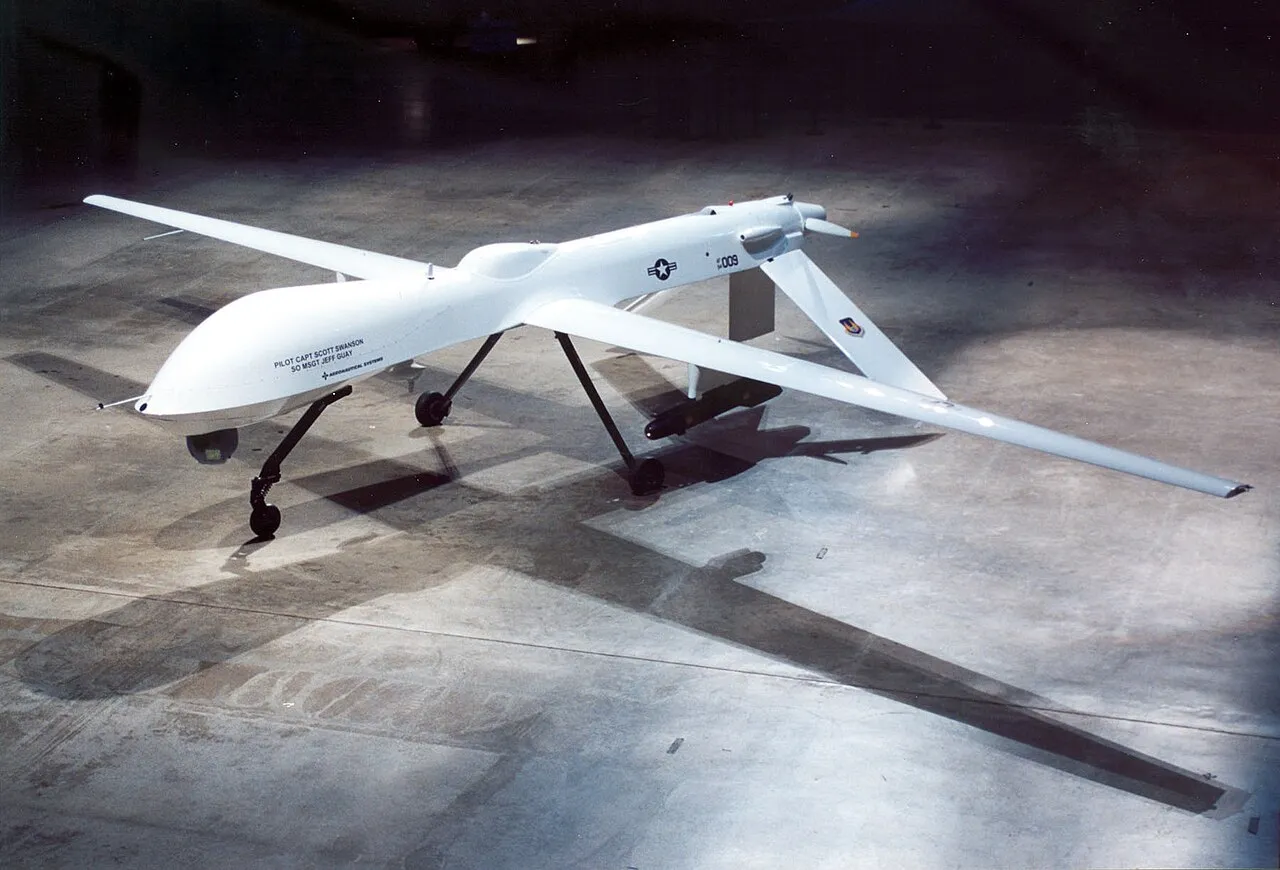
The General Atomics MQ-1 Predator is an unmanned aircraft with no one aboard, flown remotely by a pilot and a sensor operator on the ground1. Built by General Atomics Aeronautical Systems, it began as a reconnaissance drone and became the first armed, remotely piloted aircraft to fly combat missions, carrying cameras and sensors and, later, missiles over the battlefields of the 1990s and 2000s. The type is retired from United States Air Force service but still flies with a handful of other air forces2.
Design and development
The Predator traces back to the Gnat 750, an earlier General Atomics reconnaissance drone, and the prototype that became the Predator made its first flight on 3 July 19942. It was designed as a slow, long-endurance surveillance platform: a slender fuselage, long thin wings and a pusher propeller driven by a single Rotax 914F four-cylinder turbocharged piston engine rated at 115 hp1. That modest engine gave the aircraft its defining trait, the ability to loiter over a target for many hours rather than fly fast.
The US Air Force first used the type, then designated RQ-1, purely for reconnaissance, deploying it to Gjader, Albania in the summer of 1995 to watch the war in Bosnia. Its role changed after the US Air Force fired a Hellfire missile from a Predator for the first time on 16 February 2001, hitting a stationary tank on a Nevada test range. Carrying weapons earned the type the redesignation MQ-1 in 2002, and it went on to fly its first armed combat sortie over Afghanistan on 7 October 20011, making it the first remotely piloted aircraft to be used to kill a human target.
Variants
The Predator’s own designations track its shift from scout to striker. The RQ-1A and RQ-1B were the unarmed pre-production and production reconnaissance versions, while the MQ-1A carried early Hellfire and Stinger armament and the MQ-1B added upgraded avionics, a modified antenna and enlarged engine air intakes. The latest production standard, the MQ-1B Block 10/15, added three-foot wing-tip extensions, updated countermeasures and a second camera. General Atomics also built the Predator XP, an export version unable to carry weapons, aimed at customers the US government would not approve for an armed drone, and developed the type further into the MQ-1C Gray Eagle, a US Army derivative with a more powerful engine and an open avionics architecture1.
Specifications
The Predator is a small aircraft next to a crewed fighter or airliner: 8.22 m long with a wingspan of 14.8 m2 on the original RQ-1, though the later MQ-1B Block 10/15 variant spans 16.84 m. Its maximum take-off weight is about 1,020 kg, light enough that the piston engine’s modest power is enough to keep it airborne for long stretches. Cruise speed sits at a sedate 130 to 170 km/h, and ferry range is about 1,250 km. No one sits in the cockpit; a pilot and a sensor operator fly and watch the aircraft from a ground control station1, communicating with it by line-of-sight radio or satellite link.
Operators and service
General Atomics built 360 Predators in total, 285 of the original RQ-1 and 75 of the armed MQ-1. The US Air Force flew the type over the Balkans, Afghanistan, Iraq, Pakistan, Yemen, Libya, Syria and Somalia, using it for both surveillance and strike missions. One strike became especially well known: on 3 November 2002 a Predator-fired Hellfire killed al-Qaeda leader Qaed Salim Sinan al-Harethi in Yemen, the first US drone strike outside Afghanistan. The Air Force retired the MQ-1 from its own service on 9 March 2018, by which point its larger successor, the MQ-9 Reaper, had taken over most of its combat role. Outside the United States, the Predator and its export variants have continued in service with Turkey, Morocco and the United Arab Emirates2; Italy and the United Kingdom also flew the type before retiring their own fleets, and the UAE Air Force has lost at least three Predators to Houthi fire over Yemen since 20171.
Safety record
The Predator’s early years were accident-prone. By 2009 the US Air Force had lost 70 Predators: 55 to equipment failure, operator error or weather, five shot down over Bosnia, Kosovo, Syria and Iraq, and eleven more in operational accidents on combat missions. An Iraqi MiG-25 shot down a Predator on 23 December 2002, the first time a conventional crewed fighter and a drone had engaged each other in combat. In 2012 the US Air Force named the Predator, together with the Reaper and the Global Hawk, as the most accident-prone aircraft in its fleet1.
Similar aircraft
- General Atomics MQ-9 Reaper: the Predator’s larger, turboprop-powered successor, built by the same company to take over its strike and surveillance role.
- Bayraktar TB2: a Turkish medium-altitude, long-endurance drone built for a similar combination of reconnaissance and precision strike.