Contents
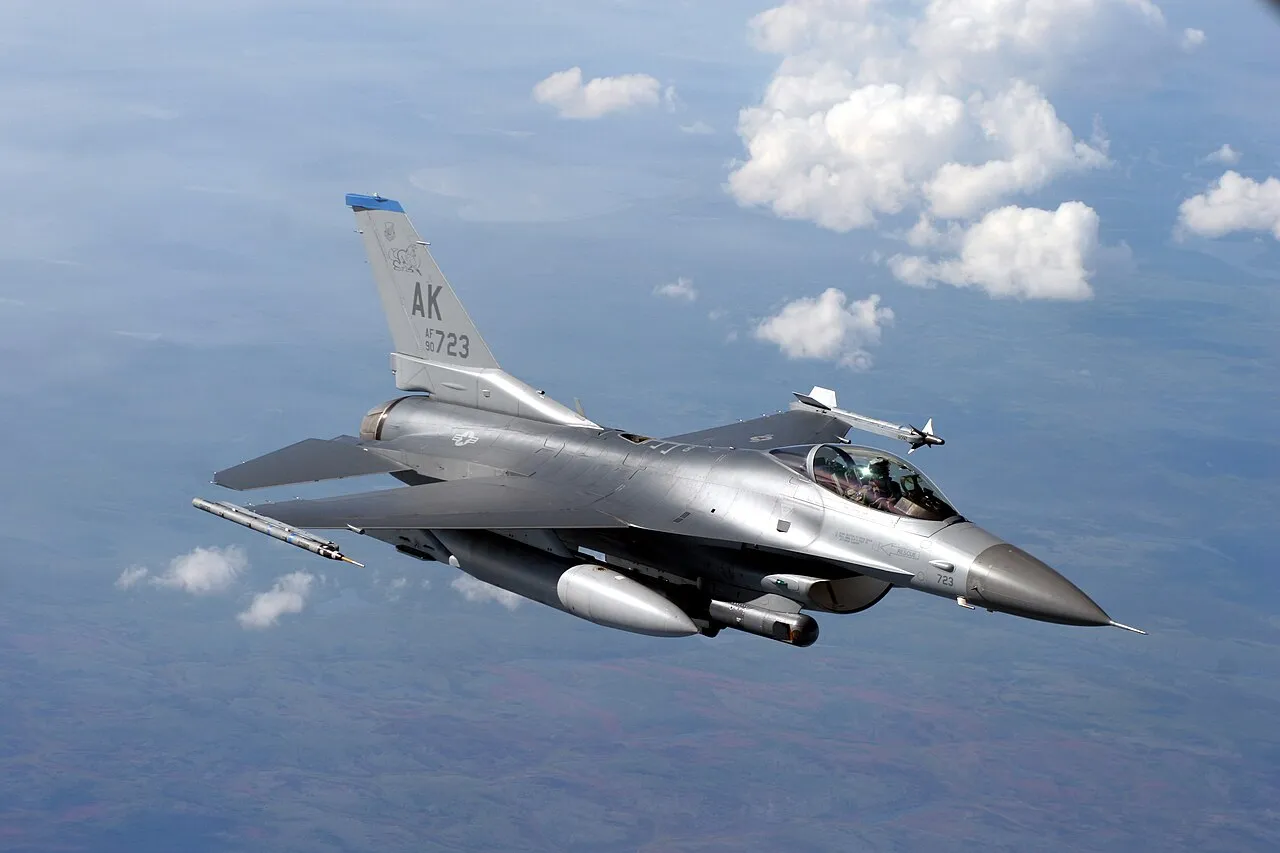
The General Dynamics F-16 Fighting Falcon is a single-engine, multirole fighter built for air-to-air combat and later adapted for ground attack. General Dynamics designed it as a lightweight day fighter, and after changes of ownership Lockheed Corporation and then Lockheed Martin took over production. Pilots mostly call it the “Viper,” after the fictional starfighter in Battlestar Galactica, even though its official name honours a bird of prey. More than four decades after its first flight it remains the world’s most common fixed-wing aircraft in military service1.
Design and development
The F-16 grew out of Colonel John Boyd’s energy-manoeuvrability theory and a group of officers and engineers nicknamed the “Fighter Mafia,” who pushed the US Department of Defense to fund studies for a lightweight fighter during the Vietnam War era. The Lightweight Fighter programme formally began with a request for proposals on 6 January 1972 for a roughly 20,000-pound day fighter optimised for speeds between Mach 0.6 and 1.6. General Dynamics and Northrop each built prototypes; Northrop’s YF-17 later became the basis for the Navy’s F/A-18 Hornet, while General Dynamics’ YF-16 made an unplanned first flight on 20 January 1974 during a high-speed taxi test, when test pilot Phil Oestricher lifted off briefly to avoid a crash, followed by its official first flight on 2 February 1974. The US Air Force picked the YF-16 as the winner on 13 January 1975, citing better manoeuvre performance and lower operating costs1.
The first production F-16A flew on 7 August 1978, and the type entered US Air Force service with the 34th Tactical Fighter Squadron at Hill Air Force Base on 1 October 1980; it was officially named “Fighting Falcon” on 21 July 1980. Four NATO partners, Belgium, Denmark, the Netherlands and Norway, signed in June 1975 for 348 aircraft, and European assembly lines at Fokker in the Netherlands and SABCA in Belgium began deliveries to Belgium in January 19791.
Engineers broke with convention by making the F-16 the first production fighter intentionally designed to be slightly aerodynamically unstable, a technique called relaxed static stability that cuts drag and sharpens manoeuvrability. Taming that instability required the first quadruplex fly-by-wire flight control system fitted to a production fighter, which removed mechanical linkages between stick and control surfaces and checks aircraft attitude thousands of times a second while limiting manoeuvres to 9 g. Early flight testing also exposed a deep-stall tendency, which engineers fixed by enlarging the horizontal stabiliser area by 25% and adding a manual override1.
Specifications
The F-16C Block 50/52, the most-produced version, is 15.06 m long with a wingspan of 9.96 m and a maximum take-off weight of 19,187 kg. It is powered by one General Electric F110-GE-129 turbofan on Block 50 aircraft or one Pratt & Whitney F100-PW-229 on Block 52 aircraft, cruises at around 934 km/h, and can ferry about 4,217 km with three external drop tanks, though its unrefuelled combat range on a typical hi-lo-hi strike mission with four 1,000 lb bombs is only about 546 km. The jet seats one pilot on the F-16A and F-16C or two on the two-seat F-16B and F-16D1.
Its frameless, bubble-shaped canopy gives the pilot 360-degree visibility, with a 40-degree look-down angle to the side and 15 degrees over the nose, and the seat reclines 30 degrees to help the pilot tolerate high g-forces; the pilot flies the aircraft with a side-stick mounted on the armrest rather than a conventional centre stick. Standard armament includes an internal 20 mm M61A1 Vulcan cannon and 11 hardpoints for weapons and fuel tanks. Radar has evolved through the type’s life, from the early Westinghouse AN/APG-66 to the AN/APG-68, which offers around 25 operating modes including ground mapping and moving-target indication, and on the newest aircraft to Northrop Grumman’s AN/APG-83 active electronically scanned array radar. The airframe is built mostly of aviation-grade aluminium alloys (about 80%), with steel, composites and titanium making up the rest, and about 80% of its access panels can be reached without maintenance stands1.
Variants
The baseline F-16A (single-seat) and F-16B (two-seat) were followed by the F-16C and F-16D with digital flight controls and other upgrades introduced from Block 40 onward. Block numbers track the upgrade generation, and blocks ending in 0 use General Electric engines while those ending in 2 use Pratt & Whitney engines, for example Block 30 versus Block 32. Block 50 and 52 aircraft introduced more powerful engines, up to 29,588 lbf of thrust from the GE F110-GE-129 and 29,160 lbf from the P&W F100-PW-229, and the Block 60 built for the United Arab Emirates uses the F110-GE-132, rated at up to 32,500 lbf. The current production standard, the F-16V “Viper,” adds the AESA radar and modernised avionics. Israel operates its own heavily modified version, the F-16I1.
Operators and service
Beyond the US Air Force, Air Force Reserve, Air National Guard and even the US Navy, which flies F-16s as adversary trainers at its Naval Strike and Air Warfare Center, the Air Force’s Thunderbirds aerobatic team also flies the type. Internationally, twenty-six nations have operated the F-16, including Israel, Pakistan, Turkey, Egypt and most other NATO members; Israel’s largest single purchase was 102 F-16I aircraft in a $4.5 billion deal completed in January 2000. Several operators built the jet under licence: besides the Belgian and Dutch lines, Turkish Aerospace Industries produced 232 F-16s and Korean Aerospace Industries built 140 Block 52 aircraft1.
Overall 4,604 F-16s have been built since 1976. Production ran at General Dynamics’ Fort Worth, Texas plant from 1974 until the company sold its aircraft division to Lockheed in 1993; Lockheed Martin delivered the last Fort Worth-built F-16, to Iraq, on 14 November 2017, ending 40 years of production there, before moving the line to Greenville, South Carolina, where serial F-16V production began in 2019. The US Air Force originally planned to retire the type by 2025 but announced in 2022 that it would keep flying F-16s for another two decades, with service-life extension work approved through at least 2048. As of the mid-2020s, about 2,102 aircraft of the F-16 family remain in operational service, roughly 15% of all active combat aircraft worldwide1.
The type has flown in combat on many sides, from its first air-to-air kill on 28 April 1981, when an Israeli F-16 shot down a Syrian Mi-8 helicopter, to the 1991 Gulf War, the Balkans conflicts of the 1990s, and later operations over Afghanistan, Iraq and Libya1.
Safety record
Combat losses have been rare for a type flown in so many conflicts: a Syrian S-200 surface-to-air missile shot down an Israeli F-16I on 10 February 2018, one of only a few modern combat losses recorded for the type. On 11 September 2001, two unarmed US Air Force F-16s scrambled to intercept United Airlines Flight 93, though the aircraft had already crashed after its passengers confronted the hijackers1.
Similar aircraft
- McDonnell Douglas F/A-18 Hornet: developed from the Northrop YF-17, the F-16’s losing rival in the same Lightweight Fighter competition1.
- Dassault Mirage 2000: a French single-engine fighter of the same era built for a similar air-superiority and multirole mission, flown by air forces that also operate the F-16.