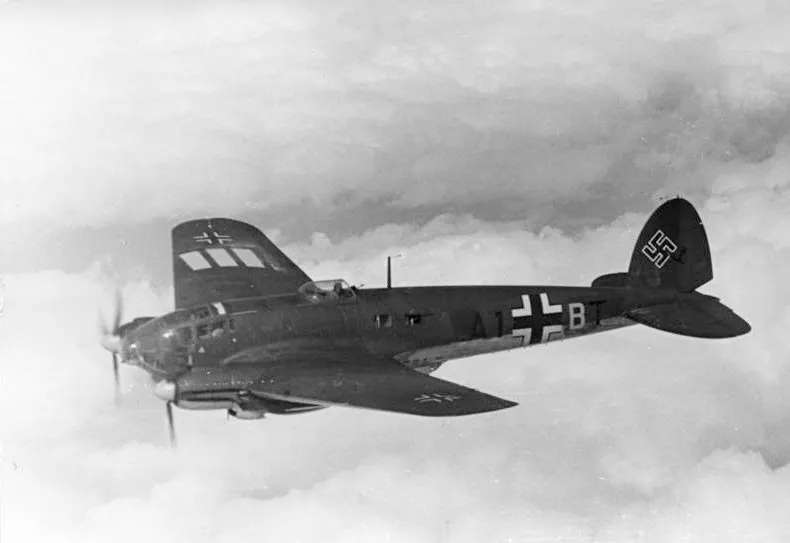
The Heinkel He 111 is a twin-engine medium bomber built by Heinkel Flugzeugwerke and flown by the Luftwaffe from the mid-1930s through the end of the Second World War. Heinkel also licensed production to Arado, and after the war the Spanish company CASA built it on under the designation CASA 2.111. Designed in the 1930s and disguised at first as a civil airliner, it became one of Germany’s principal bombers, flying in the Spanish Civil War, the Battle of Britain and on every major front of the war that followed. Across its production run, manufacturers built 6,508 examples between 1935 and 1944, including 32 prototypes and 12 civilian airliners1.
Design and development
Heinkel designed the aircraft in the early 1930s under the cover of a fast civil transport and mail plane, a cover story that let Germany develop a bomber while the Treaty of Versailles still formally restricted German air power. The prototype first flew on 24 February 1935, and both passenger and bomber versions followed from the same basic airframe. Its distinctive glazed “greenhouse” nose, adopted on later bomber variants, gave the crew wide visibility for navigation and bomb-aiming1.
The type saw its combat debut with the Condor Legion in the Spanish Civil War, where it proved faster than contemporary fighters it encountered and helped shape Luftwaffe bombing doctrine before the Second World War. Experience over Spain, and later over Britain, drove a long series of revisions: Heinkel progressively fitted more powerful engines, revised the nose glazing and added defensive armament as it became clear the aircraft was increasingly vulnerable to modern monoplane fighters1. By the time of the Battle of Britain in 1940, the He 111 was already being outpaced by RAF fighters, a shortcoming that shaped Luftwaffe losses in that campaign.
Specifications
The late-war He 111 H-16 variant is 17.4 m long with a wingspan of 22.6 m; earlier pre-production aircraft were somewhat shorter. Fully loaded for take-off, it had a maximum take-off weight of about 14,000 kg. It was powered by two Junkers Jumo 211F-2 inverted-V12 engines, with earlier variants instead using BMW VI or Daimler-Benz DB 600/601 engines, and it cruised at about 390 km/h, though a full bomb load cut that to roughly 300 km/h1.
Range, like cruise speed, depended on how much of the load was fuel rather than bombs: the He 111 H-11 carrying a 2,000 kg bomb load had a combat range of about 2,340 km, a figure that varied by variant and by how crews traded fuel for bombs. A typical crew numbered four to five: pilot, navigator/bomb aimer, radio operator and one or two gunners1.
Variants
Heinkel built the type through a long series of lettered variants, from the early He 111 B and E models through the wartime P and H series, each adding engine power, armour or armament over the last. The He 111 H became the definitive wartime version and was built in far greater numbers than any other. After the war, Spain’s CASA continued production of a licence-built version, the CASA 2.111, using Rolls-Royce Merlin engines in place of the original German powerplants1.
Operators and service
The He 111 flew primarily with the Luftwaffe, forming, alongside the Dornier Do 17 and Junkers Ju 88, the core of Germany’s bomber force at the start of the war. It bombed targets in Poland, France, the Low Countries, Britain and later the Soviet Union, and it also served as a torpedo bomber and as a glider tug and transport aircraft. Spain’s CASA-built version, the CASA 2.111, continued flying with the Spanish Air Force until 1973, long after the Luftwaffe withdrew the original from service in 19451.
Similar aircraft
- Dornier Do 17: a lighter German twin-engine bomber of the same era, flown alongside the He 111 in the early war years but phased out sooner.
- Junkers Ju 88: a later, faster German twin-engine bomber that progressively took over the medium-bomber role from the He 111 as the war went on.