Contents
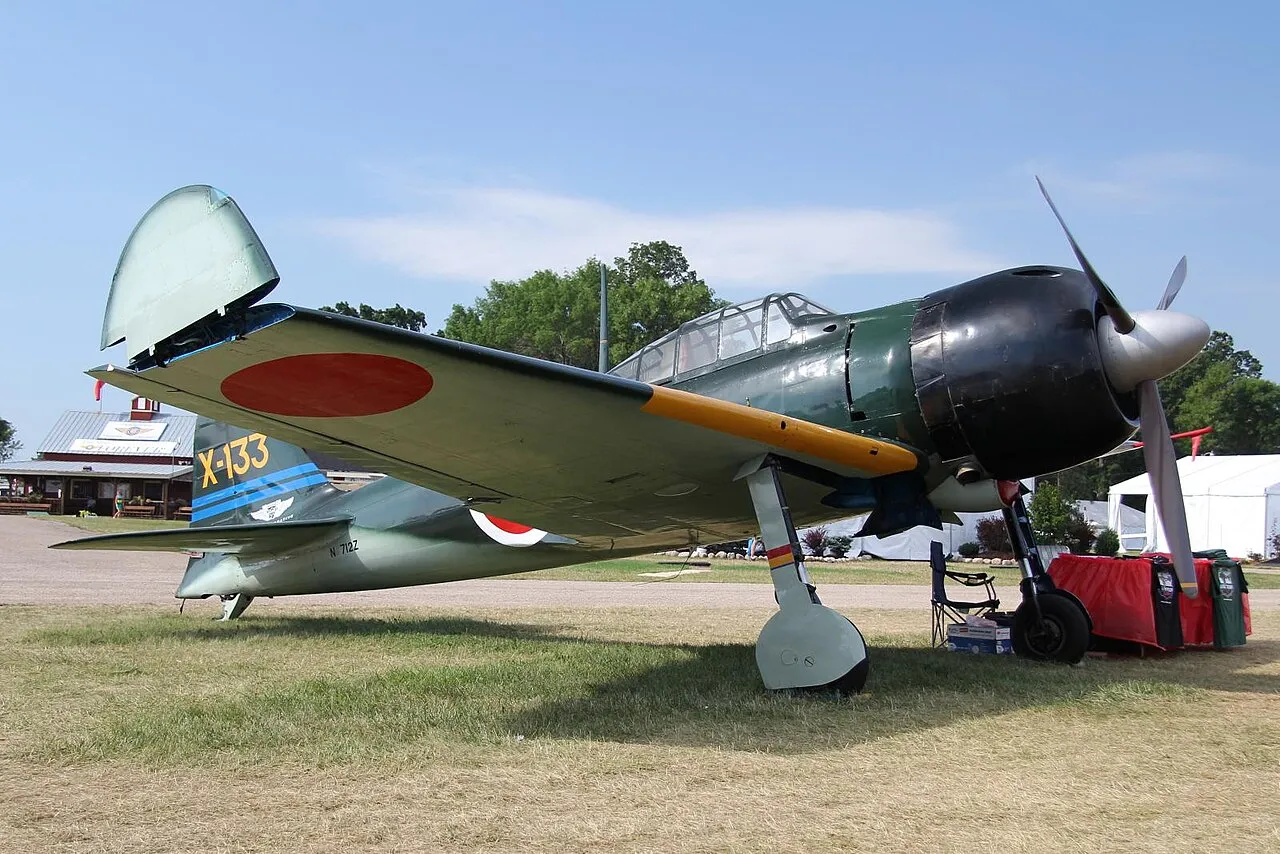
The Mitsubishi A6M Zero was a single-seat, carrier-based fighter built by the Mitsubishi Aircraft Company for the Imperial Japanese Navy Air Service. Designed by Jiro Horikoshi to meet a 1937 Navy requirement for a carrier fighter that could outclass anything in the region, it became Japan’s main fighter of the Pacific War, prized early on for its range and manoeuvrability before Allied tactics and newer aircraft eroded its edge. Production ran from 1939 to 1945 and totalled 10,939 aircraft1, making it the most-built Japanese fighter of the war.
Design and development
Mitsubishi built the type to a Navy specification issued on 5 October 1937 for a carrier fighter combining long range, high speed and tight turning performance, demands that pushed Horikoshi’s team to strip out weight wherever possible. The first prototype, the A6M1, flew on 1 April 1939 powered by a Mitsubishi Zuisei engine; production aircraft switched to the Nakajima NK1C Sakae-12 radial engine, rated at 700 kW (940 hp) for take-off, and the type entered service on 1 July 19401.
That same lightness became the aircraft’s defining weakness. To keep weight down, Mitsubishi left out armour for the pilot and engine and fitted no self-sealing fuel tanks, so the Zero tended to catch fire or explode when hit even by modest-calibre gunfire. Its light airframe also meant control forces grew heavy and manoeuvrability fell away sharply above roughly 300 km/h1, since the ailerons and rudder carried no hydraulic boost.
Specifications
The A6M2 Model 21, the early-war version detailed in Wikipedia’s specifications table, was 9.06 m long with a 12 m wingspan and a maximum take-off weight of 2,796 kg. It carried a single pilot and was powered by one Nakajima NK1C Sakae-12 fourteen-cylinder air-cooled radial piston engine, giving a cruise speed of about 333 km/h. Combat range was about 1,870 km, against a ferry range of roughly 3,100 km with drop tanks1, a reach that let Zeros escort bombers far beyond what contemporary Allied fighters could match early in the war.
Variants
The A6M2 Model 21, fitted with the Sakae-12 engine and, from its 65th airframe, folding wingtips for carrier stowage, was the main early-war version and the type Japan flew at Pearl Harbor. The A6M3 Model 32, which entered production in April 1942 with the more powerful Sakae-21 engine and a shortened wingspan, traded some range for speed, a swap the Navy reversed months later in the Model 22, which restored long-range performance. The A6M5 Model 52, first flown in August 1943, again shortened the wings and revised the ailerons for better high-speed handling, and became the most numerous and, by most accounts, most effective Zero variant. Late in the war, the A6M7 Model 62/63 added a reinforced tail for dive-bombing, and a pair of A6M8 Model 64 prototypes, fitted with the larger Mitsubishi Kinsei 62 engine, were completed in April 19451 too late to reach production.
Operators and service
The Zero flew almost exclusively with the Imperial Japanese Navy Air Service. It first saw combat over China, where on 13 September 1940 thirteen A6M2s engaged thirty-four Chinese fighters near Chongqing and claimed all twenty-seven shot down for no losses, and the type went on to claim 99 Chinese aircraft destroyed within its first year in theatre. By the attack on Pearl Harbor on 7 December 1941, 521 Zeros were in Pacific service, 328 of them with front-line units, and the type’s combination of range and manoeuvrability gave Japanese pilots an early-war kill ratio of around 12 to 11.
That dominance did not last. From the middle of 1942, improved Allied tactics and newer American fighters began to turn the Zero’s advantages against it, and losses mounted steadily for the rest of the war. By its closing weeks the type was outmatched outright: on 29 May 1945, around 150 A6Ms intercepted an American raid on Yokohama, and escorting P-51 Mustangs claimed 26 kills and 23 probables for the loss of three of their own1. In its final months the Zero was also pressed into kamikaze attacks, and Japan’s surrender in 1945 ended its front-line service with the retiring Imperial Japanese Navy.
Safety record
The Zero’s lack of pilot armour and self-sealing fuel tanks, the direct price of its light, manoeuvrable airframe, left it prone to catching fire or exploding when struck by enemy fire, a vulnerability that became increasingly costly as Allied fighters and anti-aircraft fire grew more effective through the war. Its never-exceed speed of 600 km/h1 also made high-speed diving attacks and escapes riskier than in sturdier Allied designs, a limitation Allied pilots learned to exploit by diving away from pursuing Zeros rather than trying to out-turn them.
Similar aircraft
- North American P-51 Mustang: the long-range American fighter whose escorts outfought the Zero by the war’s final year.
- Grumman F4F Wildcat: the US Navy’s main carrier fighter in the early Pacific War, heavier and less manoeuvrable but able to absorb damage the Zero could not.