Contents
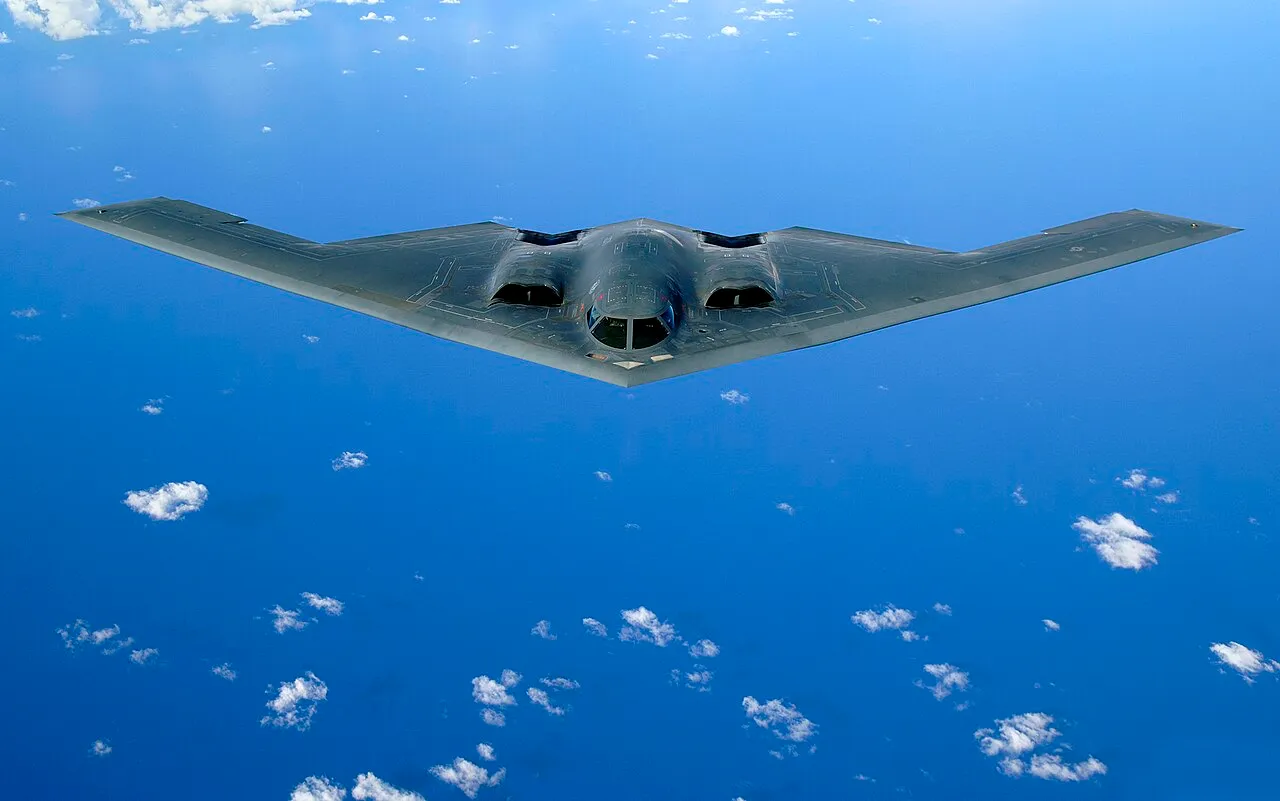
The Northrop B-2 Spirit is a long-range, heavy strategic bomber built around a tailless flying-wing shape designed to be difficult to detect by radar, infrared, acoustic and visual means. Northrop Corporation (later Northrop Grumman) built it for the United States Air Force to penetrate dense anti-aircraft defences and strike heavily defended targets with conventional or nuclear weapons. It remains one of the most expensive aircraft ever built and one of only three stealth bomber designs to reach production, alongside a line of experimental and reconnaissance types1.
Design and development
The B-2 grew out of a classified program of the late 1970s and early 1980s to design a bomber that could evade Soviet radar. Northrop won the contract in 1981 over a competing design from Lockheed, drawing on the company’s earlier experience with flying-wing aircraft dating back to the 1940s. The aircraft was developed in great secrecy and was not publicly revealed until 19881.
The first B-2 made its first flight on 17 July 1989. Its shape has no vertical tail or separate fuselage: the flying wing reduces the aircraft’s radar cross-section, and its surface is covered in radar-absorbent material maintained under strict, climate-controlled conditions. Development costs ran far above early estimates, and the program’s total cost, combined with the end of the Cold War, led Congress to cut the planned fleet from 132 aircraft to 211.
Specifications
The B-2 is 21.0 metres long with a wingspan of 52.4 metres2, giving it a wide, flat, bat-like outline with no fuselage protruding beyond the wing. Its maximum take-off weight is about 170,600 kg. It is powered by four General Electric F118-GE-100 non-afterburning turbofans, buried within the wing to hide their exhaust signature, and it cruises at around 900 km/h at an altitude of 40,000 ft1.
Unrefuelled, the B-2 has a range of about 11,112 km (6,000 nautical miles), a figure that more than doubles with a single aerial refuelling, which has allowed it to fly non-stop combat missions from the continental United States to targets in the Middle East and back. The crew consists of two: a pilot and a mission commander, seated side by side, with the aircraft’s systems automating much of the navigation and weapons work otherwise handled by a larger crew. Unit cost reached a 1996 average of about $2.13 billion per aircraft, including development, procurement and testing1, making it one of the costliest aircraft built.
Variants
Northrop built 21 B-2s between 1989 and 2000, all to the same Block 30 production standard after earlier aircraft were upgraded; no separate production variant followed, unlike the family branching seen on many other military types. One aircraft, the Spirit of Kansas, was destroyed in a crash in 2008 on Guam, reducing the fleet to 201.
Operators and service
The B-2 flies exclusively with the United States Air Force, based at Whiteman Air Force Base in Missouri. It entered service in 1997 and has since flown in several American combat operations, including the Kosovo War, the war in Afghanistan, the Iraq War and strikes in Libya. The type remains in active service1, though the US Air Force has begun retiring it as the newer Northrop Grumman B-21 Raider enters production.
Safety record
Of the 21 B-2s built, one, the Spirit of Kansas, was destroyed in a 2008 crash on takeoff from Andersen Air Force Base, Guam; both crew members ejected safely. Moisture trapped in the aircraft’s sensors was found to have caused inaccurate airspeed and angle-of-attack readings that led to the crash1.
Similar aircraft
- Rockwell B-1 Lancer: a supersonic American strategic bomber of a similar era, built for low-level penetration rather than stealth.
- Boeing B-52 Stratofortress: the long-serving American heavy bomber the B-2 was meant to eventually complement rather than fully replace.
- Lockheed F-117 Nighthawk: an earlier American stealth aircraft, smaller and designed for precision strike rather than heavy payload.
_RYxzm.webp)