Contents
The Yakovlev Yak-40 is a regional jet designed in the Soviet Union by Yakovlev1, with the NATO reporting name Codling. Aviation Week called it a Soviet feederliner jet transport3 built in classically rugged Russian design. It was built for Aeroflot’s local routes, replacing piston-engined Li-2s, Il-12s and Il-14s, and went on to sell more than 1,000 examples2, some of them to buyers in Western Europe.
Design and development
In the 1960s the Soviet Union had thousands of small airfields, and around a thousand of them were grass strips under 700 metres long. Aeroflot’s requirement did not ask for speed; it asked for safe, reliable operation from poorly equipped airports with short, unpaved runways of less than 700 metres2. The Yakovlev design bureau was assigned to design it1.
Yakovlev studied turboprops and even vertical take-off designs with lift jets, then settled on a straight-winged trijet for 20 to 25 passengers2, powered by the new AI-25 turbofan from Ivchenko in Zaporizhzhia.
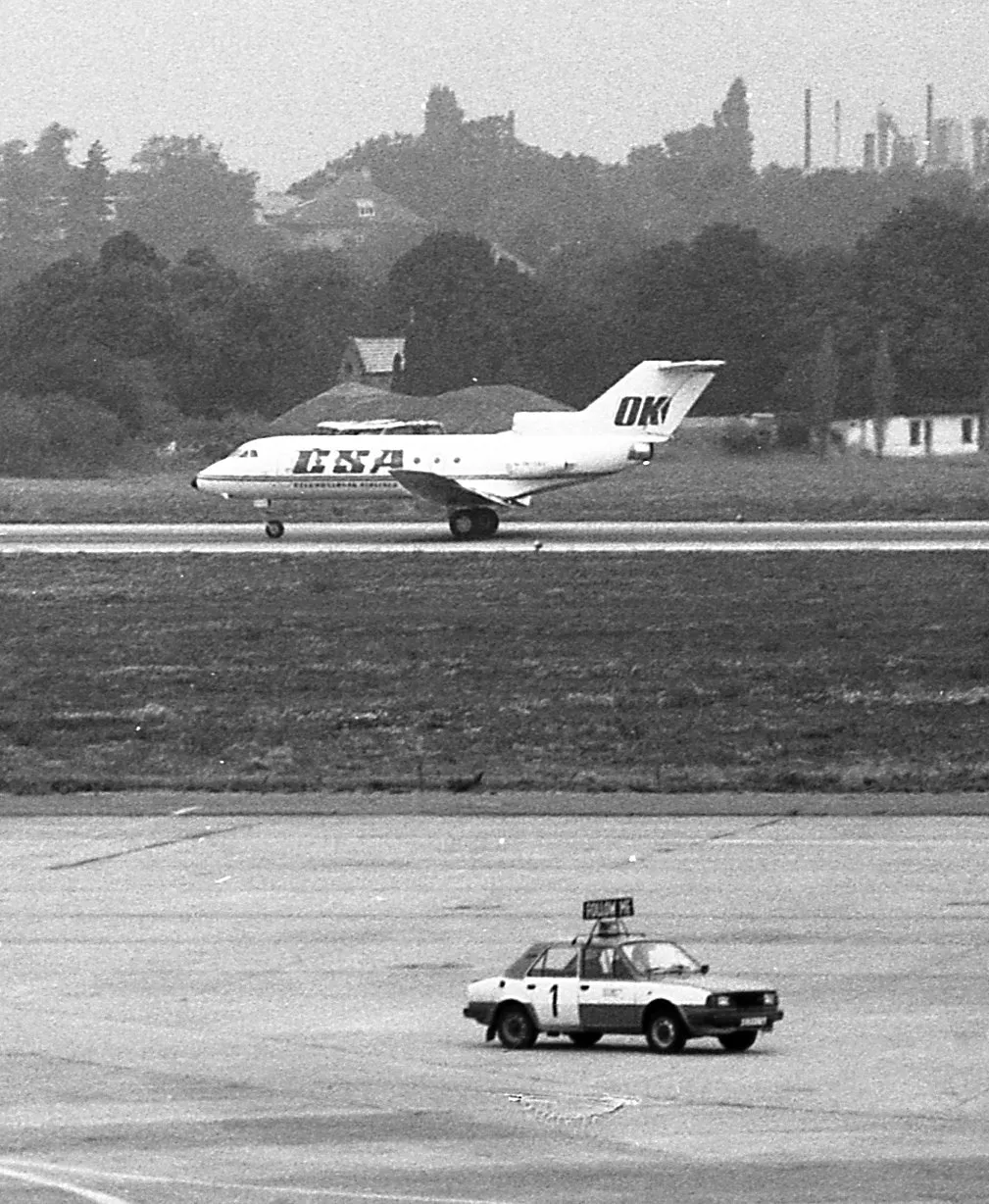
The Yak-40 is a low-winged monoplane with unswept wings, a large T-tail and retractable tricycle landing gear. Two AI-25s hang on short pylons on the rear fuselage and a third sits in the tail, fed through an S-duct from a dorsal intake. An auxiliary power unit lets the crew start the engines with no ground cart. The wing has large slotted trailing-edge flaps but no leading-edge devices; Yakovlev relied on a low wing loading for short take-offs and landings. A large fin swept at 50 degrees2 moves the unswept tailplane rearwards to make up for the short rear fuselage. The Yak-40 was the first Soviet-built airliner designed to Western airworthiness requirements1.
The first of five prototypes flew on 21 October 1966. Production began at the Saratov Aviation Plant in 1967, Soviet certification followed in 1968, and the type flew its first Aeroflot passenger service on 30 September 19682.
Specifications
The Yak-40 is 20.36 m long with a wingspan of 25.0 m1. Its pressurised cabin, 2.4 metres in diameter, normally seats 24 to 27 three-abreast, or up to 32 four-abreast. Passengers board through ventral airstairs in the rear fuselage. The wing runs as one structure from tip to tip and carries about 3,800 litres of fuel2 in integral tanks.
Each of the three Ivchenko AI-25 turbofans gives 14.7 kN. Early aircraft had no thrust reversers at all2; later examples have a reverser on the centre engine. Performance figures give a cruise speed of 550 km/h at 7,000 m, a range of 1,800 km and a service ceiling of 8,000 m1. Aviation Week’s reporter Herbert J. Coleman found it an easy aircraft to fly with heavy reserve power from its three-engine package, in a pilot report from April 19903.
Variants
A longer-range Yak-40D added fuel, and the Yak-40K of 1975 to 1981 added a large cargo door for freight and combi work. The Yak-40V was an export version with AI-25T engines1. Military conversions included the Yak-40-25 with a MiG-25R nose2 and electronic intelligence equipment, the Yak-40 Fobos with dorsal viewing domes and the Yak-40REO with a ventral infrared linescan canoe.
Proposals with Western engines did not reach production: a Yak-40L with two Lycoming LF507 turbofans2, studied with Textron Lycoming, and a three-engined Yak-40TL. SibNIA built the experimental Yak-40MS with two Honeywell TFE731-5 turbofans. The design was later developed into the Yakovlev Yak-421.
Operators and service
The Yak-40 became the backbone of Aeroflot’s local network. By 1980 the type served 276 domestic destinations, and by 1993 Aeroflot’s Yak-40s had carried 354 million passengers. Production ended in November 1981 with 1,011 or 1,013 aircraft built2, depending on the source.
It was demonstrated in 75 countries, including the United States, and became the first Soviet aircraft certified in Italy and West Germany. In all, about 130 were exported, to customers from Afghanistan, Angola and Cuba to Czechoslovakia, Poland, Yugoslavia and Zambia. In Italy, Aertirrena bought Yak-40s in 1969 in exchange for textile machinery; in West Germany, General Air Nord linked Saarbrücken with Düsseldorf, Frankfurt, Cologne-Bonn and Munich. The Korean People’s Army Air Force ordered 11 in 1978 for VIP transport2.
As of July 2019, only 22 of the 1,011 aircraft were still with civil operators, most of them converted to VIP charter layouts. Vologda Aviation Enterprise had 5 in service as of February 20251. FlightGlobal’s World Air Forces 2026 directory, published in late 2025, listed no Yak-40s in service with any air force2.
TASS reported that a Yak-40 flying laboratory with the VK-800 engine completed its maiden test flight, which lasted 934 seconds. The new Russian turboprop is designed for the LMS-901 Baikal aircraft4.
Safety record
The type’s first hull loss came in 19701, when Aeroflot Flight Sh-4 crashed.
Similar aircraft
- Yakovlev Yak-42: a larger trijet with a cabin designed to carry 120 passengers in six-abreast layout, whose T-tail has both the vertical fin and the horizontal surfaces swept5.
- Fokker F28 Fellowship: a twin-engined, short-range jet airliner6 from the Dutch manufacturer Fokker.
- VFW-Fokker 614: a twin-engined jetliner whose most distinctive feature was its engines mounted in pods on pylons above the wing7.