Contents
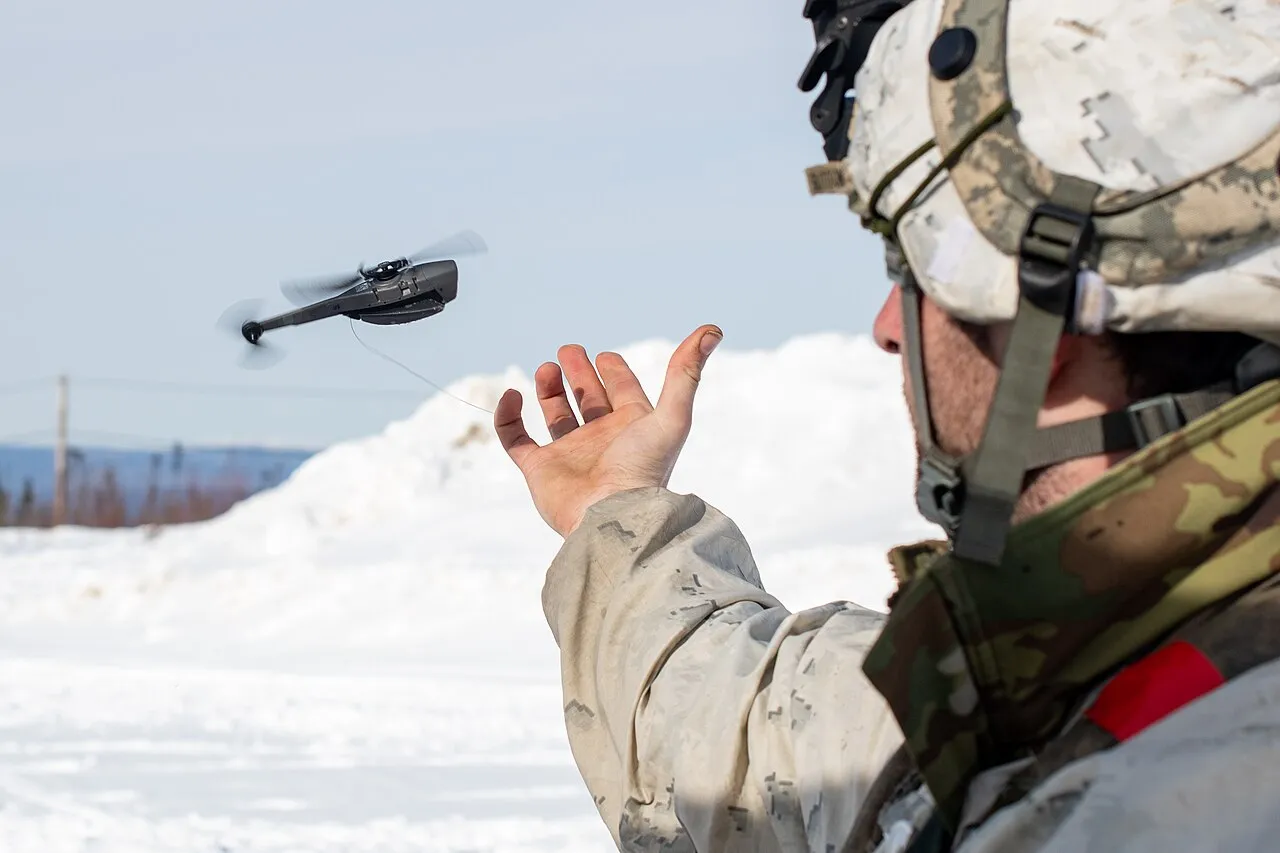
The Black Hornet is a military micro unmanned aerial vehicle developed by Prox Dynamics AS of Norway, a company bought by Teledyne FLIR in 2016 for 134 million dollars1. Teledyne FLIR Defense sells it as an airborne personal reconnaissance system for dismounted soldiers. In February 2013 the UK Ministry of Defence reported that British troops in Afghanistan were the first to use these handheld nano surveillance helicopters3. As of 2026 the maker’s newest model is the Black Hornet 42.
Design and development
The first Black Hornet was developed by Prox Dynamics under a £20 million contract for 160 units3 with Marlborough Communications Ltd. The drone is linked to its operator by a digital data link and GPS, and its images are shown on a small handheld terminal that the operator also uses to control it. It is launched from a small box strapped to a utility belt, and that box also stores the transmitted data. Because the drone itself does not store any data, it is of no advantage to anyone who captures it. Operators can steer it or set waypoints for it to fly itself1.
In July 2014 the US Army’s Natick Soldier Research, Development and Engineering Center selected the PD-100 Black Hornet for its Cargo Pocket Intelligence, Surveillance and Reconnaissance programme. It concluded that a US Army role needed a reconfigured data link, night vision and improved navigation. In October 2014 Prox Dynamics unveiled a version with night vision, using long-wave infrared and day video sensors. The Army later sought a mini-drone for individual squads through its Soldier Borne Sensors programme, but the individually handmade Black Hornet was seen as too expensive for large-scale deployment, at as much as US$195,000 a unit1.
The company’s later models are the Black Hornet 3 and the Black Hornet 4, which it unveiled at the AUSA conference. Teledyne FLIR has since won a $91 million US Army contract for Black Hornet 4 nano-drones4, and the Black Hornet 4 was approved for the Defense Innovation Unit’s Blue UAS list2.
Specifications
The published figures belong to different generations, so they do not form a single spec sheet. The original Black Hornet Nano measured around 10 cm by 2.5 cm and weighed as little as 16 grams3, according to the UK Ministry of Defence in 2013. That early model had a top speed of 21 km/h. Each package held two helicopters: a 90% charge took 20 to 25 minutes, the same as its hovering time1, so one could fly while the other recharged.
As of 2026 the Black Hornet 3 is listed with a flight time of up to 25 minutes4. The Black Hornet 4 is heavier at 70 grams and, by its maker’s figures, can fly for more than 30 minutes, over three kilometers, and work in 25-knot winds and rain. Teledyne FLIR gives it ground speeds up to 10 m/s and wind tolerance of 25 knots plus gusts (12 m/s). The complete Black Hornet 4 system has a total weight of 1.3 kg depending on configuration and is small enough to carry on a utility belt2.
Sensors and weapons
The Black Hornet is a reconnaissance system built around cameras. The original PD-100, first used by troops in 2013, carried three cameras1: one looking forward, one straight down and one pointing down at 45 degrees, and sent full-motion video and still images3 to the soldier’s handheld terminal. As of 2026 the maker says the Black Hornet 3 combines EO and IR technology and transmits live video and HD still images4. The Black Hornet 4 has a high-resolution thermal imager and an electro-optical camera that its maker says has exceptional low-light capabilities, plus new obstacle avoidance. Teledyne FLIR says the Black Hornet 4 can survive GPS-denied and contested environments and describes its visual and audible signatures as extraordinarily low2.
Operators and combat use
In Afghanistan, soldiers used the drone to peer around corners or over walls and other obstacles to identify hidden dangers. A sergeant of the Brigade Reconnaissance Force told the Ministry of Defence that his unit used it to look for insurgent firing points3. In October 2013 the British Army had 324 Black Hornets in service. It was retired in 2016 after Operation Herrick1 and brought back in April 2019 for research and development work.
Over 3,000 Black Hornets had been delivered as of 2014. By September 2016 the PD-100 was in use with the militaries of 19 NATO-allied countries. In the United States it had deployed with Marine Corps special operations teams by 2015. The US Army bought 60 Hornet 3 drones in 2018 and another 300 in 2022, and in 2023 an undisclosed number, some of them intended for Ukraine. As of 2026 its users include the armed forces1 of Norway, the United States, France, the United Kingdom, Germany, Denmark, Algeria, Ireland, Australia, the Netherlands, Poland, New Zealand, India, Turkey, South Africa, Ukraine, Morocco and Vietnam.
Variants
- Black Hornet Nano (PD-100): the original Prox Dynamics model, first used by British troops in Afghanistan3.
- Black Hornet 3 PRS: Teledyne FLIR calls it combat-proven, pocket-sized and nearly silent4.
- Black Hornet 4 PRS: the next generation in covert UAV capabilities2, with a thermal imager and obstacle avoidance.
- Black Recon: a larger model revealed in 2023 after five years of development, designed to be launched from armored vehicles. An 80 kg box bolted onto the vehicle holds three drones, each weighing 350 g, with a 6 km reach and 45 minutes’ endurance1. Teledyne FLIR describes autonomous flight and automatic collision avoidance5.
Similar drones
- AeroVironment RQ-11 Raven: also launched by hand, but thrown into the air like a free flight model airplane rather than lifted by rotors, and much heavier at about 1.9 kg6.
- Skydio X2D: the military variant of the Skydio X2, a drone with folding arms and a 35-minute flight time7 that carries a Teledyne FLIR Boson thermal camera; the US Army version is the RQ-28A.