Contents
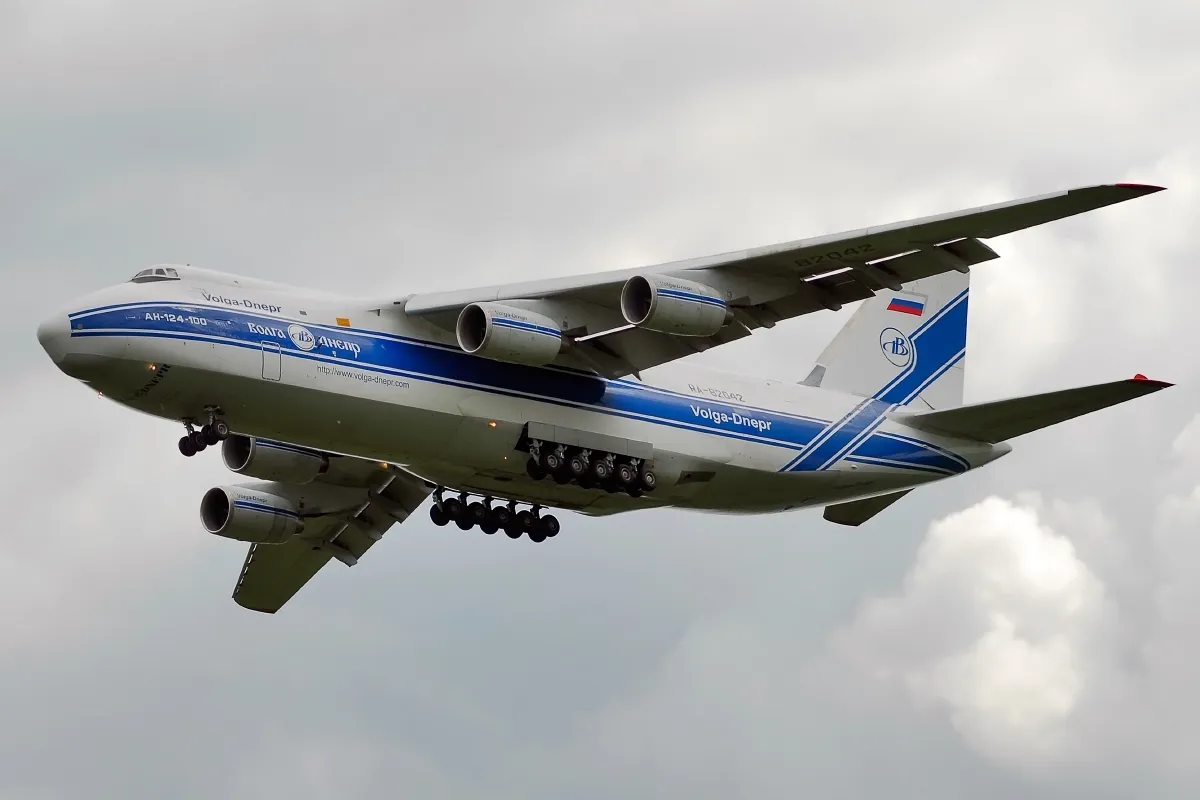
The Antonov An-124 Ruslan is a four-engined strategic airlifter built by Antonov and manufactured by Aviastar-SP, designed to move outsized military and civilian cargo over long distances. It is the world’s second-heaviest production cargo aircraft, behind only the An-225 Mriya that was later derived from it. Decades after its Cold War origins, it remains the largest military transport aircraft in active service1, flying for military and commercial operators alike.
Design and development
The aircraft answered a Soviet strategic airlift shortfall of the 1970s, when the Military Transport Aviation Command had only about 50 ageing An-22 turboprops and a 1975 CIA analysis concluded the USSR did not match American heavy-lift capability. Design work began in 1971 at the Antonov Design Bureau under chief engineer Viktor Tolmachev, initially under the designation Izdeliye 400, or An-40 in Western reporting. Building it drew on more than 100 factories across the Eastern bloc, with final assembly split between Aviastar-SP in Ulyanovsk, Russia, and the Kyiv Aviation Plant AVIANT in Ukraine1.
The An-124 first flew on 24 December 1982 and made its first appearance in the West at the 1985 Paris Air Show. Civil certification, which opened the way to commercial cargo work after the Soviet collapse, followed on 30 December 19921.
Specifications
The An-124 is 69.1 metres long with a wingspan of 73.3 metres and a maximum take-off weight of 402,000 kg. It is powered by four Progress D-18T turbofans and flown by a crew of eight: pilot, copilot, navigator, chief flight engineer, electrical flight engineer, radio operator and two loadmasters. Its ferry range with maximum fuel is about 14,000 km, falling to 3,700 km with its maximum payload1.
Loading is built around a “kneeling” main landing gear that lowers the fuselage for easier access through the forward cargo doors, and the aircraft carries a fully pressurised upper deck for up to 88 passengers or attendants separately from its partially pressurised main cargo hold1.
Variants
The baseline commercial version is the An-124-100. A single aircraft was converted to the An-124-100M-150, fitted with upgraded Lotarev D-18T Series 4 engines to raise maximum payload to 150 tonnes. Antonov unveiled a prospective Russian-built successor, the An-124-102 Slon, at the 2017 MAKS air show, stretched to 82.3 metres and designed for a 150 to 180-tonne payload with a modern digital flight deck. Other proposals never left the drawing board, including the An-124-200 with General Electric CF6 engines and the An-124-210, offered with Rolls-Royce RB211-524H-T engines for a UK airlift requirement that the C-17 ultimately won; an An-124-300 with upgraded engines was ordered by the Russian Aerospace Forces in 20201.
Operators and service
Around 57 aircraft were built between 1982 and 2004. As of late 2020, Volga-Dnepr Airlines flew 12, Antonov Airlines 7, and Maximus Air Cargo 1, alongside military fleets with the Russian Aerospace Forces, the type’s main user, and historically the Ukrainian Air Force. Under the Strategic Airlift Interim Solution, six An-124-100s flown by Antonov Airlines and Volga-Dnepr served 18 NATO member states, with two aircraft based permanently at Leipzig/Halle Airport1.
The type has carried some of the heaviest and most unusual cargoes ever airlifted. It set a world distance record of 20,151 km without refuelling in May 1987 and, two months earlier that decade, carried 171,219 kg to an altitude of 2,000 m and 170,000 kg to 10,750 m in July 1985. Later missions included moving the first IE 201 Class diesel-electric locomotive from Canada to Ireland in June 1994, airlifting the Obelisk of Axum from Rome to Ethiopia in April 2005, delivering a Delhi Metro railcar in February 2009, transporting a Putzmeister concrete pump to the Fukushima nuclear plant in April 2011, and carrying 101 tonnes of humanitarian aid for Turkey-Syria earthquake victims in March 2023. After Russia’s 2022 invasion of Ukraine, one aircraft was destroyed during the Battle of Antonov Airport and five others diverted to Leipzig1.
Safety record
As of November 2020, the An-124 had suffered five hull-loss accidents with 97 fatalities. The first, on 13 October 1992, killed eight of nine crew near Kyiv when a nose cargo door failed during a high-speed test descent and the crew lost control. A 15 November 1993 crash into a mountain near Kerman, Iran, during a holding pattern killed 17, and a low-visibility approach accident at Turin Caselle Airport on 8 October 1996 killed four. The deadliest crash came on 6 December 1997, when an aircraft went down in a residential area of Irkutsk, Russia, shortly after takeoff, killing all 23 on board and 45 people on the ground. Most recently, an uncontained engine failure after takeoff from Novosibirsk on 13 November 2020 led to a runway excursion and nose gear collapse on landing; Volga-Dnepr voluntarily grounded its entire fleet, returning the first aircraft to service on 29 December 20201.
Similar aircraft
- Antonov An-225 Mriya: a stretched, six-engined derivative of the An-124, built to carry the Soviet Buran spacecraft and later destroyed at Hostomel in 2022.
- Ilyushin Il-76: a smaller four-engined Soviet military transport that served alongside the An-124 in Russian strategic airlift.
- Lockheed C-5 Galaxy: the comparable American strategic airlifter, developed a decade earlier for the same heavy-cargo role.