Contents
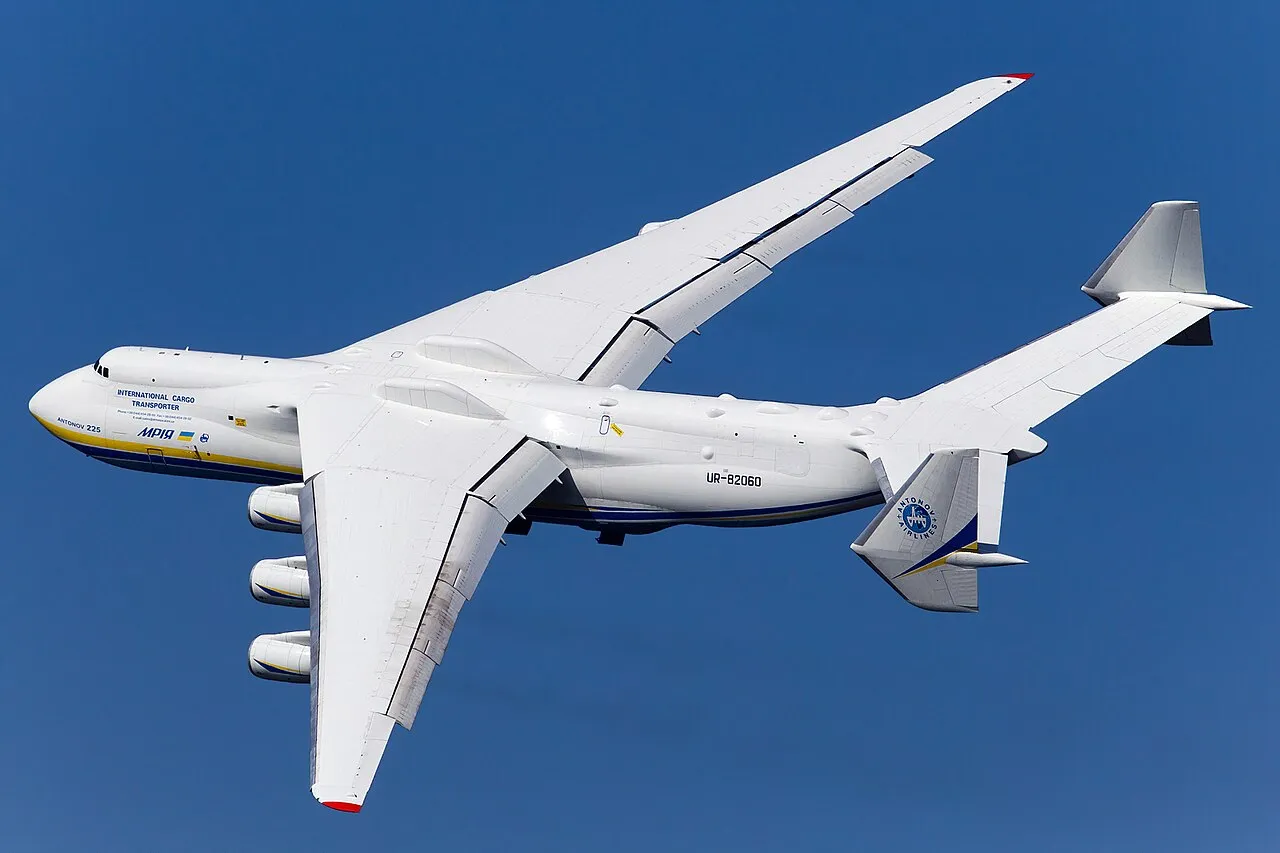
The Antonov An-225 Mriya was the heaviest aircraft ever built, developed from 1984 at Soviet government request as an enlarged derivative of the Antonov An-124 airlifter. Antonov built it to carry the Buran spacecraft and the boosters of the Energia rocket for the Soviet space programme. Only one was ever completed, and it was destroyed on 27 February 2022 during the Battle of Antonov Airport near Hostomel, Ukraine1.
Design and development
The An-225 retained many similarities with the preceding An-124, from which it was derived, but Antonov stretched the fuselage with barrel extensions fore and aft, redesigned the wing with root extensions, and fitted six Progress D-18T turbofans in place of the An-124’s four. A twin tail replaced the An-124’s single fin, needed to handle the wake turbulence of the external loads it was designed to carry. The requirement called for a maximum payload of about 231,838 kg and the ability to operate from 3,500-metre runways1.
The aircraft made its maiden flight on 21 December 1988 and made its public debut at the 1989 Paris Air Show carrying a Buran orbiter on its back1.
Specifications
The Mriya was 84 metres long with a wingspan of 88.4 metres. Its maximum take-off weight was 640,000 kg, reached after a 2000–2001 modernisation, costing $20 million, that raised the gross weight from 600 to 640 tonnes and added reinforced flooring and updated avionics. It could carry up to 250,000 kg internally or 200,000 kg on the upper fuselage, with external loads up to 70 metres long. It was flown by a crew of six: two pilots, two navigators and two flight engineers, and powered by six Progress D-18T turbofans producing 229.5 kN of thrust each, giving it a cruise speed of about 800 km/h2. Its range with no payload was about 15,400 km, dropping to roughly 4,000 km with a 200-tonne payload1.
Variants
A second airframe was partially built in the late 1980s and suspended after the collapse of the Soviet Union; by 2016 it was reported to be 60 to 70 percent complete. After the destruction of the first aircraft, President Volodymyr Zelenskyy announced on 20 May 2022 that Ukraine intended to complete the second airframe as a replacement, and Antonov put the cost of finishing it at about $500 million1.
Operators and service
The sole completed An-225 flew for Antonov Airlines, the carrier Antonov founded in 1989, and entered commercial heavy-cargo service on 3 January 2002 with a flight from Stuttgart to Thumrait, Oman, carrying 216,000 prepared meals. Over two decades it carried outsized freight such as wind turbine blades and diesel locomotives and set 240 world records, including carrying five battle tanks at a total weight of 253.82 tonnes on 11 September 2001 and transporting a 189,980 kg generator for an Armenian power plant on 11 August 2009. From 2009 it carried the blue and yellow livery of the Ukrainian flag, and the New York Times called it Ukraine’s winged ambassador to the world. Its last commercial mission ran from 2 to 5 February 2022, collecting almost 90 tonnes of COVID-19 test kits from Tianjin, China, for delivery to Billund, Denmark1.
Safety record
The aircraft flew without a recorded accident until the Russian invasion of Ukraine in 2022. After Russia invaded on 24 February, Ukrainian authorities banned civilian flights and the runway at Hostomel was put out of action. The An-225, which had not been evacuated, was destroyed on 27 February 2022 during the Battle of Antonov Airport, according to a statement by the state manufacturer Ukroboronprom; Russian state television showed the first clear footage of the wreck on 4 March. A Hungarian-registered Cessna 152 was crushed by the An-225’s wingtip as it fell and was also destroyed. Ukroboronprom estimated restoring the aircraft would cost more than $3 billion and take over five years1; Ukraine instead pursued finishing the uncompleted second airframe.
Similar aircraft
- Antonov An-124 Ruslan: the four-engined airlifter the An-225 was stretched and re-engined from, and the next-largest aircraft Antonov ever built.
- Lockheed C-5 Galaxy: a large American military airlifter of comparable role, though well below the An-225’s payload and weight.