Contents
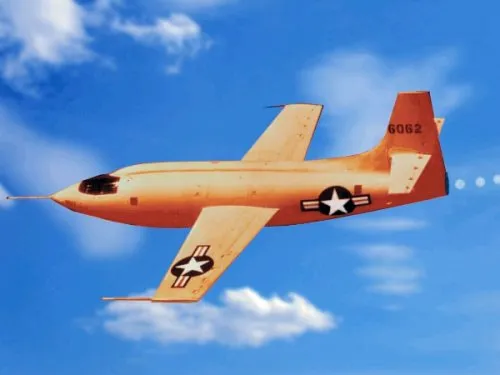
The Bell X-1 is a rocket-powered research aircraft that, on 14 October 1947, became the first airplane to fly faster than the speed of sound. It was built by the Bell Aircraft Corporation of Buffalo, New York for a programme that NACA and the US Army Air Forces started in 1944 to develop crewed transonic and supersonic research aircraft. Flown by US Air Force Captain Charles “Chuck” Yeager, the first X-1 reached Mach 1.06 at an altitude of 43,000 feet, and Yeager named the airplane “Glamorous Glennis” in tribute to his wife1.
Design and development
The Army Air Forces first discussed the aircraft with Bell in early December 1944, asking for a piloted research airplane that could fly at least 800 mph for 2 to 5 minutes at 35,000 feet or above2. On 16 March 19451 the Army awarded Bell a contract for three aircraft under project designation MX-653, and the type was designated XS-1, later X-13.
Bell’s engineers, writing in a 1948 Air Force report, said they looked at turbojets, ramjets and rockets, but found that an airplane built around existing turbojets would not reach the desired speeds at the desired altitude. Sweepback was ruled out because information on its effects was at that time quite fragmentary, and the horizontal stabilizer was mounted as high as was considered feasible above the wing wake2 and made rapidly adjustable to cope with large trim changes. The fuselage followed the lines of a .50-caliber machine gun bullet1 and was packed with two propellant tanks, twelve nitrogen spheres, a pressurised cockpit, the landing gear and more than 500 pounds of test instrumentation.
The X-1 was originally designed for conventional ground takeoffs1, but every X-1 was air-launched from a Boeing B-29 or B-50 Superfortress because of the performance penalties and safety hazards of taking off from the ground with a rocket. Bell test pilot Jack Woolams made the first flight, a glide over Pinecastle Army Airfield in Florida, on 19 January 19463. The first powered flight followed at Muroc, California, on 9 December 19462.
Specifications
The X-1 is a single-engine, single-seat, mid-wing rocket plane, 30 ft 9 in long with a span of 28 ft and a weight of 6,130 lb in the museum’s listing. Its airframe was built from high-strength aluminum, with propellant tanks made of steel1. The wing had an area of 130 square feet and an aspect ratio of 62.
Power came from a Reaction Motors engine made up of four 1,500-pound-thrust rockets, which burned liquid oxygen and ethyl alcohol, with one part water mixed with three parts ethyl alcohol to help cool the motor. The chambers could not be throttled, so the pilot had only 25%, 50%, 75% and 100% of full thrust to choose from. The tanks held enough propellant to run the 6,000-pound motor for 4.1 minutes. The 1948 report gives a launch weight of 13,034 pounds2 and a landing weight of 6,784 pounds at about 135 mph.
The specification called for launch from the mother ship at 30,000 ft and 345 mph, with an absolute ceiling of 87,750 ft2. In practice the first X-1 reached Mach 1.45, approximately 957 mph, on 26 March 1948, and on 8 August 1949 Major Frank K. Everest Jr. took it to 71,902 feet1, its highest flight.
Variants
Bell built three XS-1 aircraft. The first two fed the engine by direct nitrogen pressurization instead of turbopumps; the third, known as Queenie, had a turbopump-driven, low-pressure fuel feed system1.
Three additional X-1 aircraft1, the X-1A, X-1B and X-1D, were built and test-flown. The X-1A was longer and heavier, with a stepped canopy and the same Reaction Motors XLR-11 engine; Yeager flew it to Mach 2.44 on 12 December 1953, and Major Arthur W. Murray reached 90,440 feet on 28 May 1954. The X-1B carried more than 300 thermal probes for aerodynamic heating research and was the first aircraft to fly with small reaction rockets for directional control, a system later used on the North American X-15. The X-1C, meant to test armament at transonic and supersonic speeds, was canceled at the mockup stage. The X-1D, built for heat transfer research, made only one successful flight, a glide on 24 July 1951. The X-1E was a rebuild of the second X-1 with a turbopump fuel system, a very thin wing and an ejection seat; Joe Walker reached Mach 2.213 in it before the X-1E was grounded after its 26th flight in November 1958.
Operators and service
The X-1 flew with the US Air Force and NACA. Bell’s contract flights on the first aircraft ended when the Army Air Force Flight Test Division took over the test program on 24 June, while NACA flight-tested the second XS-1. On 5 January 1949 Yeager made a ground takeoff in the first X-1 from Muroc Dry Lake, the only conventional launch3 of the programme. The first aircraft kept flying until mid-1950, completing nineteen contractor demonstration flights and fifty-nine Air Force test flights1.
Bell Aircraft president Lawrence D. Bell, NACA scientist John Stack and Yeager received the 1947 Robert J. Collier Trophy for first exceeding the speed of sound. On 26 August 1950 the Air Force presented the first X-1 to the Smithsonian, which displays it in the Boeing Milestones of Flight Hall1 in Washington, DC. The X-1B is shown at the National Museum of the United States Air Force3 in Ohio, and the X-1E stands in front of NASA’s Armstrong Flight Research Center at Edwards Air Force Base.
Safety record
The third X-1 was lost in a 1951 explosion on the ground that injured its pilot, and the X-1A and X-1D were also lost as a result of propulsion system explosions1. The X-1D blew up during preparations for its first powered flight on 22 August 1951, and the X-1A exploded on 8 August 1955 while being readied for launch from its RB-50 mothership; pilot Joseph A. Walker got out before it was jettisoned. The explosions were traced to leather gaskets treated with tricresyl phosphate in the liquid oxygen plumbing. In flight, Yeager’s record run in the X-1A on 12 December 1953 ended with the aircraft spinning out of control3 through inertia coupling before he regained control.
Similar aircraft
- D-558: the Bureau of Aeronautics project that soon followed the XS-1; unlike the air-launched XS-1, it was to be ground launched under its own power2 and gather data at low altitudes.
- Miles M.52: a British supersonic design that was turbojet-powered rather than rocket-powered, and was cancelled in February 19463 before it flew.
- North American X-15: a later rocket plane launched from a B-52, which reached Mach 6.7 on 3 October 19674.