Contents
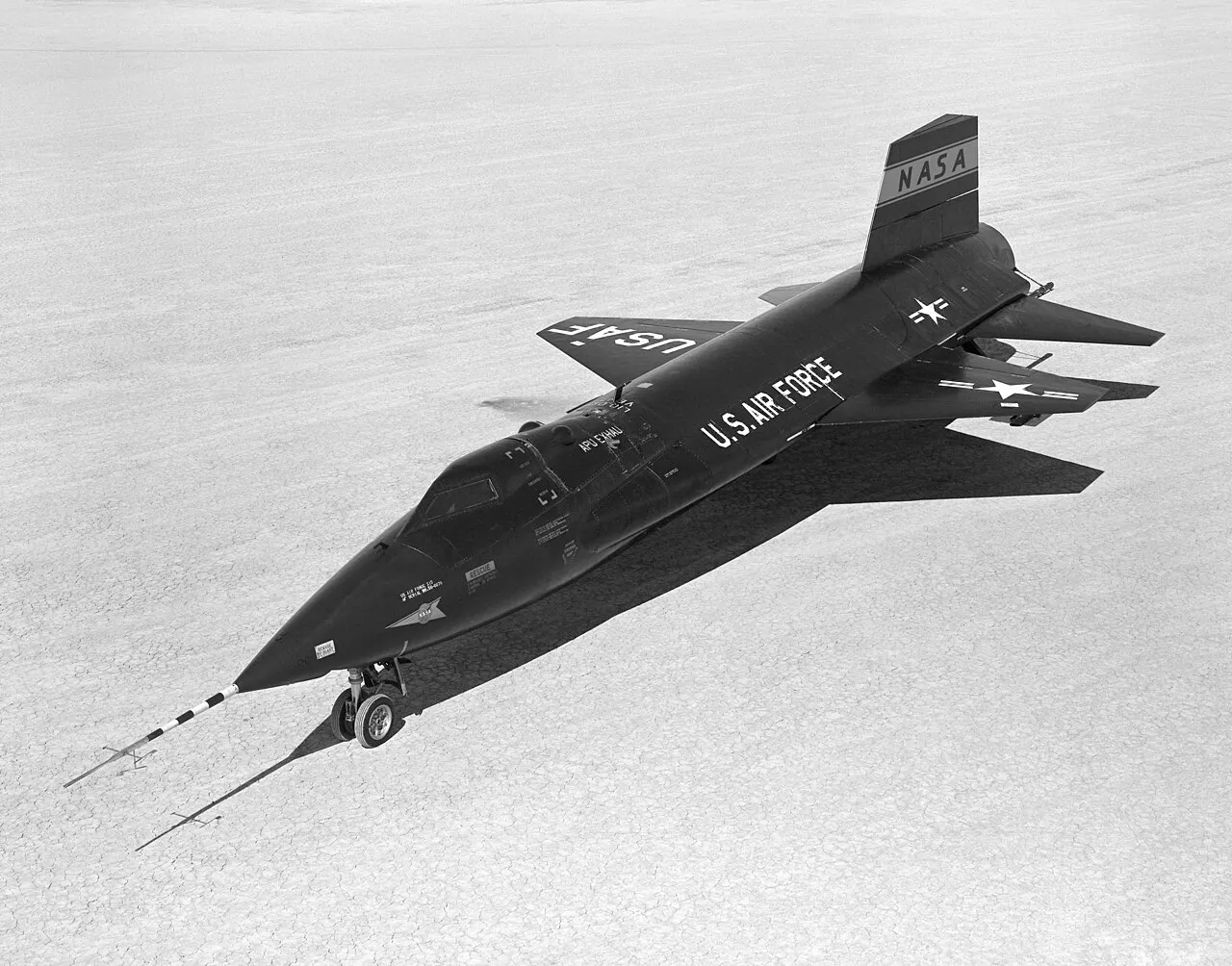
The North American X-15 is a rocket-powered research aircraft built by North American Aviation for a joint programme run by NASA, the US Air Force, the US Navy and North American Aviation. Dropped from under the wing of a modified B-52 mothership rather than taking off under its own power, it explored flight at the edge of space and still holds the official record for the highest speed ever recorded by a crewed, powered aircraft1.
Design and development
The concept traces to a study by Walter Dornberger for NACA, and North American Aviation won the contract to build the airframe in November 1955, with Reaction Motors contracted for the engine in 1956. As an X-series research type, it was designed to be carried aloft and drop-launched from under the wing of a B-52 mothership rather than take off conventionally, and its fuselage used heat-resistant Inconel-X 750 alloy to survive the temperatures of hypersonic flight1.
Scott Crossfield flew the first, unpowered glide flight on 8 June 1959, followed by the first powered flight on 17 September 1959. The first 24 powered flights used two Reaction Motors XLR11 engines giving a total of 16,000 lbf (71 kN) of thrust, a stand-in while the intended engine was finished; by November 1960 the Reaction Motors XLR99 was delivered, producing 57,000 lbf (250 kN) of thrust and able to burn 15,000 lb (6,800 kg) of propellant in 80 seconds1.
Two modified B-52 Stratofortresses served as motherships, NB-52A “The High and Mighty One” and NB-52B “The Challenger,” nicknamed Balls 8; release normally came at about 45,000 ft (8.5 miles, 13.7 km) and a speed of around 500 mph. Twelve pilots flew the programme’s 199 total flights between 1959 and 1968, among them Neil Armstrong, who later walked on the Moon, and Joe Engle, who later commanded a Space Shuttle1.
Specifications
The X-15 was 14.99 m long with a wingspan of 6.81 m and a maximum take-off weight of 15,195 kg, small for an aircraft that flew so far beyond the atmosphere. It carried a single pilot and was powered by a single Reaction Motors XLR99-RM-2 liquid-fuelled rocket engine rated at 70,400 lbf (313 kN) of thrust. Under rocket power it had a powered range of about 450 km before gliding to an unpowered landing1, since the type had no cruise regime of its own.
Its top speed remains the benchmark the aircraft is remembered for: William J. “Pete” Knight flew 4,520 mph (7,274 km/h; Mach 6.7) on 3 October 1967, which stands as the official world record for the highest speed ever recorded by a crewed, powered aircraft. On the altitude side, Joe Walker passed the 100 km boundary of space in July and August 1963, setting the programme’s altitude record of 67.1 miles (108.0 km) on 22 August 1963. Across the programme, 8 of the 12 pilots flew a combined 13 flights that passed the US Air Force’s spaceflight threshold of 50 miles (80 km) altitude, qualifying those pilots as astronauts; the three civilian pilots among them received NASA astronaut wings only in 2005, 35 years after the last X-15 flight1.
Variants
Only the second airframe, X-15-2 (56-6671), was substantially rebuilt, after a landing accident on 9 November 1962 that injured pilot John McKay, into the X-15A-2, which first flew on 25 June 1964. It gained a 28 in (71 cm) fuselage extension to carry additional propellant, external fuel tanks, and a full ablative heat-resistant coating for faster flights1, and it was this stretched aircraft that set the programme’s speed record.
Operators and service
The X-15 never left test service: all three airframes flew for the joint NASA, US Air Force, US Navy and North American Aviation research programme and never saw operational or combat use, flying 199 total flights between 1959 and 1968 before its final flight was permanently cancelled on 20 December 1968. The first aircraft, X-15-1 (56-6670), is preserved at the National Air and Space Museum in Washington, D.C., and the rebuilt X-15A-2 (56-6671) is displayed at the National Museum of the United States Air Force at Wright-Patterson Air Force Base, Ohio, after its retirement in October 19691.
Safety record
The programme’s only fatal accident destroyed the third airframe, X-15-3, on 15 November 1967. Flying the aircraft’s 191st flight, Major Michael J. Adams entered a hypersonic spin while descending, and the aircraft then oscillated violently as aerodynamic forces built up during re-entry; it broke apart at about 60,000 ft (18 km) altitude, scattering wreckage across roughly 50 square miles (130 km²). Adams was killed and was posthumously awarded astronaut wings1, since he had passed 50 miles of altitude on the flight.
Similar aircraft
- Lockheed SR-71 Blackbird: the fastest air-breathing crewed aircraft ever built, though far slower than the rocket-powered X-15’s speed record. See the SR-71 page.
- Bell X-1: the earlier rocket-powered American research aircraft that first broke the sound barrier, and the type the X-series programme that produced the X-15 continued.
_1q2mX3.webp)