Contents
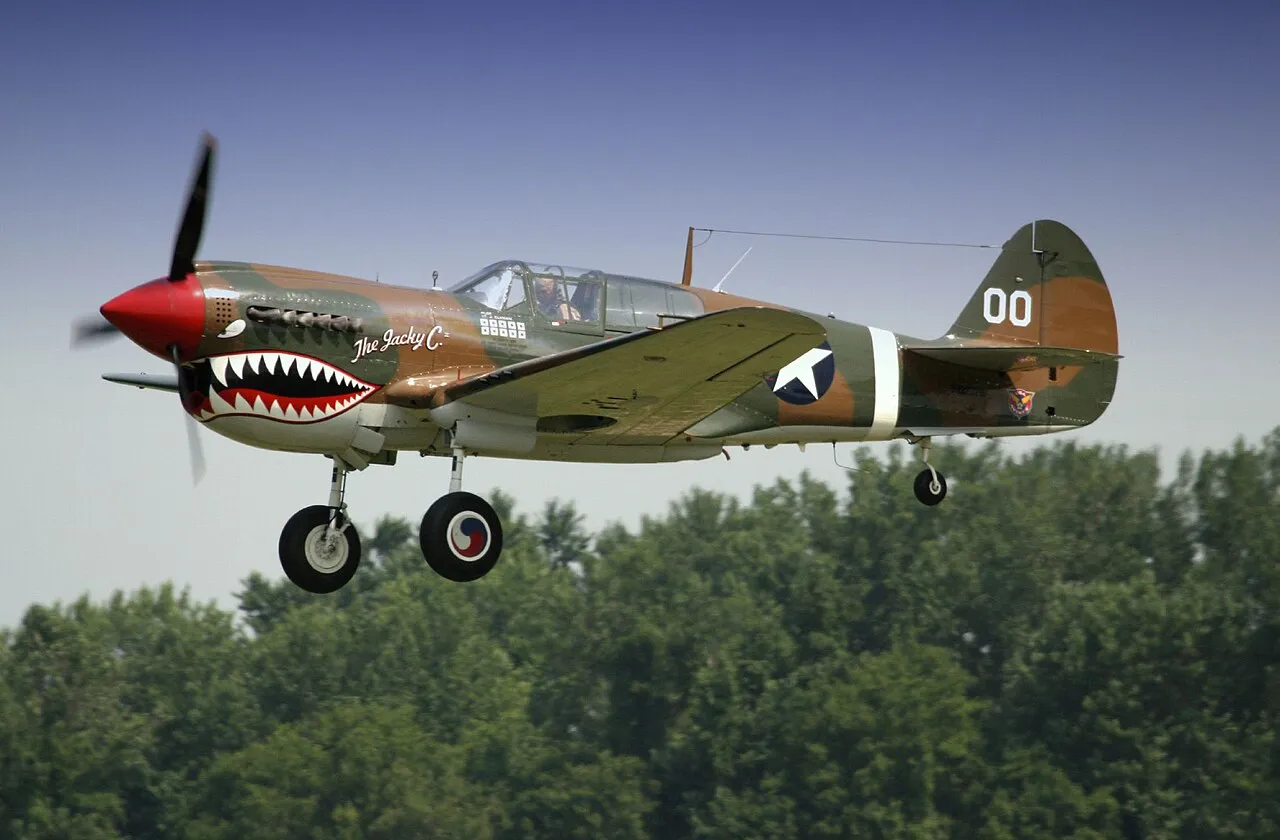
The Curtiss P-40 Warhawk is a single-seat, single-engine American fighter built by Curtiss-Wright1. Developed just before the Second World War, it became one of the most widely used Allied fighters of the conflict’s early years, flying with air forces on almost every front, and it is remembered above all for the shark-mouthed aircraft of the American Volunteer Group, the “Flying Tigers”, in China.
Design and development
Curtiss’s chief engineer, Don R. Berlin, created the P-40 by re-engining the tenth production Curtiss P-36 Hawk, replacing its air-cooled Pratt & Whitney R-1830 Twin Wasp radial with a liquid-cooled Allison V-1710 V-12. The prototype first flew on 14 October 1938 in Buffalo, New York, reaching about 315 mph (507 km/h) in early trials. Wind-tunnel work then moved the radiator from an underbelly position to the chin intake seen on production aircraft, and in April 1939 the US Army Air Corps placed the largest fighter order it had made up to that point, for 524 P-40s1, putting the type into mass production ahead of most of its wartime rivals.
Specifications
The production aircraft that resulted, typified by the P-40E, was powered by one Allison V-1710-39 V-12 liquid-cooled piston engine rated at 1,240 hp, driving a single-seat fighter 9.66 m long with a wingspan of 11.38 m and a gross weight of 3,862 kg. It cruised at around 496 km/h and had a range of about 1,152 km at 70% power. The single-stage supercharger gave strong performance at low and medium altitude but made it a poor high-altitude fighter: the Allison worked best at 15,000 ft (4,600 m) or below, well under the roughly 30,000 ft (9,100 m) a Spitfire could reach. In exchange, pilots found the airframe could dive fast, accelerate well and take a tremendous amount of punishment, with a five-spar wing strong enough for hard turns and a range nearly double that of a Spitfire or Messerschmitt Bf 109. In all, 13,738 P-40s were built at Curtiss-Wright’s Buffalo plants between 1939 and November 19441.
Variants
Early P-40, P-40B and P-40C models kept a single-stage supercharger rated at 1,040 hp at sea level; British Commonwealth and Soviet units called these “Tomahawk”. The P-40D, sold to the Commonwealth as the Kittyhawk I, carried heavier armament with two .50-inch guns in each wing, and from that point on the Commonwealth name became “Kittyhawk”. The P-40E stepped up to a 1,200 hp engine and became the most-built early variant. Supply problems with Allison engines led Curtiss to fit some aircraft with the 1,400 hp Packard-built Merlin, producing the P-40F and P-40L, known to the Commonwealth as the Kittyhawk II. The P-40K and P-40M reverted to Allison power as the Kittyhawk III, while the lightened P-40N, the Kittyhawk IV, reached squadrons from early 1943. The US Army Air Corps called the type Warhawk from the start, and the US Army Air Forces extended that name to every model after June 19411.
Operators and service
The United States Army Air Forces, Royal Air Force, Royal Australian Air Force and Royal Canadian Air Force were the type’s primary users; France had ordered 100 aircraft, later raised to 230, but the country fell before they left the factory and the order was diverted to British and Commonwealth service instead. In all, 18 RAF squadrons and several Canadian, South African and Australian squadrons serving with RAF formations flew the P-40, first in combat with the Desert Air Force in the Middle East and North Africa from June 19411.
The type’s best-known service came in China, where Claire Chennault led the American Volunteer Group, the “Flying Tigers”, recruited from US Navy, Marine Corps and Army aviators, flying P-40Bs assembled in Burma at the end of 1941. In just six and a half months the Flying Tigers destroyed 297 enemy aircraft for the loss of only four of their own in air-to-air combat, a record built around the shark-mouthed nose art later applied across the type. The US Army Air Forces flew the P-40 as their main fighter in the South West Pacific and Pacific Ocean areas during 1941–42 and, in the China Burma India theatre, claimed 973 kills, 64.8% of all enemy aircraft shot down there; in the Mediterranean, the Tuskegee Airmen of the 99th Fighter Squadron flew P-40s into their first aerial combat over Pantelleria, Italy, on 9 June 19431.
Commonwealth air forces flew the type in large numbers: the Royal Australian Air Force received 841 Kittyhawks, the Royal Canadian Air Force 134, and the Royal New Zealand Air Force 301 under Lend-Lease. The Soviet Union received 247 P-40B/C and 2,178 later-model P-40s between 1941 and 1944. More than 200 Allied pilots became aces flying the P-40, among them the RAAF’s Clive Caldwell, who claimed 22 of his 28½ victories in the type. Production ended in November 1944; the type is retired today, with its last operational use by the Brazilian Air Force in 19581.
Safety record
The P-40’s combat record had a harsh start: during the attack on Pearl Harbor, most USAAF fighters present were P-40Bs, and the majority were destroyed on the ground, though a handful got airborne and shot down several Japanese aircraft. Over North Africa, three Desert Air Force squadrons sampled by Wikipedia’s account suffered 100 P-40 losses in total against 283 claimed victories between June 1941 and May 1943. The airframe’s reputation for durability is best illustrated by a 1944 incident in which an RAAF pilot flew his P-40N more than 200 mi (322 km) after losing the port aileron and a quarter of that wing’s area in a mid-air collision1. No consolidated fleet-wide accident-rate figure survives for the type; as with other wartime fighters, its losses are recorded campaign by campaign rather than as a single statistic.
Similar aircraft
- Hawker Hurricane: a contemporary single-engine Allied fighter that, like the P-40, was valued more for rugged construction and numbers in service than for outright performance.
- North American P-51 Mustang: the later American fighter that eventually replaced the P-40 in front-line US service once a two-stage supercharger solved its high-altitude weakness.
- Messerschmitt Bf 109: the German fighter the P-40 met over North Africa, faster and better at altitude but with a shorter range.