Contents
The Messerschmitt Bf 109 was a single-seat fighter built by Bayerische Flugzeugwerke, later renamed Messerschmitt AG, and it became Nazi Germany’s main fighter of the Second World War. Designed as an interceptor, it ended up flying almost every fighter role the Luftwaffe needed, from bomber escort to ground attack. Production ran from 1936 to 1945, reaching 34,248 airframes1, and more aerial victories were scored with it than with any other aircraft type of the war.
Design and development
The type began with a 1933 German Air Ministry requirement for a fast interceptor. Designer Willy Messerschmitt and Robert Lusser started work at Bayerische Flugzeugwerke in March 1934, and the first prototype flew at Augsburg on 29 May 1935. Early aircraft used the Junkers Jumo 210 engine, rated at around 700 hp; later production switched to the more powerful Daimler-Benz DB 601 and then DB 605 engines, including the 1,475 PS DB 605A-1 fitted to the G-6 production variant1.
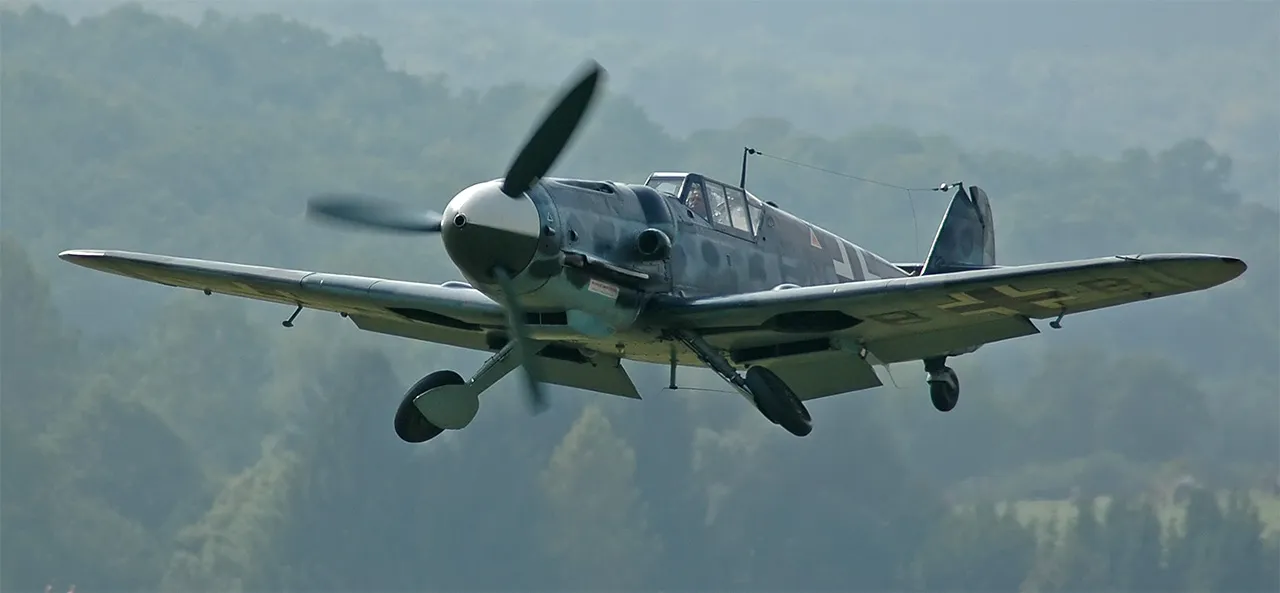
The airframe carried that growth in power throughout the war with only incremental changes to its original 1935 layout, which kept it competitive but also exposed its limits. Its narrow, outward-raked undercarriage1, fitted to keep the wing light and the wheels clear of the propeller, made the aircraft difficult to handle on the ground throughout its service life.
Specifications
The production G-6 variant, the figure given in Wikipedia’s specifications table, was 8.95 m long with a wingspan of 9.925 m and a maximum take-off weight of 3,400 kg. It carried a single pilot and was powered by one Daimler-Benz DB 605A-1 inverted V-12 liquid-cooled piston engine producing 1,475 PS, giving a cruise speed of about 590 km/h at 6,000 m. Combat range, depending on fuel load, was given by Wikipedia as 880–1,144 km, with 1,012 km as a representative midpoint figure1.
Variants
The type went through five main lettered series over a decade of production. The E-series (“Emil”) introduced structural changes to carry the heavier DB 601 engine and was the Luftwaffe’s main variant until mid-1941. The F-series (“Friedrich”) followed with new wings, a revised cooling system and armament concentrated in the fuselage, and is considered by many historians the high point of the design. The G-series (“Gustav”), introduced in mid-1942 with the DB 605 engine, became the most-built version: the G-6 alone accounted for more than a third of all Bf 109s built, around 12,000 aircraft. The final production version, the K-series (“Kurfürst”)1, arrived in late 1944 with a DB 605D engine reaching 2,000 PS and aerodynamic refinements.
After the war, production continued abroad: Czechoslovakia built the Avia S-199, fitted with a Jumo 211 engine in place of the unavailable Daimler-Benz unit, with 603 built, and Spain built the Hispano Aviación HA-1112, eventually re-engined with the Rolls-Royce Merlin, with 239 built1.
Operators and service
The Luftwaffe was the main operator, but the Bf 109 also flew with several of Germany’s wartime partners: Finland (159 aircraft), Romania (more than 200 G-series), Hungary (about 490 G-series), Bulgaria (145 G-2/-6/-10s), Croatia (more than 50) and Slovakia (60 in total)1 all flew the type, alongside smaller numbers in Italy and with Spanish volunteers on the Eastern Front.
Service continued well after the war in Luftwaffe colours ended on 9 May 1945. Switzerland kept its G-6s in service well into the 1950s, and Finland retired its last examples in March 1954. Israel’s air force flew Avia S-199s from 1948 in its war of independence, its first fighter type. The last operator of a Bf 109 derivative was the Spanish Air Force, which retired its Hispano HA-1112s on 27 December 19651.
More than 105 pilots who flew the Bf 109 scored 100 or more aerial victories each, with 13 exceeding 200, and the war’s top-scoring fighter ace, Erich Hartmann, claimed 352 victories flying the type1.
Safety record
The Bf 109’s narrow undercarriage and poor ground visibility made take-off and landing the aircraft’s most dangerous moments rather than combat. Wikipedia reports that at least 10% of all Bf 109s built were lost in take-off and landing accidents, including around 1,500 between 1939 and 1941 alone1, a toll that fell especially hard on newly trained pilots.
Similar aircraft
- Supermarine Spitfire: the Royal Air Force’s main single-seat fighter and the Bf 109’s principal opponent throughout the war, built in broadly comparable numbers.
- Focke-Wulf Fw 190: Germany’s other main wartime single-seat fighter, which supplemented the Bf 109 in Luftwaffe service from 1941.