_rQIcV.webp)
Contents
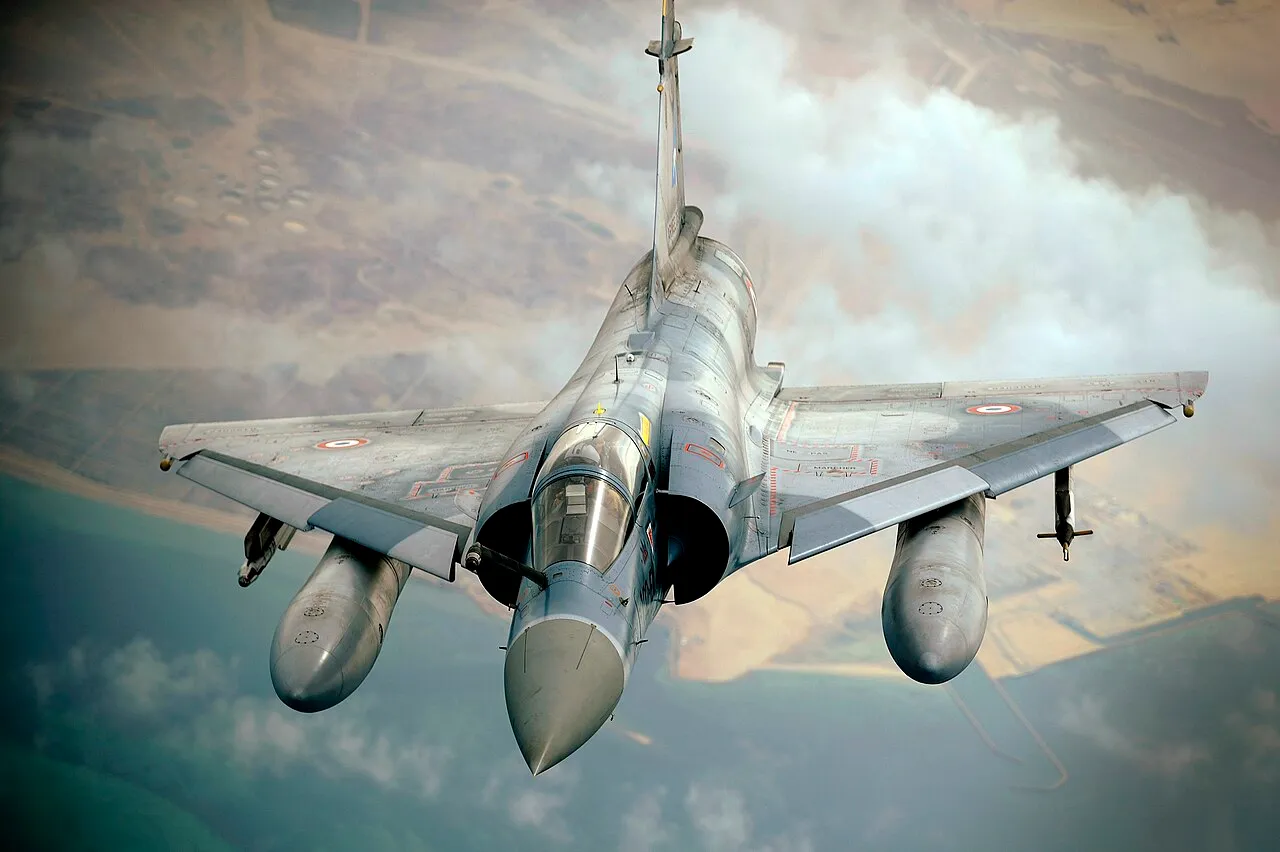
The Rafale is a twin-engine, delta-wing, canard-equipped multirole fighter built by Dassault Aviation for France’s air force and navy. Dassault calls it an “omnirole” aircraft because a single airframe flies air superiority, deep strike, reconnaissance, anti-ship and nuclear deterrence missions, the roles that were once split between separate French fighter types. Since entering service in 2001, it has flown in combat over Afghanistan, Libya, Mali, Iraq and Syria, and by India near its border with Pakistan, and it has become one of the more commercially successful European fighters, with export orders from Egypt, India, Qatar, Greece, Croatia, Indonesia and the United Arab Emirates1.
Design and development
The Rafale traces back to French air force and navy requirements of the mid-1970s. France initially joined the UK, Germany, Italy and Spain in multilateral talks on a Future European Fighter Aircraft, but withdrew in July 1985 to preserve the independence of its fighter industry and pursued its own design. The government awarded a contract for a technology demonstrator on 13 April 1983; the resulting Rafale A was rolled out in December 1985 and made its first flight from Istres on 4 July 1986, reaching an altitude of 11,000 m and a speed of Mach 1.3 on that first flight. The demonstrator flew 867 sorties before its retirement in January 19941.
Production-standard development followed with separate first flights for each variant: the single-seat, land-based Rafale C on 19 May 1991, the carrier-based Rafale M on 12 December 1991, and the twin-seat Rafale B on 24 November 1998. The French Navy’s Flottille 12F became the first operational squadron, converting from May 2001 after receiving its first aircraft in December 2000, and the Rafale M was declared fully operational with the Navy in June 2004; the French Air Force received its first aircraft in April 20051.
Aerodynamically, Dassault combined a delta wing with close-coupled active canards to maximise manoeuvrability, leaving the aircraft deliberately unstable and dependent on a quadruple-redundant digital fly-by-wire system to maintain control. The airframe is rated to withstand loads from −3.6g to 9g in normal use, with up to 11g available in an emergency1.
Specifications
The Rafale is 15.27 m long with a wingspan of 10.86 m2, compact next to twin-engine rivals like the Eurofighter Typhoon. Maximum take-off weight is 24,500 kg, and it is powered by two Snecma M88-4e turbofans, each rated at about 50 kN of dry thrust and 75 kN with afterburner. With external drop tanks the ferry range reaches about 3,700 km, though on a representative deep-strike mission with external tanks and a weapons load the combat radius is closer to 1,056 km flown hi-lo-hi. The canards also let the Rafale land as slow as 115 kn, with airspeeds as low as 15 kn observed during training1.
Crewing follows the variant: the single-seat Rafale C and M carry one pilot, and the two-seat Rafale B and N carry two1. By 31 December 2025, 313 Rafales had been built, with production ongoing2 for both France and its export customers.
Variants
Beyond the baseline C (single-seat, air force), B (two-seat, air force) and M (single-seat, carrier) models, Dassault built dedicated export variants: the two-seat Rafale DQ and single-seat EQ for Qatar, the two-seat DG and single-seat EG for Greece, and the two-seat DI and single-seat EI for Indonesia. Egypt received a mix of two-seat Rafale DM and single-seat EM aircraft, the first export deliveries diverted from French Air Force production. The current production standard is Rafale F4, which the United Arab Emirates became the first export customer to field; India’s 36 jets are being considered for an upgrade to the same standard, and Croatia signed a letter of intent in December 2025 to upgrade its 12 aircraft from F3-R to F41.
Operators and service
France remains the largest operator. By 2026 the French Air and Space Force and Navy together fielded around 165 Rafales, 124 with the air force and 41 with the navy, after selling 12 jets each to Greece and Croatia from its own stock; France has ordered a total of 286 Rafales for delivery by 20351.
Egypt became the first export customer in February 2015, ordering 24 Rafales as part of a US$5.9 billion package that also included a frigate and missiles; by November 2017 deliveries had brought 14 of those 24 into service, and Egypt later added 30 more Rafales in a 2021 order, taking its total to 54. Qatar ordered 24 Rafales in 2015 and a further 12 in 2017; the first Qatari Rafale was delivered in February 2019, and its 36-jet fleet is now fully delivered. India signed for 36 Rafales in a 2016 deal worth €7.8 billion, delivered between 2020 and 2022; in February 2026 its Defence Acquisition Council cleared a further 88 single-seat and 26 two-seat jets, while the Indian Navy was separately approved to buy 26 Rafale M F4s for its carrier air wing. Greece ordered 24 Rafales between 2020 and 2021, all delivered by January 2025, while Croatia bought 12 second-hand F3-R jets from French stock, delivered by April 2025. The United Arab Emirates signed for 80 Rafale F4s in 2021, the largest single export order to date, and Indonesia has 42 Rafale F4s on order, with the first six delivered by May 20261.
The type’s combat debut came in 2007, when a rushed upgrade let six Rafales drop laser-guided bombs over Afghanistan from Tajikistan and the carrier Charles de Gaulle. French Rafales later flew strike missions over Libya from 2011, struck rebel camps in Mali from 2013, flew sorties over Iraq and Syria against Islamic State from 2014, and took part in the 2018 missile strikes on Syria, each jet carrying two SCALP EG missiles. In 2024, French Rafales based in Jordan helped intercept Iranian drones during Iran’s attack on Israel, and from 2026 French Rafales deployed to the United Arab Emirates were reported to have shot down at least 60 Iranian drones amid the 2026 Iran war. India has flown Rafales operationally in the 2025 India–Pakistan conflict, where Pakistan claimed to have shot down three Rafales and Western outlets reported crash debris consistent with the loss of at least one jet1; India’s government acknowledged losing aircraft without confirming the type or number.
Safety record
Dassault’s own sourced record lists several fatal accidents. A French Air Force two-seat Rafale crashed during a training flight on 6 December 2007 after the pilot suffered spatial disorientation, killing him. Two unarmed French Navy Rafales collided in mid-air near Perpignan on 24 September 2009 while returning to their carrier, killing one test pilot. A carrier-based Rafale crashed in the Arabian Sea on 28 November 2010 after its engines were starved of fuel when the pilot became confused switching fuel tanks; the pilot ejected safely. Most recently, two French Air Force two-seat Rafales collided over Colombey-les-Belles on 14 August 2024; one pilot ejected, and the trainee and instructor aboard the second aircraft died1.
Similar aircraft
- Eurofighter Typhoon: the European multirole rival the Rafale has repeatedly faced in export competitions, including in Qatar, India and the UAE.
- Saab JAS 39 Gripen: a lighter, single-engine multirole fighter that competes with the Rafale in the same export market, including in Croatia and Colombia.
- General Dynamics F-16 Fighting Falcon: an older single-engine American multirole fighter that several Rafale export customers, including Greece and Croatia, also fly.