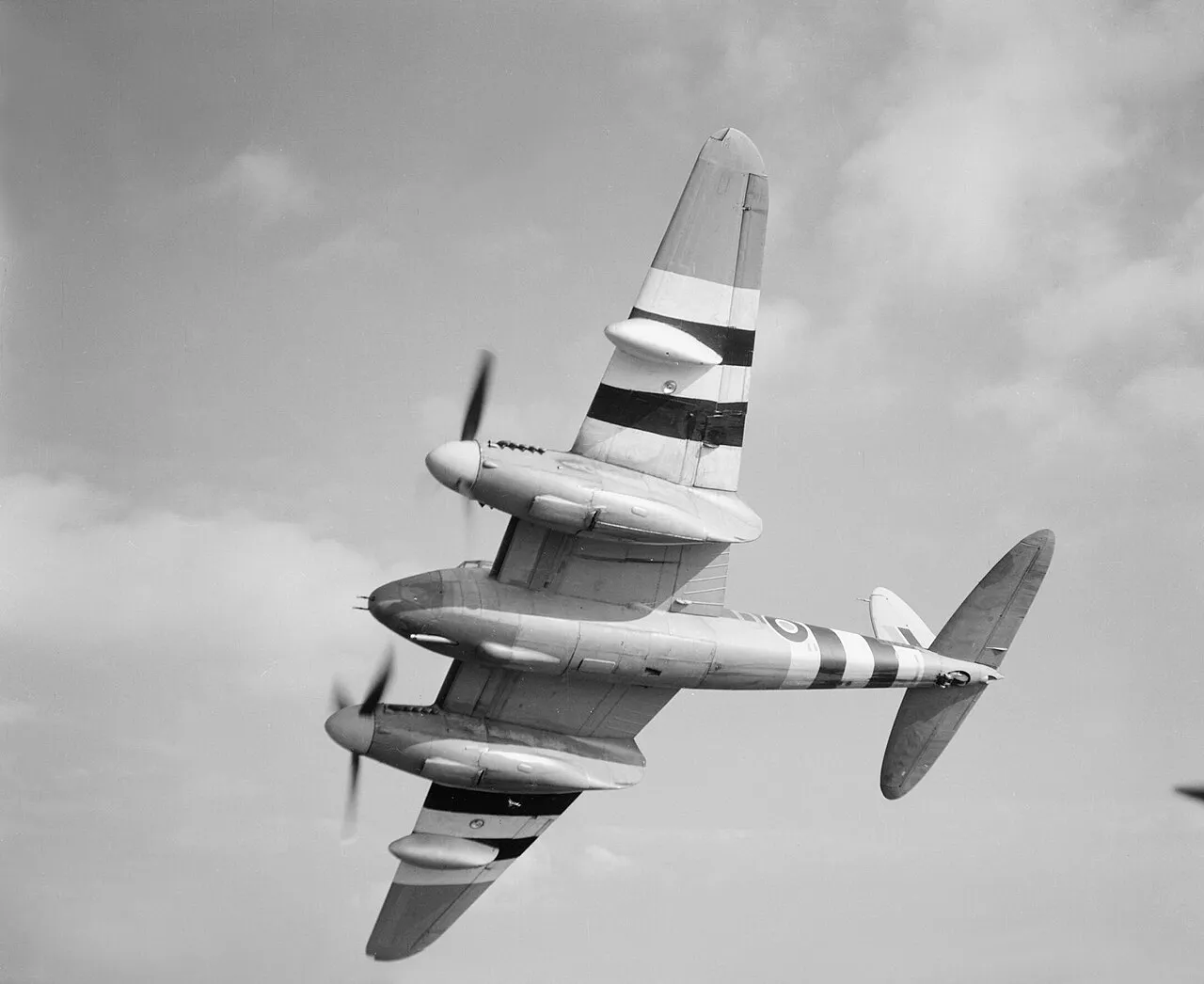
The de Havilland Mosquito is a British twin-engine combat aircraft built mostly of wood, flown as a bomber, night fighter, fighter-bomber and reconnaissance aircraft during the Second World War. De Havilland Aircraft Company2 designed it around the then-unconventional idea that a fast, unarmed bomber could outrun fighters without needing heavy defensive guns. Crews and the press nicknamed it the “Mosquito” and, for its material, the “Wooden Wonder”1.
Design and development
De Havilland proposed the design to the Air Ministry in 1938 as a fast, unarmed bomber relying on speed rather than defensive armament to avoid interception, an idea the ministry initially resisted. The company built the aircraft largely from wood, a material chosen partly to avoid competing with other aircraft programmes for scarce aluminium and skilled metalworkers, and partly because De Havilland had experience with wooden construction from its pre-war airliners. The prototype made its first flight on 25 November 1940, and early trials showed a performance that matched or exceeded contemporary fighters in speed1.
The wooden airframe used a sandwich construction of plywood skins around a balsa wood core for the fuselage, built in two half-shells glued together around the internal structure. This let furniture makers and other woodworking firms outside the usual aircraft industry supply major subassemblies, which spread production across many smaller workshops1.
Specifications
The production fighter-bomber variant, the FB Mk VI, is 12.55 m long with a wingspan of 16.51 m. It had a maximum take-off weight of about 10,100 kg and was powered by two Rolls-Royce Merlin Mk.23 or Mk.25 piston engines. It reached a top speed of about 608 km/h at 4,000 m, fast enough that early versions could outrun the Luftwaffe’s contemporary fighters, and had a combat range of about 1,800 km. It carried a crew of two, a pilot and a navigator1, seated side by side rather than in tandem.
Variants
De Havilland built the Mosquito in many roles from a shared airframe. Unarmed bomber variants carried bomb loads and had a longer, rounded nose without gun armament. Night fighter variants carried airborne interception radar and cannon armament to intercept enemy bombers after dark. The FB Mk VI fighter-bomber, the most-built variant, combined four 20 mm cannon and four machine guns with underwing bombs or rockets. Photo-reconnaissance variants removed armament for extra fuel and cameras, exploiting the type’s speed to evade interception. In all, de Havilland and its licensees built 7,781 Mosquitoes between 1940 and 19501.
Operators and service
The Royal Air Force was the principal operator, flying the type on bombing raids, night-fighter patrols, maritime strikes and long-range reconnaissance. Mosquito bombers flew low-level precision raids against targets in occupied Europe, including a notable attack on the Gestapo headquarters in Oslo, and the type also flew unescorted daylight raids deep into Germany, using speed and altitude in place of a fighter escort. Beyond Britain, the aircraft served with the air forces of Canada, Australia and other Commonwealth and allied air arms, and was built under licence in Canada and Australia. The Royal Air Force retired its last Mosquitoes in 19631, and the type is retired from military service worldwide today; a small number survive in airworthy or static preservation.
Similar aircraft
- Hawker Hurricane: a British single-engine fighter of the same war, built from conventional metal instead of wood.
- North American P-51 Mustang: an Allied long-range fighter of the same era that, like the Mosquito, also flew deep into enemy territory on its own speed and range.
- Junkers Ju 88: the Luftwaffe’s closest equivalent, a twin-engine German aircraft built in bomber, night-fighter and reconnaissance variants much as the Mosquito was.