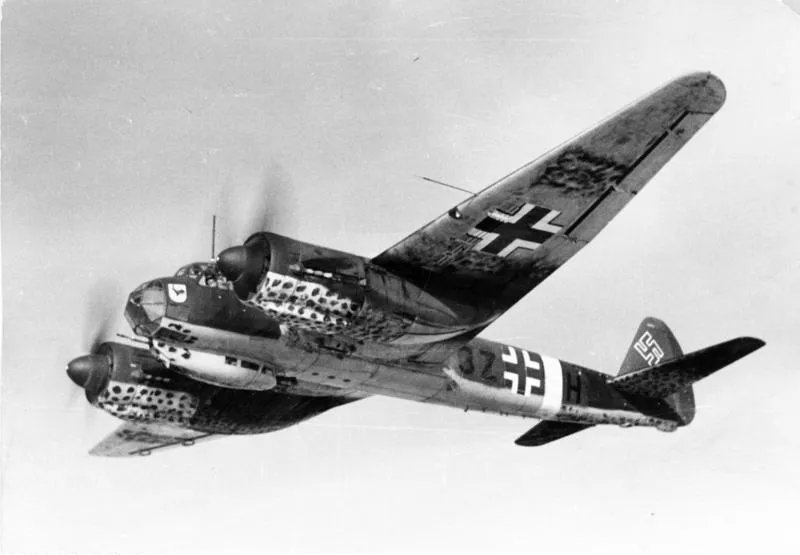
The Junkers Ju 88 was built by Junkers Flugzeug- und Motorenwerke as a fast medium bomber for the German Luftwaffe, first flying on 21 December 1936. It went on to become one of the most versatile combat aircraft of the Second World War1, flying as a level and dive bomber, a night fighter, a heavy fighter, a reconnaissance aircraft and a torpedo bomber, often with little more than a change of nose and equipment.
Design and development
The type grew out of a 1934 German air ministry requirement for a multi-purpose aircraft, which by August 1935 had narrowed into a specification for an unarmed, fast “Schnellbomber” carrying a crew of three and a bomb load of 800-1,000 kg. Junkers chief designer Ernst Zindel produced two competing in-house studies from January 1936, and the air ministry chose the single-finned Ju 88 over its twin-finned sister design. The first prototype flew on 21 December 1936 and reached about 580 km/h, a speed that persuaded the ministry to drop rival designs from Henschel and Messerschmitt1.
From 1938 the air ministry asked for the design to double as a “heavy” dive bomber, and Junkers answered with strengthened wings, dive brakes, a longer fuselage and a fourth crew member, changes that steadily added weight and cut into the prototype’s original speed advantage. The production aircraft also carried a distinctive single-leg main landing gear that rotated through 90 degrees as it retracted, so each wheel lay flat above its strut in the wing1.
That same airframe proved adaptable enough to be rebuilt for roles far from the original bomber brief. Night-fighter versions carried airborne radar and cannon armament to intercept Allied bombers over Germany, while heavy-fighter and ground-attack variants traded bomb load for forward-firing guns. The breadth of that rework is reflected in the engines fitted across the type’s life: early bomber variants ran two Junkers Jumo 211 V-12 liquid-cooled engines, while heavy-fighter variants switched to two BMW 801 radial engines1.
Specifications
The Ju 88 was 14.4 m long with a wingspan of 20 m. The A-4 bomber variant had a maximum take-off weight of about 14,000 kg and a cruise speed of about 370 km/h. Its ferry range reached about 2,730 km, against a standard fuel range of about 1,790 km. A bomber crew numbered four: pilot, bombardier/front gunner, radio operator/rear gunner and navigator/ventral gunner1, packed closely into a common cockpit that was itself a Ju 88 trademark.
Variants
Junkers and its subcontractors built more than 15,000 Ju 88s across dozens of variants, making it the most-produced German twin-engine aircraft of the war and, behind the four-engined B-24 Liberator, the second most-produced bomber of all time. The A-series level and dive bombers, built around the Jumo 211 engine, formed the backbone of production; the A-4 carried a maximum bomb load of 3,000 kg, though crews typically flew with 1,500-2,000 kg1, while the A-17 dropped the ventral gun gondola to serve as a dedicated torpedo bomber.
The C-series started as a fighter-bomber with a solid metal nose housing one 20 mm cannon and three machine guns in place of the bomber’s glazing, and its C-6 model became a night-fighter mainstay fitted with early Lichtenstein airborne radar before switching, from October 1943, to a longer-ranged radar set carried on large antlered aerials across the nose. The purpose-built G-series night fighters that followed dropped the ventral gondola for a cleaner, faster fuselage; later G-6s switched to Jumo 213 inverted-V12 engines for more power at altitude. Alongside these came D-series long-range reconnaissance aircraft, an S-series high-speed bomber with a smoothly glazed nose and nitrous-oxide power boost that was the fastest of all the variants, and small-batch P-series anti-tank aircraft carrying a single large-calibre cannon of up to 75 mm in a conformal pod under the fuselage1. Few other wartime designs were rebuilt for so many different jobs on the same basic airframe.
Operators and service
The Ju 88 flew for Nazi Germany’s Luftwaffe throughout the Second World War, entering squadron service with only a dozen aircraft on the first day of the invasion of Poland in 1939. It fought on every front the Luftwaffe held, from the Battle of Norway, where Ju 88s helped damage the battleship HMS Rodney and sink the destroyer HMS Gurkha, to the Battle of Britain, where Ju 88 losses over the summer and autumn of 1940 totalled 303 aircraft, more than either the Dornier Do 17 or Heinkel He 111. After the German invasion of the Soviet Union in June 1941, Ju 88 units took part in the first day’s strikes on Soviet airfields, with one wing alone claimed to have destroyed more than 100 aircraft on the ground, and later flew against the Arctic convoys supplying the Soviet war effort. In the Mediterranean the type bombed Malta and Allied shipping for years, and on 2 December 1943 some 105 Ju 88s struck the Allied-held port of Bari in Italy, sinking more than 20 ships for the loss of only one bomber. From 1942 its night-fighter variants, carrying increasingly capable airborne radar, became central to the air defence of the Reich, flown by high-scoring aces such as Helmut Lent and Heinrich Prinz zu Sayn-Wittgenstein. Late in the war some bomber-variant Ju 88s were converted into unmanned, explosive-filled lower components of the Mistel composite aircraft, flown into their targets while coupled beneath a manned fighter1.
Beyond Germany, Finland bought 24 Ju 88 A-4s in April 1943 and flew them against Soviet bases near Leningrad and in the Arctic; Finnish crews found the type’s wings suffered stress damage from steep dives and restricted it to 45-degree dives instead of the 60-80 degrees flown by the Luftwaffe, flying their last combat mission on 4 April 1945 before using surviving aircraft for training until 1948. In Luftwaffe hands the type remained in service until Germany’s defeat in 1945. Captured and surplus examples flew on afterwards: France’s Armée de l’Air kept Ju 88s in service until 19511, the last operator of the type.
Similar aircraft
- Junkers Ju 87: the Luftwaffe’s dedicated dive bomber, built by the same manufacturer and flown alongside the Ju 88 in close-support and anti-shipping roles.
- Heinkel He 111: Germany’s other principal wartime bomber, a slower but longer-serving design that the Ju 88 was meant to complement and eventually outperform.