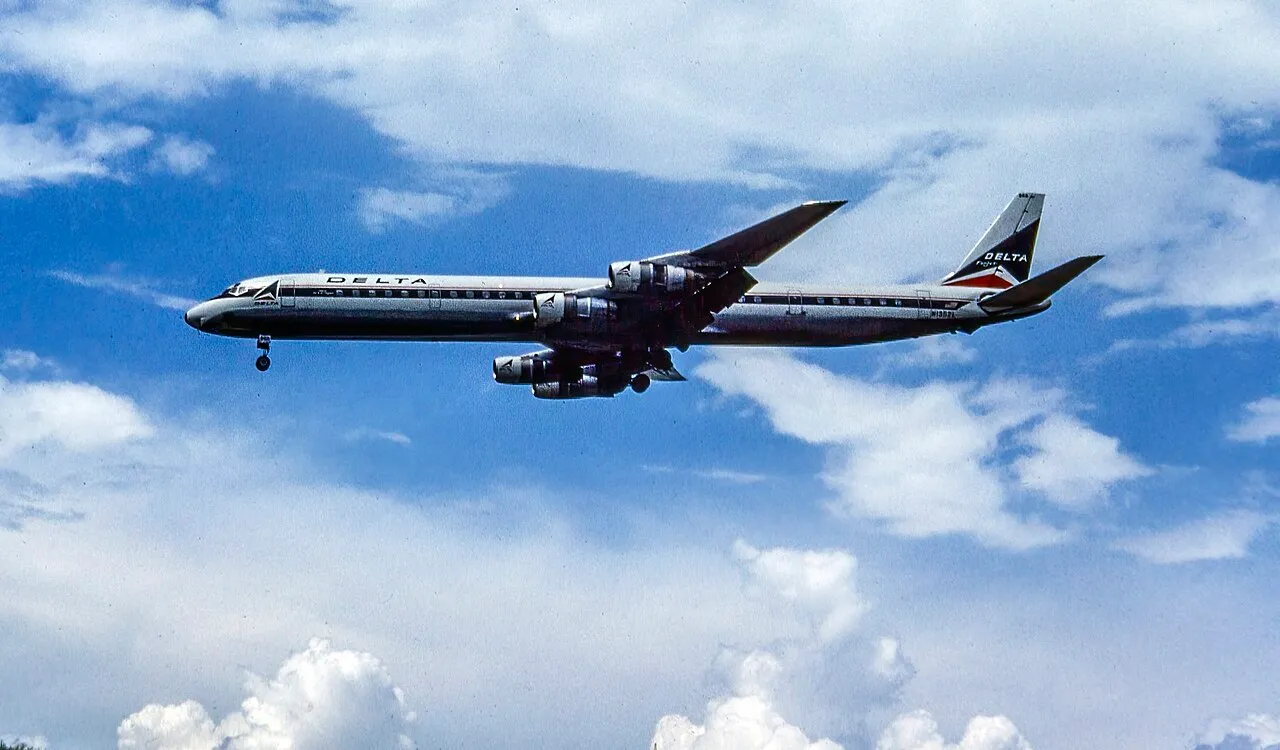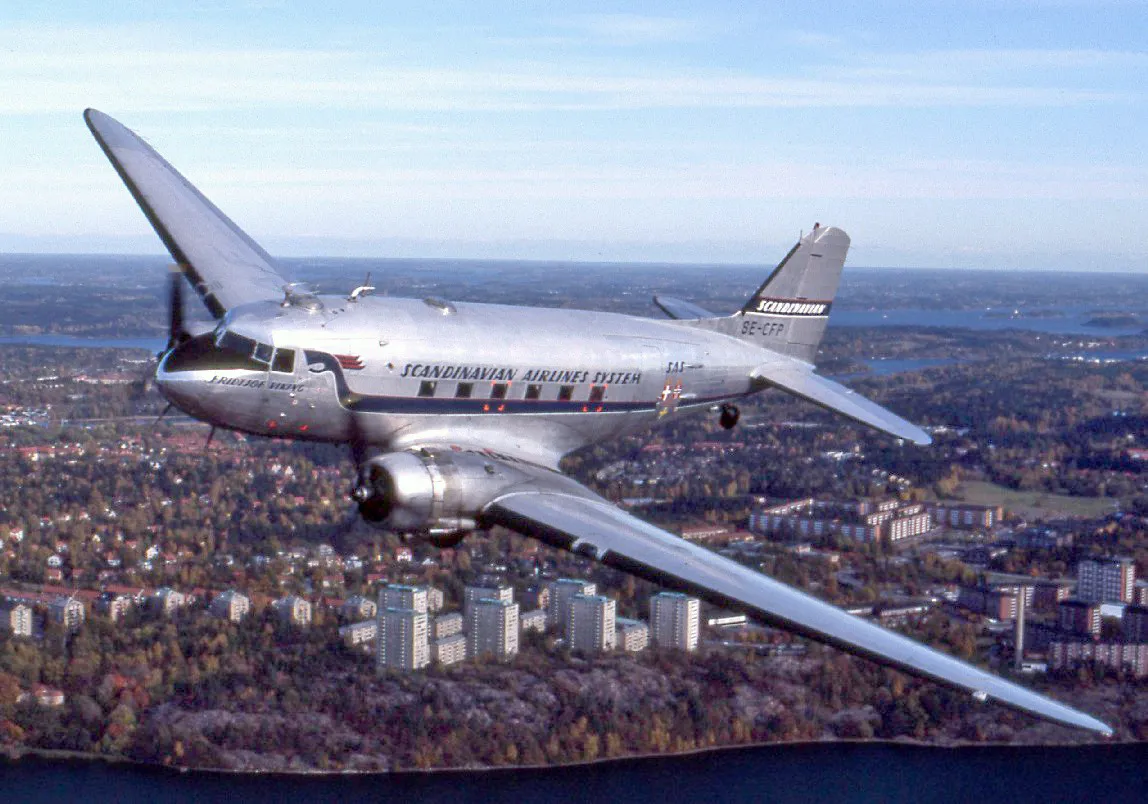
The Douglas DC-3 is a twin-engine piston airliner built by the Douglas Aircraft Company that became the backbone of civil air travel in the years before the Second World War and, as the military C-47 Skytrain (Dakota)1, one of the most widely used transport aircraft of the war. Eighty years after its first flight, a small number still earn their keep hauling cargo and passengers.
Design and development
The DC-3 exists because American Airlines chief executive C. R. Smith persuaded Donald Douglas by telephone to build a sleeper version of the existing DC-2, committing to buy 20 aircraft before a single one was built. The resulting Douglas Sleeper Transport (DST) had a cabin widened to 92 inches to fit side-by-side sleeping berths, well beyond the DC-2’s 66-inch cabin. No prototype was built first: the DST flew for the first time on 17 December 1935, piloted by Carl Cover, and the first day-passenger DC-3 followed it off the same production line. American Airlines put the type into passenger service on 26 June 19361, built to compete with United Airlines’ Boeing 247.
The design’s efficiency, comfort and reliability caught on fast. By 1939, around 90% of the world’s airline flights were operated by a DC-3 or one of its derivatives1, a dominance no single airliner type has matched since.
Specifications
The DC-3 is 19.7 metres long with a wingspan of 29 metres and a maximum take-off weight of 11,431 kg. It carries a typical seating of 21 to 32 passengers and flew with a crew of two pilots. Power comes from two Pratt & Whitney R-1830-S1C3G Twin Wasp radial piston engines, each rated at 1,200 hp (some aircraft instead used Wright R-1820 Cyclone engines of similar output). The type cruises at about 339 km/h and has a range of roughly 2,540 km. In 1936 a DC-3 cost its airline customer between $60,000 and $80,0001.
Variants
Douglas built the civilian line as the DST sleeper and the day-passenger DC-3, with 607 civilian aircraft produced between 1936 and the mid-1940s, and limited production continuing to 1950. The military version, the Douglas C-47 Skytrain, known to the British and Commonwealth air forces as the Dakota, accounts for 10,048 of the roughly 16,000 DC-3-family aircraft built. Other countries built their own versions under licence: the Soviet Union’s Lisunov Li-2, with 4,937 built, and Japan’s Showa/Nakajima L2D, with 487 built. A later civilian update, the Super DC-3 (DC-3S), lengthened the fuselage by 39 inches and fitted more powerful engines, but only 5 were built. From the 1950s onward, operators also re-engined surviving aircraft with turboprops, among them the Conroy Turbo-Three with Rolls-Royce Dart engines and the Basler BT-67 with Pratt & Whitney PT6A turboprops1.
Operators and service
Before the war, the DC-3 flew with American Airlines, United Airlines, TWA, Eastern Air Lines and Delta in the United States, and internationally with carriers including KLM, Air India, Cubana de Aviación and Cathay Pacific. The Second World War turned it into a military workhorse: more than 10,000 military C-47 and C-53 derivatives served in transport and troop-carrying roles across Allied and neutral air forces. After the war the type became uneconomical on main trunk routes but stayed in demand for regional and feeder service, a role many still fly today: the aircraft is retired from most scheduled service, but around 150 were still flying as of 2023, mostly with small cargo operators and charter services. As of 2026, the last DC-3 flying in regular scheduled passenger service was operated by Aerolíneas del Llano in Colombia1.
Similar aircraft
- Douglas DC-2: the smaller, narrower-cabin airliner the DC-3 was developed from.
- Lockheed Model 18 Lodestar: a twin-engine American airliner of the same era aimed at a similar market.
- Junkers Ju 52: Germany’s equivalent-era transport, widely used by the Luftwaffe much as the C-47 was used by the Allies.