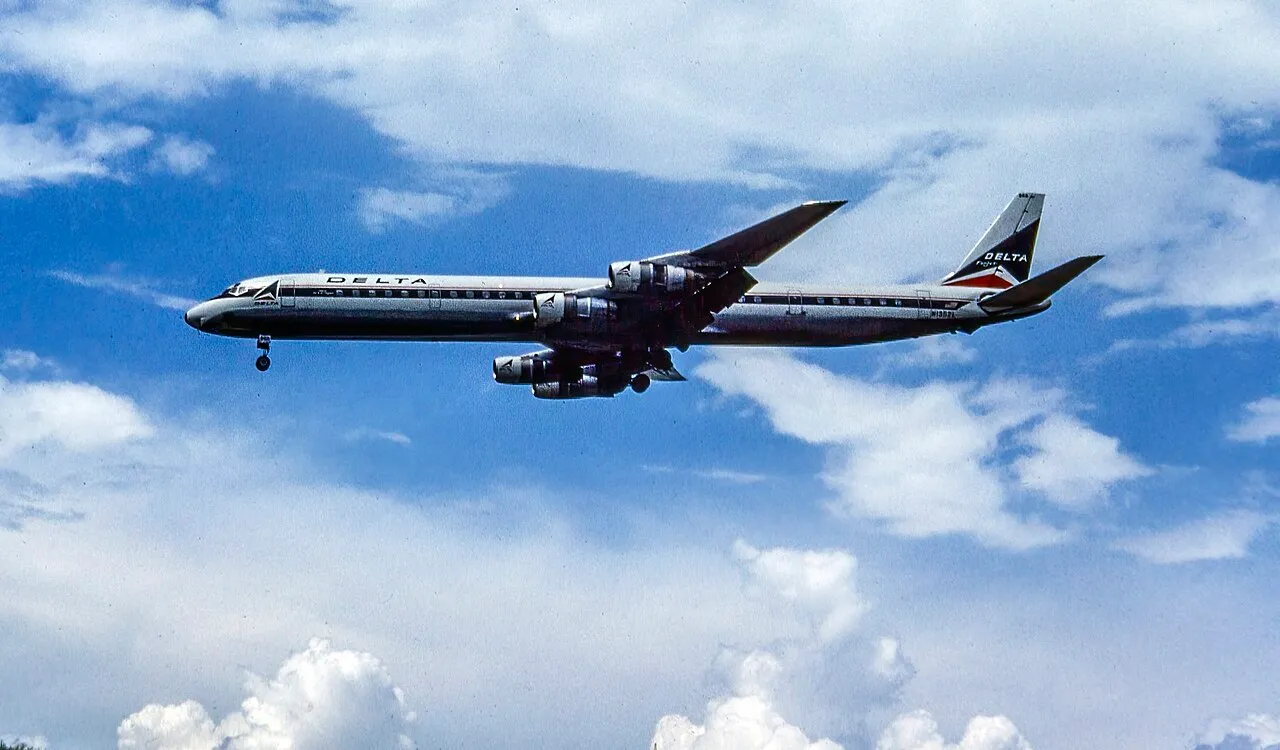
The Douglas DC-8 is a four-engine jet airliner built by the Douglas Aircraft Company, and from 1967 by McDonnell Douglas, as a long-range rival to the Boeing 707. Airlines flew it as a passenger and cargo transport on domestic and transatlantic routes, and Douglas built 556 of the type between 1958 and 1972, spanning the original series and the later stretched and re-engined variants described below. The DC-8 is retired from passenger service, though a small number remain in cargo service1.
Design and development
Douglas launched the DC-8 to compete with Boeing’s jet airliner programme, and the type made its first flight on 30 May 1958. Early production aircraft shared a similar swept-wing, four-engine layout with the 707, and the two types competed closely for airline orders through the late 1950s and 1960s. Douglas later stretched the airframe into the “Super Sixty” series to add capacity and range without a new design, and in the 1980s many surviving aircraft were re-engined with CFM International CFM56 turbofans as “Super Seventy” conversions1, extending their working lives in cargo service.
Specifications
The original DC-8-10/20/30 series measured 45.9 m long with a 43.4 m wingspan, while the stretched Super Sixty variants (DC-8-61/63/71) grew to 57.1 m long with a 45.2 m wingspan on the -62/63/72/73 wing. Maximum take-off weight rose from 123,800 kg on the first DC-8-10 to 158,760 kg on the DC-8-63, and range grew accordingly: the DC-8-63 flew about 7,400 km, while the long-range DC-8-62 reached about 9,600 km. A stretched DC-8-61/63 could seat about 259 passengers in a high-density layout, against roughly 177 on the original DC-8-10/20/30. The aircraft cruised at about 895 km/h, or Mach 0.82, and needed a crew of three: two pilots and a flight engineer. Depending on the variant, it flew with Pratt & Whitney JT3C or JT4A turbojets, Pratt & Whitney JT3D turbofans, Rolls-Royce Conway turbofans on some -40 series aircraft, or CFM International CFM56 turbofans on re-engined Super Seventy conversions1.
Variants
Douglas built the DC-8 in two broad generations. The original series — the DC-8-10, -20, -30, -40 and -50 — differed mainly in engines and range, from the domestic-focused -10 to the longer-range -50. The stretched “Super Sixty” family that followed — the DC-8-61, -62 and -63 — lengthened the fuselage for more seats, with the -62 optimised for range and the -63 combining the longer fuselage with extra fuel capacity. From the early 1980s, many Super Sixty airframes were converted to “Super Seventy” standard (DC-8-71, -72 and -73) with new CFM56 turbofan engines1, which cut noise and fuel burn enough to keep the aircraft flying under later noise rules.
Operators and service
Launch customers and major operators through the 1960s and 1970s included large American and international carriers that also flew the Boeing 707, using the DC-8 on domestic trunk routes and transatlantic services. As airlines retired the type from passenger service from the 1980s onward, many aircraft, especially re-engined Super Seventy conversions, moved into cargo service, where their four-engine reliability and payload suited freight operators. The DC-8 is retired from passenger service, with only a small number of Super Seventy conversions still flying in cargo roles today1.
Similar aircraft
- Boeing 707: the rival four-engine jet airliner Douglas designed the DC-8 to compete against; Boeing began delivering 707s to Pan Am in August 1958, about a year before the DC-8 entered service with Delta Air Lines on 18 September 19591.
- McDonnell Douglas DC-10: a later, wide-body Douglas airliner that succeeded the DC-8 in long-haul service once trijet and twin-aisle designs took over from narrow-body four-jets.