Contents
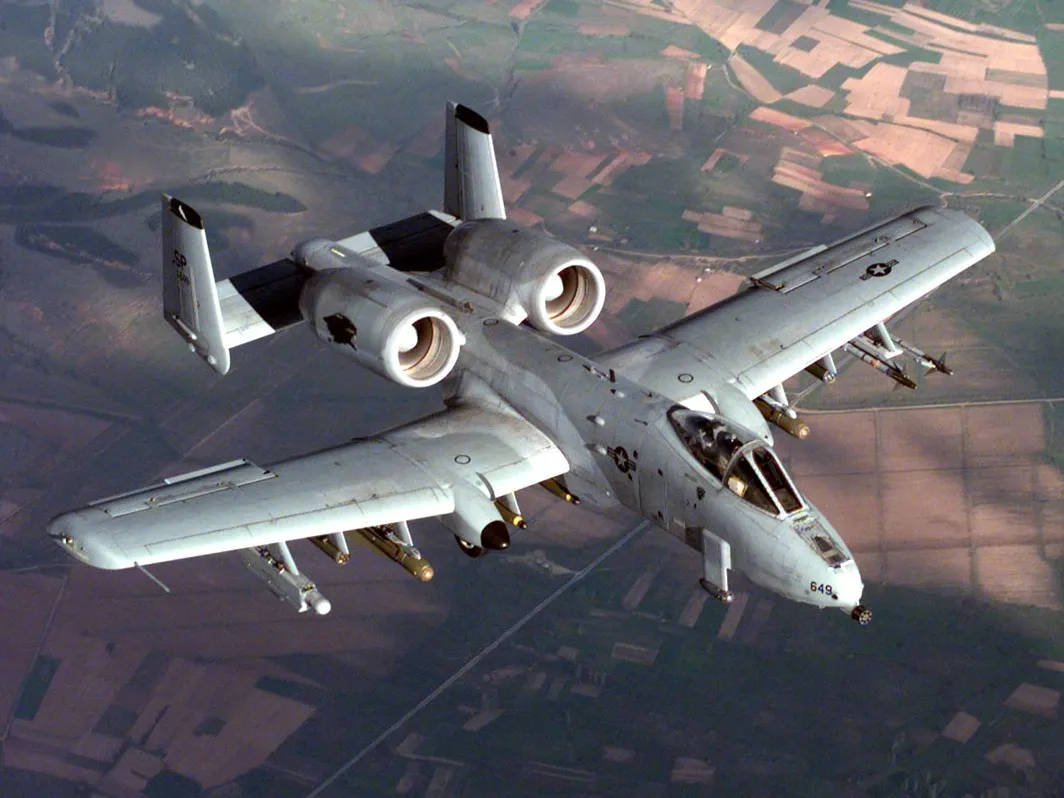
The Fairchild Republic A-10 Thunderbolt II, nicknamed the “Warthog”, is a single-seat, twin-engine jet built around a single enormous cannon for close air support, flying low and slow to attack ground targets directly. Fairchild Republic built it for the US Air Force, and more than five decades after its first flight the type remains in service, having flown in the Gulf War, the Balkans, Afghanistan, Iraq, Libya, the campaign against Islamic State and, most recently, the 2026 Iran war1.
Design and development
The US Air Force’s interest in a dedicated attack aircraft followed the Vietnam War, where the ageing Douglas A-1 Skyraider lost some 266 aircraft in action, largely to small-arms fire. General John P. McConnell ordered development of a close air support aircraft on 8 September 1966, launching the Attack Experimental programme. In May 1970 the Air Force specified a 30 mm rotary cannon, a maximum speed of 460 mph and a $1.4 million unit cost; Northrop and Fairchild Republic were picked from six bidders to build prototypes, the YA-9A and YA-10A. After a flyoff, the Air Force announced the YA-10’s selection for production on 18 January 19731.
The prototype first flew on 10 May 1972, the first production aircraft followed in October 1975, and deliveries began in March 1976. By 1984, 715 aircraft, including two prototypes and six development aircraft, had been delivered. The design centres on the GAU-8/A Avenger, a 30 mm rotary cannon firing up to 3,900 rounds a minute of depleted-uranium armour-piercing shells, accurate enough to put 80 percent of its shots inside a 40-foot circle from 4,000 feet. Around the cockpit sits 1,200 lb of titanium armour, nicknamed the “bathtub”, able to withstand 23 mm high-explosive and armour-piercing rounds, 37 mm high-explosive hits and some fragments from 57 mm shells1.
Specifications
The A-10 is 16.26 metres long with a wingspan of 17.53 metres2, flown by a single pilot. Maximum take-off weight is 20,865 kg, and power comes from two General Electric TF34-GE-100A turbofans, mounted high on the fuselage to cut their exposure to ground fire and infrared detection. Typical cruise speed is 560 km/h, well below the aircraft’s design maximum, since the jet is built to loiter over a target rather than to race to one; ferry range with reserves is about 4,150 km1.
Besides the GAU-8 cannon, the A-10 carries ordnance on 11 external hardpoints, including AGM-65 Maverick missiles, AIM-9 Sidewinders for self-defence, cluster bombs, rocket pods and GPS- or laser-guided bombs. Many systems are deliberately interchangeable between the aircraft’s left and right sides, and the jet can land with its gear up if damaged, reflecting a design built to survive heavy battle damage. In all, 716 A-10s were built between 1972 and 1984, and the type remains in service1 today.
Variants
The original A-10A was the only version built in significant numbers. From 2005 to June 2011 the whole fleet of 356 A-10s and OA-10s was upgraded to the A-10C standard under the Precision Engagement programme, adding all-weather attack capability, an improved fire-control system, smart-bomb targeting, a Link 16 and satellite communications suite, and two multifunction cockpit displays. In 1987 many A-10s were redesignated OA-10 for the forward air control role while remaining physically unchanged and fully combat-capable. A single experimental two-seat YA-10B, carrying a second crew member for electronic countermeasures and navigation, was built by converting a test aircraft, but the US Air Force and export customers showed no interest in it1.
Operators and service
The US Air Force is the only operator of the A-10. In the 1991 Gulf War, 132 A-10s flew 8,100 sorties with a 95.7 percent mission-capable rate and launched 90 percent of the AGM-65 Mavericks fired in the conflict; on 6 February 1991 an A-10 used its cannon to shoot down an Iraqi helicopter, the type’s first air-to-air kill. The jet flew over the Balkans through the 1990s, firing about 10,000 rounds of 30 mm ammunition over Bosnia in 1994 and 1995 and flying escort and strike missions during the 1999 Kosovo campaign1.
A-10 squadrons deployed to Afghanistan from March 2002, and sixty A-10s and OA-10s took part in the 2003 invasion of Iraq, firing 311,597 rounds of 30 mm ammunition. Between 2006 and October 2013 the type flew 19 percent of close air support missions in Iraq and Afghanistan, and it returned to combat against Islamic State from October 2014, including a strike that destroyed a convoy of more than 100 ISIL-operated oil tanker trucks in Syria on 15 November 2015. The Air Force has repeatedly proposed retiring the A-10 in favour of the Lockheed Martin F-35 Lightning II, only for Congress to delay or block the cuts, and in April 2026 the Secretary of the Air Force pushed the retirement date back to 2030 amid that year’s Iran war, during which A-10s hunted fast-attack boats in the Strait of Hormuz1.
Safety record
The A-10’s low-level mission has brought heavy losses in high-threat environments: in the Gulf War, four A-10s were shot down by surface-to-air missiles and eleven were hit by anti-aircraft artillery, and two more were hit and damaged by missiles over Kosovo in May 1999. One A-10 survived severe battle damage over Baghdad on 7 April 2003, when flak knocked out one engine and crippled the hydraulics; the pilot flew on manual reversion controls for nearly an hour and landed safely, and during the 2026 Iran war an A-10 was shot down by Iranian air defences on 3 April 2026, with the pilot ejecting and being rescued. The record also includes friendly fire: between 2010 and 2015 A-10s were involved in the deaths of 35 Afghan civilians, more than any other US aircraft type, and in four incidents between 2001 and 2015 in the deaths of ten US troops1.
Similar aircraft
- Sukhoi Su-25: the Soviet equivalent, a dedicated, heavily armoured close air support jet built to a similar Cold War-era concept.
- Northrop YA-9: the rival prototype the A-10 beat in the US Air Force’s close air support competition, never put into production.