Contents
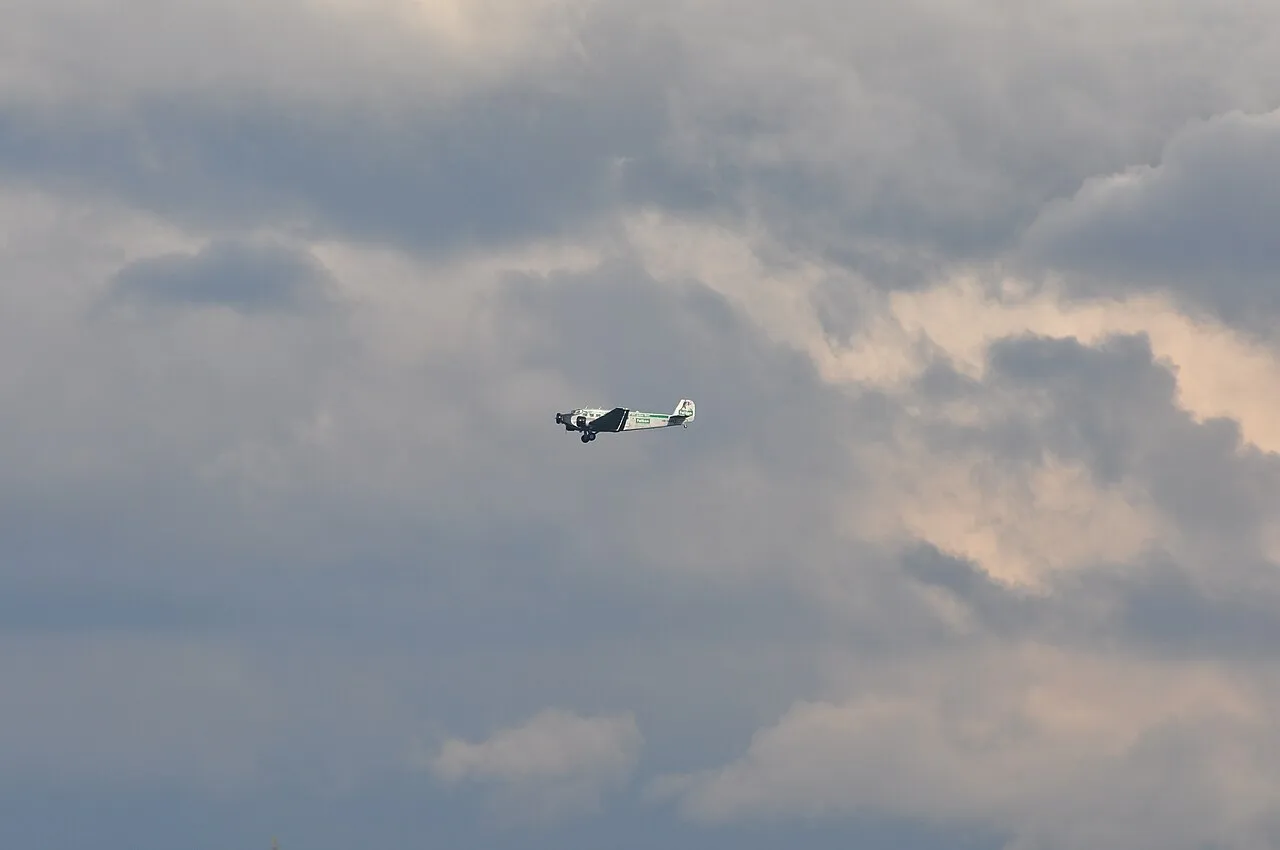
The Junkers Ju 52 is an airliner and transport built by Junkers, whose three-engined Ju 52/3m version was designed for Deutsche Luft Hansa in 1932. By the mid-1930s, airlines throughout Europe and Latin America were flying it, and in the Second World War it was the Luftwaffe’s primary transport. It was nicknamed Tante Ju1, or “Auntie Ju”, and even in the 21st century2 several aircraft have remained operational, typically for heritage displays and sightseeing flights.
Design and development
Junkers engineer Ernst Zindel designed the Ju 521. Its corrugated duralumin skin was a strengthening measure, and the corrugation added structural strength but also aerodynamic drag. The single-engine Ju 52 made its maiden flight on 13 October 19302, but it was judged underpowered, and later Ju 52s were built with three radial engines.
Zindel added two more Hornet engines in 1932, and the tri-motor received the new designation Ju 52/3m. The extra power let it cruise at about 150 mph1 (about 240 km/h) and take off and land on small airfields. The main undercarriage was fixed and divided2.
Specifications
The Ju 52 has a wingspan of 29.25 m and a length of 18.9 m3. The military Ju 52/3mg3e had a maximum take-off weight of 10,500 kg and range of 1,000 km. As an airliner the Ju 52/3m could carry 17 passengers or 3 tons of freight, while the Ju 52/3mg7e transport version could carry 18 troops or 12 stretchers2. The Smithsonian’s Spanish-built example stands 4.5 m tall, with an empty weight of 5,346 kg and a gross weight of 9,200 kg, and has a top speed of 290 km/h1.
Variants
Work on a militarised Ju 52/3m, designated Ju 52/3mg3e, began in 1934. Minesweeping aircraft carried a 14 m degaussing ring under the airframe to trigger submerged naval mines. In France the Junkers-controlled Avions Amiot built the type during the war and continued afterwards with the AAC 1 Toucan, of which 415 were built. In Spain, CASA built 170 under licence, designated CASA 352/3m, and kept building them until 1952; the Smithsonian’s example is a CASA 352-L built in 19511. The Ju 52 was in production between 1931 and 1952, with 4,845 built2.
Operators and service
Lufthansa took the Ju 52 into its fleet in 1932, where it made up about 50 percent of the fleet and was valued for its reliability and economy; Deutsche Luft Hansa operated more than 200. One of its restored aircraft, registration D-AQUI, is to go on permanent display at the Lufthansa Group conference and visitor centre in Frankfurt from 20264. Lufthansa also acquired the Smithsonian’s CASA-built aircraft for promotional flights, then donated it in 1987; Fairoaks Aviation in England had bought it in the mid-1970s1, and it appeared in several films.
The Luftwaffe accepted 2,8041 and used them in roles such as troop carrier, bomber and ambulance. In late May 1941 the Luftwaffe used 493 Ju 52/3m aircraft to carry most of the troops flown onto Crete for the Luftwaffe’s largest airborne invasion of the war. Many were shot down during the attempt to resupply the German Sixth Army trapped at Stalingrad in the winter of 1942–19432.
Outside Germany, airlines and cargo carriers in South America, China and South Africa also flew the Ju 52/3m, and the last one making scheduled passenger flights in New Guinea stopped flying in the late 1960s1. After the war, large numbers were still in use by the 1980s, and the Swiss Air Force flew the type from 1939 to 1982. Other operators included Bolivia, the Colombian Air Force, the Yugoslav Air Force and Soviet agencies, which used it until 19502.
Safety record
On 4 August 2018, a Ju 52/3mg4e operated by Ju-Air, registration HB-HOT, crashed near Piz Segnas in Switzerland, killing all 20 people on board. It had followed its scenic route into a basin southwest of Piz Segnas, where the aircraft stalled; the stall went out of control and recovery was impossible. The final report of 28 January 2021 found that the crew flew at low altitude with no possibility of an alternative flight path, that the engines were not producing rated power, and that the company tolerated risky behaviour and rule breaking. Ju-Air resumed flights under stricter conditions after the crash, but in March 20195 the Federal Office of Civil Aviation banned it from commercial passenger flights with Ju 52s, allowing only private flights for club members.
Similar aircraft
- Douglas DC-3: an American transport of comparable role, configuration and era to the Ju 522, flying two engines with a retractable undercarriage6 against the Ju 52’s fixed gear and third engine.
- Fokker F.VII: an earlier Dutch trimotor airliner that converted from a single-engine design to three Wright Whirlwind engines in 1925, built with a fabric-covered steel-tube fuselage and wooden wing7 rather than the Ju 52’s corrugated metal skin.