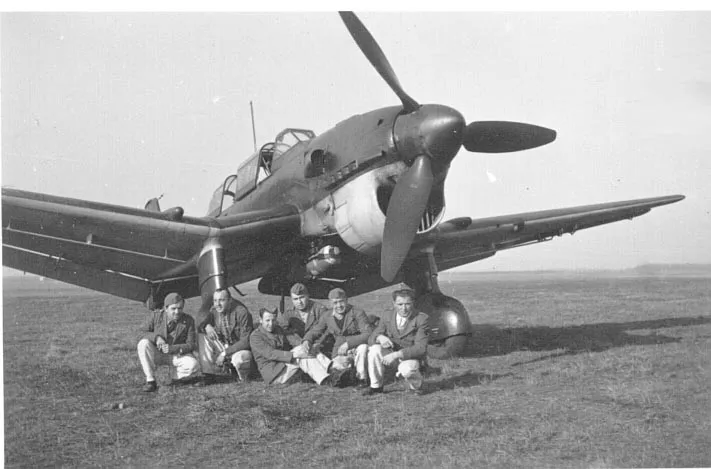
The Junkers Ju 87, known as the Stuka (from the German Sturzkampfflugzeug, dive bomber), was built by Junkers as a dedicated dive bomber for the German Luftwaffe. It first flew on 17 September 19352 and went on to serve throughout the Second World War, attacking ground targets, ships and armoured columns in close support of advancing troops1.
Design and development
The Ju 87 was designed around a near-vertical diving attack, which let its crew aim bombs with far greater accuracy than level bombers of the period could manage. Its most recognisable features were its inverted gull wings and fixed, spatted undercarriage, and on several variants wind-driven sirens mounted on the undercarriage legs produced a screeching noise during the dive, intended to add a psychological, terrorising effect on troops and civilians below1.
The aircraft proved highly effective in the early campaigns of the war, when it operated with air superiority already secured and flew in close coordination with fast-moving ground forces. That dependence on air cover became a weakness once the Luftwaffe lost air superiority: the Ju 87 was slow and only lightly armed for defence, which made it vulnerable to modern fighter aircraft in the later years of the war1.
Specifications
The figures below describe the Ju 87D-1 variant. It was 11.5 m long with a wingspan of 13.8 m, and its maximum take-off weight was 6,600 kg. Power came from one Junkers Jumo 211J V-12 inverted, liquid-cooled piston engine rated at 1,400 hp, giving it a cruise speed of about 319 km/h at 16,700 ft and a maximum range of about 1,535 km. The aircraft carried a crew of two, a pilot and a rear gunner/radio operator1.
Variants
Junkers built about 6,000 Ju 87s between 1936 and 1944 across a series of variants that grew steadily heavier and better armed through the war, from the early Ju 87A and the much-produced Ju 87B to the up-engined Ju 87D used for the specifications above and the dedicated tank-killing Ju 87G, which carried two underwing 37 mm anti-tank cannon in place of bombs1.
Operators and service
The Ju 87 flew for Nazi Germany’s Luftwaffe as its principal dive bomber, and Germany’s wartime allies, including Italy’s Regia Aeronautica, also operated the type. It entered service in 1936 and remained in front-line use until the war ended in 1945, after which surviving examples were retired along with the rest of the Luftwaffe’s wartime fleet1. The type is retired today2, with a small number preserved in museums.
Similar aircraft
- Ilyushin Il-2 Sturmovik: the Soviet Union’s equivalent ground-attack aircraft of the same war, built in far greater numbers for the same close-support role.
- Aichi D3A: Imperial Japan’s carrier-based dive bomber, which filled a comparable tactical role in the Pacific theatre.