Contents
The Sikorsky UH-60 Black Hawk is a twin-engine utility helicopter built by Sikorsky Aircraft, now a Lockheed Martin company. The US Army uses it to move troops, haul cargo and evacuate casualties, and more than 35 countries fly it worldwide as of 20241. Over five decades it has become one of the most widely recognised military helicopters, with derivatives serving at sea, on special operations and as presidential transport.
Design and development
The US Army launched the Utility Tactical Transport Aircraft System (UTTAS) programme in the late 1960s to replace the Bell UH-1 Iroquois. Sikorsky’s design competed against Boeing Vertol’s YUH-61A in a fly-off, and the Army selected the UH-60 in December 1976. The prototype first flew on 17 October 1974, and deliveries of the UH-60A to the Army began in October 1978, with the helicopter entering service in June 19791.
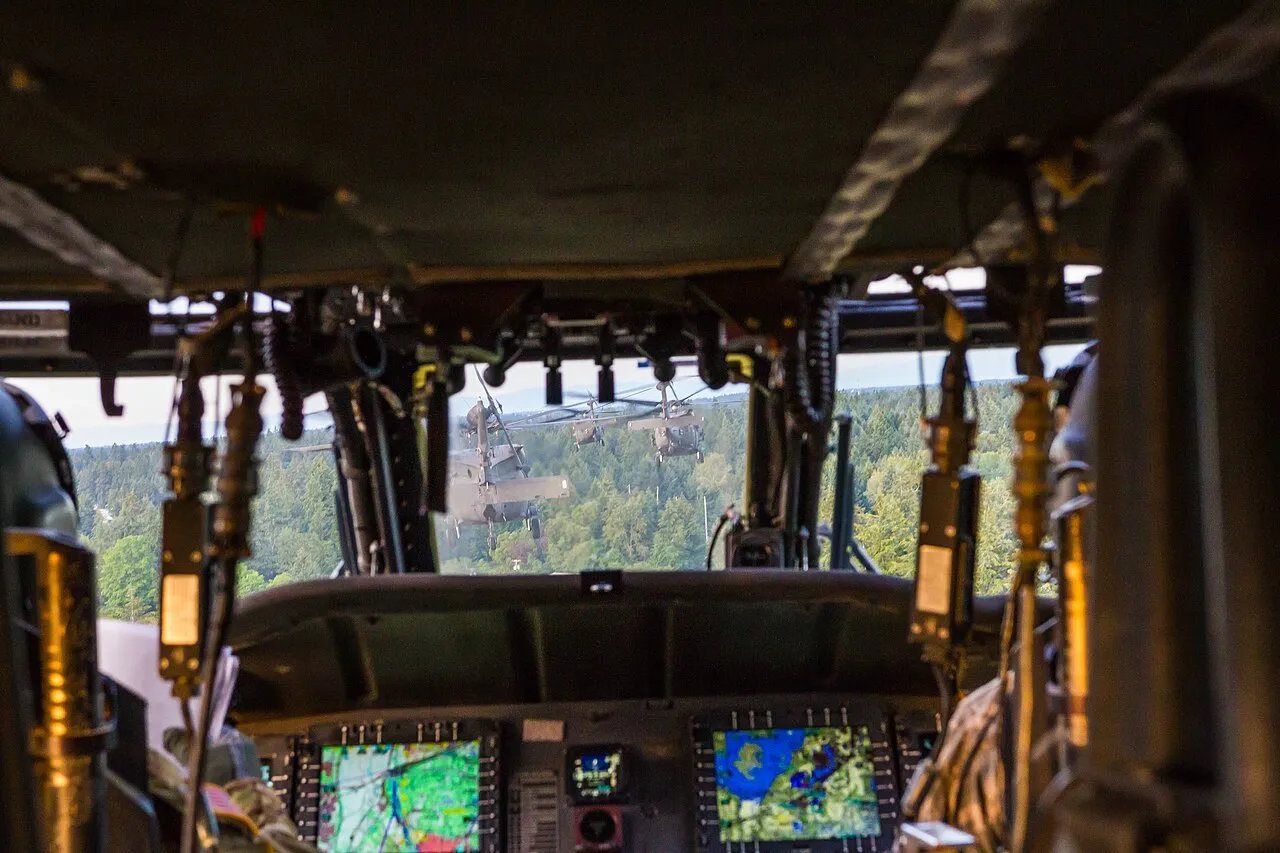
The design broke from older utility helicopters in its layout: it carries two pilots and two crew chiefs or gunners, with the cabin seating up to 11 equipped troops or 6 litters for medical evacuation. Drawing on experience from Vietnam, the UTTAS specification demanded better reliability and survivability, which Sikorsky answered with dual engines, a modular airframe, run-dry gearboxes, redundant ballistically tolerant hydraulic, electrical and flight-control systems, and armoured, crashworthy crew and troop seats. It is powered by two General Electric T700-GE-701C/D turboshaft engines1, and Sikorsky has kept it in production and in continuous development for decades, with more than 5,000 UH-60 Black Hawks delivered by January 20232.
Specifications
The current production version is the UH-60M. It measures 19.76 m long with the rotors turning, and its four-blade main rotor has a diameter of 16.36 m. Lockheed Martin lists the UH-60M’s maximum take-off weight at 22,000 lb (about 9,979 kg)3. Its two T700 turboshaft engines give it a cruise speed of about 282 km/h at maximum-range power settings1.
Combat range is modest for a helicopter of its size: the UH-60M’s combat radius is about 593 km, though fitting external auxiliary fuel tanks extends ferry range to about 2,221 km1 for long self-deployments.
Variants
The baseline UH-60A was followed by the UH-60L and the current UH-60M, each adding more powerful engines and updated avionics. Special operations crews fly the MH-60 series, built with advanced avionics and weapons for covert insertion and strike support, while the US Air Force operates the HH-60 Pave Hawk for combat search and rescue, now being replaced by the newer HH-60W. Other military derivatives include the EH-60 electronic warfare version, the UH-60Q medical evacuation model and the VH-60 series used for presidential and VIP transport1.
The airframe also went to sea: the US Navy and Coast Guard fly the SH-60 Seahawk and MH-60 Jayhawk maritime variants, built for anti-submarine warfare, search and rescue and utility work from ships. Export customers generally receive S-70 variants under numerous international designations1.
Operators and service
The US Army remains the largest operator, and the type has since spread widely: the UH-60 serves with 35 countries as of 2024, including Colombia, Japan, South Korea and Australia among numerous NATO and allied air arms. Lockheed Martin reports that Sikorsky had delivered more than 5,000 UH-60 Black Hawks by January 20232, and the type remains in production and in service more than 45 years after it entered the US Army1.
Safety record
The Black Hawk has flown in every major US combat deployment since its introduction. Two UH-60s were shot down during the 1991 Gulf War, and two more were lost during the 1993 Battle of Mogadishu in Somalia1, an incident that became widely known through the book and film Black Hawk Down.
Similar aircraft
- Mil Mi-8: a Soviet-designed medium utility helicopter that fills the equivalent role for Russian and allied forces, and the world’s most-produced helicopter, with more than 17,000 built for over 50 countries4.
- Bell UH-1 Iroquois: the Vietnam-era utility helicopter the UH-60 was designed to replace under the UTTAS programme.