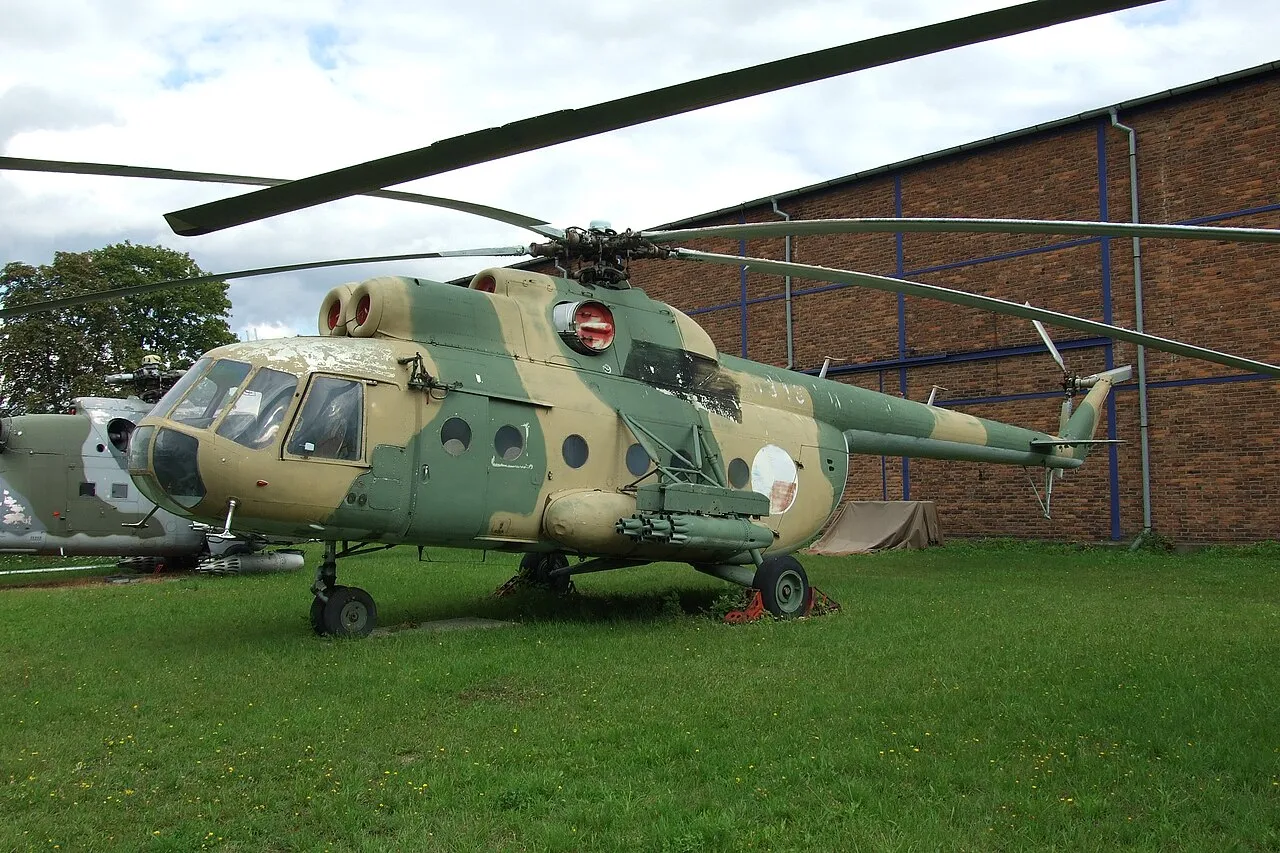
The Mil Mi-8 is a Soviet-designed medium twin-turbine helicopter built by the Mil Moscow Helicopter Plant, with production carried out at the Kazan Helicopter Plant and the Ulan-Ude Aviation Plant. It was designed as a general-purpose transport, able to carry troops, cargo or stretchers, and it has also been built in armed gunship and VIP versions. With more than 17,000 built since 19611, it is the most-produced helicopter in history, and it remains in both production and widespread service today.
Design and development
Mil began development as a single-engine successor to the Mi-4, but switched during design to a twin-turbine layout for better reliability and payload, the configuration that became the Mi-8’s defining feature. Twin turboshafts meant the helicopter could keep flying and land safely if one engine failed, a margin the single piston engine of the Mi-4 could not offer, and the extra power let Mil enlarge the cabin for more troops or cargo. The prototype made its first flight on 7 July 1961. Series production followed at two plants, Kazan and Ulan-Ude, which between them have built the type for more than six decades1. That long production run, spanning the late Soviet period through to today’s Russian state, let the design absorb successive rounds of engine and avionics upgrades without a change of basic airframe, which is why the Mi-8 family still shares its silhouette with the 1961 prototype even as its systems have moved on.
Specifications
The Mi-8’s fuselage is 18.17 metres long2, and its five-blade main rotor spans 21.29 metres in diameter. It is powered by two Klimov TV3-117MT turboshaft engines, giving the Mi-8T variant a maximum take-off weight of 13,000 kg and a cruise speed of about 240 km/h. Standard range on internal fuel is about 495 km, extendable to a ferry range of 960 km with auxiliary tanks. The cabin typically seats 24 passengers or troops, or 12 stretchers in the medevac role, flown by a crew of three: pilot, co-pilot and flight engineer1.
Variants
The baseline Mi-8T is the transport version built in the largest numbers, fitted with the twin Klimov turboshafts and a cargo cabin that converts for troops, freight or stretchers. Armed variants add rocket pods, gun pods and other weapons on external pylons for a gunship or armed-escort role without giving up the transport cabin. Later production shifted to the Mi-17 family (also marketed as the Mi-8MT and Mi-8AMT), which uses uprated engines and a tail rotor moved to the left side of the tail boom for better performance at altitude. VIP and civilian passenger conversions strip the cargo fittings for airline-style seating and cabin furnishings1.
Operators and service
The Mi-8 and its Mi-17 derivatives serve with military, government and civilian operators across the world, from the Russian armed forces to UN peacekeeping missions and oil-and-gas charter fleets. Its size and ruggedness have made it a mainstay of utility and troop-transport duty in the former Soviet states and in countries that bought Soviet or Russian military equipment, and civilian operators have leaned on the same qualities for charter work in places with little ground infrastructure, carrying workers and supplies to remote drilling sites, mines and settlements that have no road access. The type remains in production more than six decades after its first flight1, and is in service today as both a military and civilian workhorse, a longevity few other helicopter designs of its generation have matched.
Similar aircraft
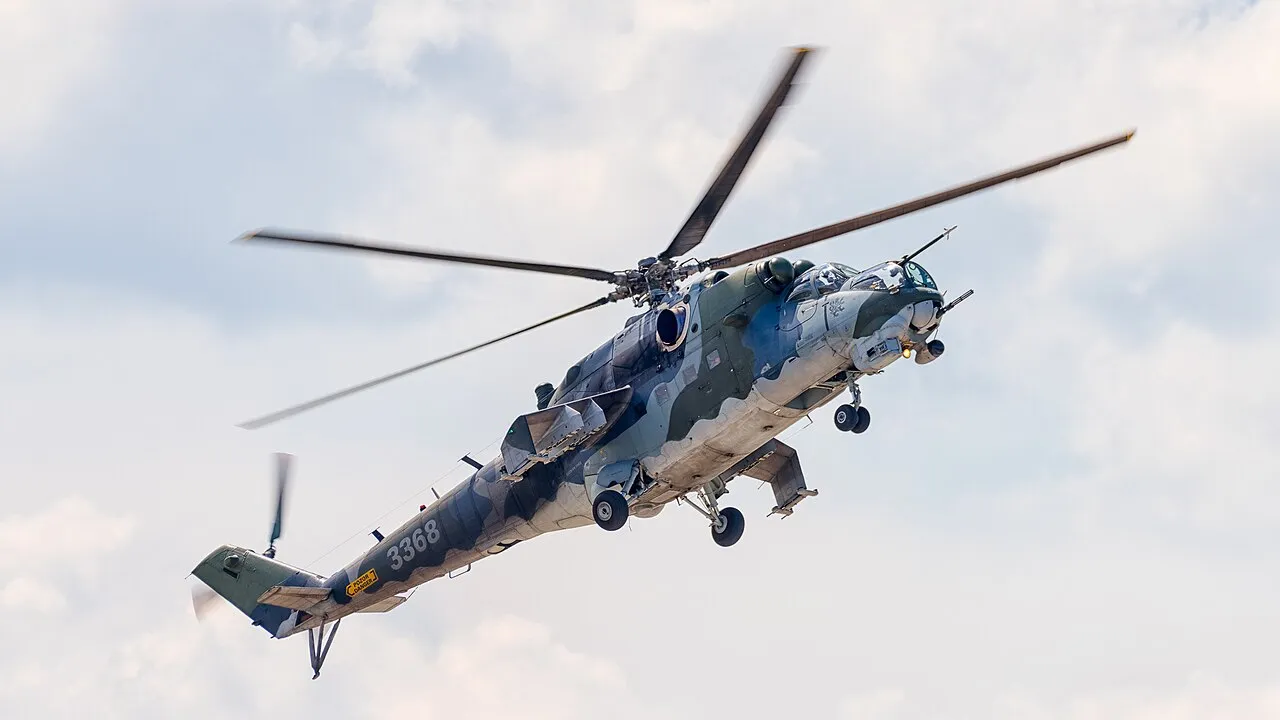
- Mil Mi-24: a Soviet attack helicopter developed from the Mi-8’s dynamic systems, trading cargo capacity for armour and weapons.
- Sikorsky S-61 / CH-3: a Western medium twin-turbine transport helicopter of a similar era and payload class, without a direct linked page on this site.
- Eurocopter AS332 Super Puma: a later Western medium helicopter built for similar troop and offshore transport roles, without a direct linked page on this site.
_(522-03)_Z26QJ04.webp)