Contents
The Supermarine Spitfire is a British single-seat fighter built by Supermarine, a subsidiary of Vickers-Armstrong. The Royal Air Force flew it as an interceptor, built to climb fast and fight at high altitude against incoming bombers and their escorts. It became the only British fighter in continuous production throughout the war1.
Design and development
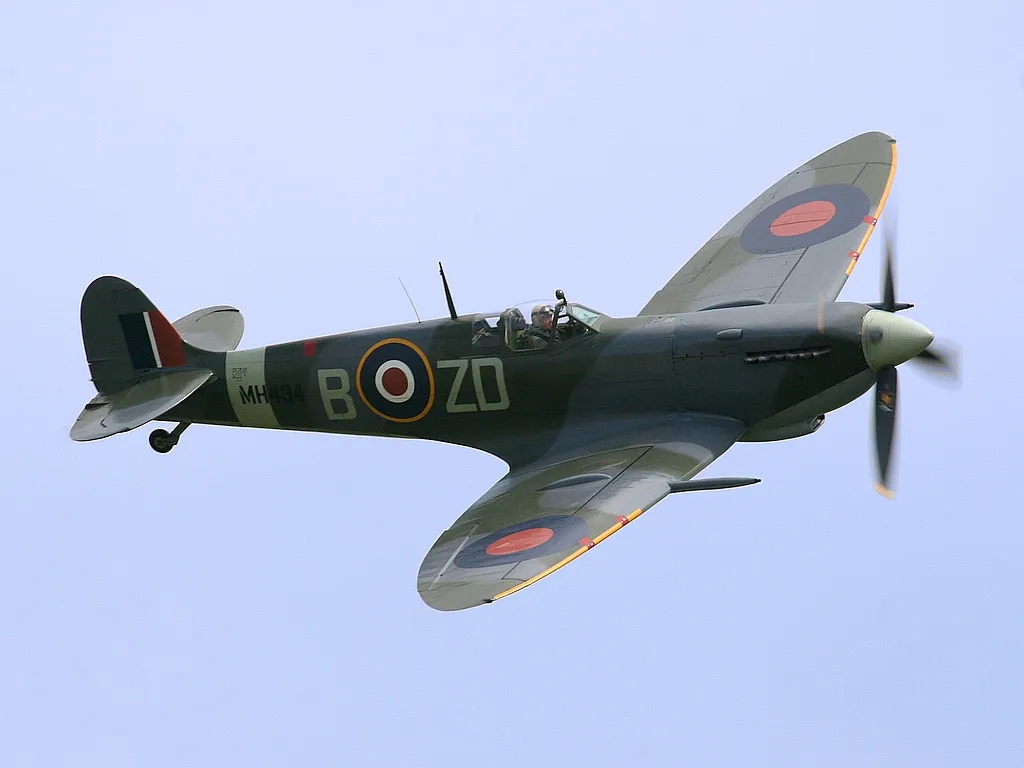
The Spitfire was designed by R. J. Mitchell as a short-range, high-performance interceptor, drawing on his earlier work on Schneider Trophy racing seaplanes. Its distinctive elliptical wing gave it a thin cross-section for speed while still housing retractable undercarriage and armament, a shape that also made it instantly recognisable. The prototype first flew on 5 March 19361, and the Air Ministry ordered the type into production soon after.
Mitchell died in 1937, before the Spitfire reached squadron service, and Joseph Smith took over as chief designer, overseeing the aircraft’s development through the war1. Smith’s team kept adapting the airframe to more powerful engines and new roles, which is why the Spitfire changed so much in shape and performance between its early and late marks while keeping its basic layout.
Specifications
The figures below describe the Spitfire Mk Vb, one of the most-produced early variants; later marks differed, sometimes significantly, as the design evolved. The Mk Vb was 9.12 m long with an 11.23 m wingspan and a maximum take-off weight of 3,039 kg, figures that made it compact and light next to most contemporary fighters. It carried a single pilot and had a range of about 771 km on internal fuel — a shorter combat range of roughly 399 km once manoeuvring and fighting are accounted for — extendable to about 1,770 km as a ferry range with a drop tank1.
Power came from the Rolls-Royce Merlin V-12 liquid-cooled piston engine in early and mid-war marks, with later marks switching to the larger Rolls-Royce Griffon1. That engine change, more than any airframe revision, explains the jump in performance between early- and late-war Spitfires: Griffon-engined marks flew faster and higher than the Merlin originals could manage.
Variants
Supermarine built the Spitfire in a long run of marks as engines, armament and roles changed through the war, from the Merlin-powered early marks used in the Battle of Britain to the later Griffon-engined marks developed for high-altitude interception and ground attack. By the end of production, more than 20,351 Spitfires had been built, with manufacturing ending in 19481 — a run long enough to span from biplane-era thinking to the edge of the jet age.
Operators and service
The Spitfire served first and foremost with the Royal Air Force1, where it became the aircraft most associated with victory in the Battle of Britain, flying alongside the Hawker Hurricane against the Luftwaffe. Allied and Commonwealth air forces flew it as well, and production and service continued across the war’s major theatres as new marks reached squadrons.
Military use ended long ago: the type is retired from military service. It has not disappeared from the skies, though — around 60 Spitfires remain airworthy today with private owners and historic flight operations1, making it one of the most common warbirds seen at air shows.
Safety record
Wartime loss figures for a combat type spread across many air forces and theatres are not tracked as a single safety record the way a modern airliner’s are, and no consolidated figure of that kind appears in the sourced history of the type.
Similar aircraft
- Messerschmitt Bf 109: the Luftwaffe’s equivalent single-seat fighter and the Spitfire’s main adversary over Britain.
- Hawker Hurricane: the other RAF fighter that bore the brunt of the Battle of Britain alongside the Spitfire.
- North American P-51 Mustang: a later Allied fighter that, in its definitive form, was also built around a Rolls-Royce Merlin engine.