Contents
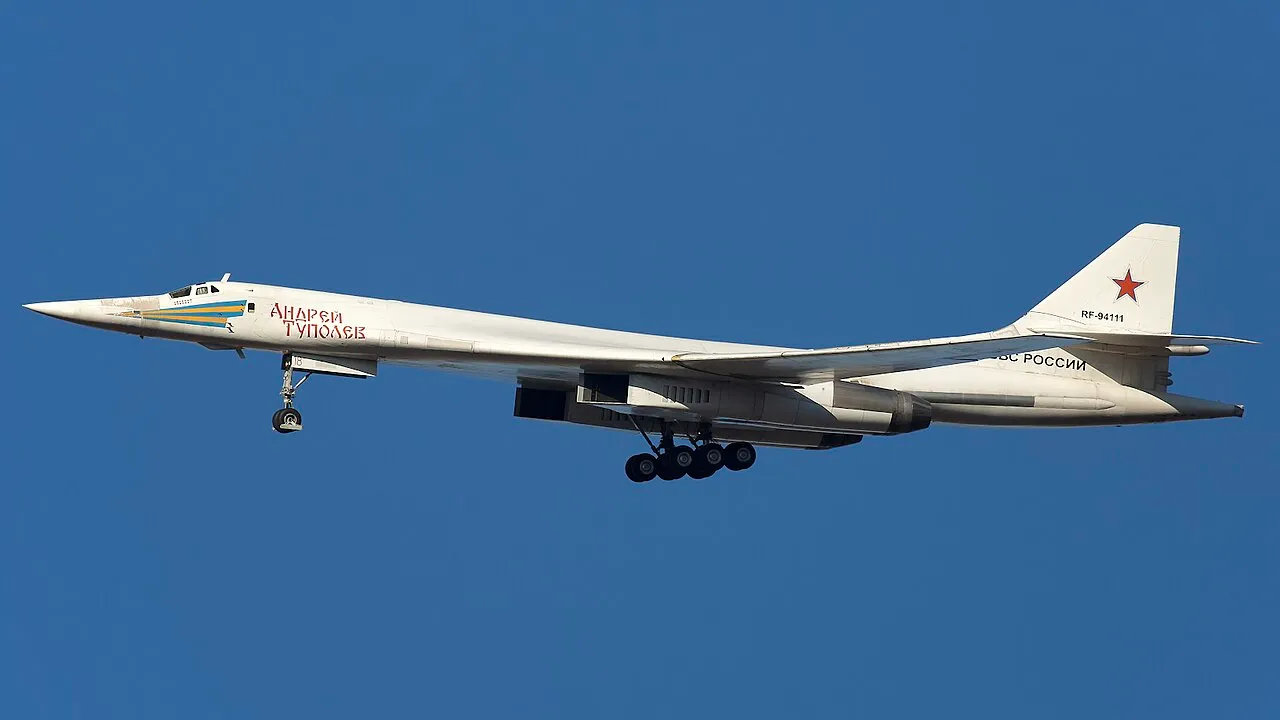
The Tupolev Tu-160, NATO reporting name Blackjack, is the heaviest combat aircraft ever built and the fastest bomber in operational service. Tupolev designed it, and the Kazan Aircraft Production Association builds it1, as a variable-geometry, supersonic-capable strategic bomber for long-range nuclear and conventional strike missions. It remains in front-line service with Russia’s Aerospace Forces, flying cruise-missile strikes as recently as the war in Ukraine.
Design and development
The Soviet Union launched a competition in 1972 for a variable-geometry supersonic strategic bomber able to reach Mach 2.3, prompted in part by the American B-1 bomber programme. Tupolev’s design, then known as Aircraft 160M, won against rival proposals from the Myasishchev and Sukhoi design bureaus. The first prototype flew on 18 December 1981, and the type entered service in April 1987 with the 184th Guards Heavy Bomber Regiment at Pryluky in the Ukrainian SSR. Its swing wings let it combine low-speed handling for takeoff and low-level flight with a supersonic dash at altitude, and it carries the most powerful engines ever fitted to a combat aircraft. During 1989 and 1990 Tu-160 crews set 44 world speed and payload records in their weight class1.
Specifications
The Tu-160 is 54.1 m long, longer than the Boeing B-52 Stratofortress, with a wingspan that varies from 35.6 m fully swept to 55.7 m spread for takeoff and landing. Its maximum take-off weight is 275,000 kg, and it can carry up to 45,000 kg of ordnance. Four Kuznetsov NK-32 afterburning turbofans give it a top speed of Mach 2.05, about 2,220 km/h at 12,200 m, though it cruises at around 960 km/h. Ferry range without refuelling is about 12,300 km; its combat radius is far shorter, around 2,000 km at Mach 1.5 or 7,300 km flying subsonic. A crew of four flies it: pilot, co-pilot, bombardier and defensive systems officer. Production ran from 1984 to 1992, when 35 aircraft had been completed, and resumed in 2002, 2008, 2017 and again from 2021; in total 41 have been built, nine of them prototypes or test aircraft1.
Variants
The original production version gave way to the Tu-160M, an upgrade with new weaponry, electronics and avionics first delivered in December 2014. A further revision, the Tu-160M2, adds a glass cockpit, more powerful engines and new defensive systems, and first flew on 25 January 20181.
Operators and service
Ukraine inherited 19 Tu-160s when the Soviet Union broke up; it transferred eight to Russia in 1999 to offset gas debt and scrapped the rest under the Nunn-Lugar disarmament programme, with one surviving aircraft now displayed at the Poltava Museum. Russia’s Aerospace Forces now fly the type from Engels-2 air base in Saratov Oblast with the 121st Guards Heavy Bomber Aviation Regiment, with 18 Tu-160/M aircraft in the active fleet, five more in repair or modernisation and two further Tu-160M airframes under construction. The type first saw combat on 17 November 2015, launching Kh-101 cruise missiles during Russia’s intervention in the Syrian Civil War, and has flown long-range deployments to Venezuela in September 2008 and December 2018 and to South Africa in October 2019. It has flown cruise-missile strikes in Russia’s invasion of Ukraine since March 20221.
Safety record
The Tu-160 “Mikhail Gromov” crashed on 18 September 2003 during a test flight after an engine replacement1.
Similar aircraft
- Tupolev Tu-95: Tupolev’s earlier, turboprop-powered strategic bomber, which the Tu-160 has largely taken over long-range missions alongside in Russian service.
- Rockwell B-1 Lancer: the American variable-geometry supersonic bomber whose development spurred the Tu-160 programme.