Contents
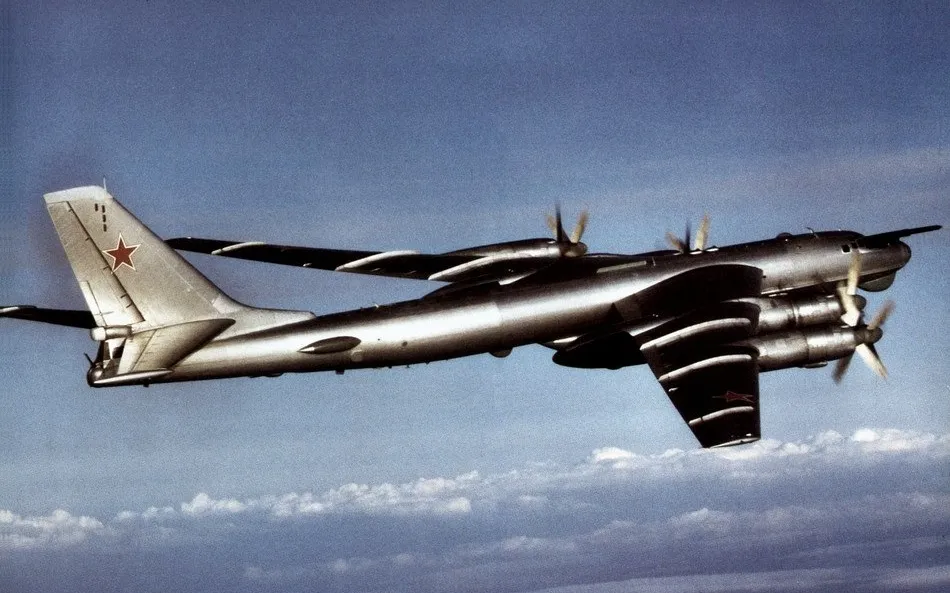
The Tupolev Tu-95, NATO reporting name Bear, is the only turboprop-powered strategic bomber still in operational use, and the only propeller-driven aircraft with swept wings built in large numbers. Tupolev built it for the Soviet Air Forces as a long-range, nuclear-capable bomber, and four Kuznetsov NK-12 turboprops2 drive its contra-rotating propellers, whose blade tips travel at supersonic speed and make the aircraft one of the loudest military aircraft ever built1. The type remains in front-line service with the Russian Aerospace Forces as a carrier of cruise missiles.
Design and development
In 1950 the Soviet government issued a requirement for an intercontinental bomber able to fly 8,000 km without refuelling while carrying an 11,000 kg payload. Andrei Tupolev’s design bureau chose turboprop engines over the jets of the day, judging them the only way to meet the range requirement while still flying faster than a piston-engined bomber; the resulting swept wing, built for a propeller aircraft, is one of the type’s defining features. The project received government approval on 11 July 1951, and the first prototype made its maiden flight on 12 November 19522, flown by Alexey Perelet. That prototype crashed six months later after a propeller gearbox failure; a second prototype switched to the more reliable Kuznetsov NK-12 engines that the production aircraft kept, and series production began in January 1956. The combination of swept wings and the NK-12’s contra-rotating propellers, whose tips spin faster than the speed of sound, has kept the Tu-95 the only turboprop-powered strategic bomber still flying1 more than seventy years after it was designed.
Specifications
At 46.2 m long with a 50.1 m wingspan, the production aircraft has a maximum take-off weight of 188,000 kg. It is powered by four Kuznetsov NK-12 turboprops driving contra-rotating propellers, giving it a cruise speed of about 710 km/h, fast for a propeller-driven aircraft. Its ferry range is about 15,000 km, and a typical crew numbers six to seven. More than 500 were built between 1952 and 19932, and the type remains in service1 today.
Variants
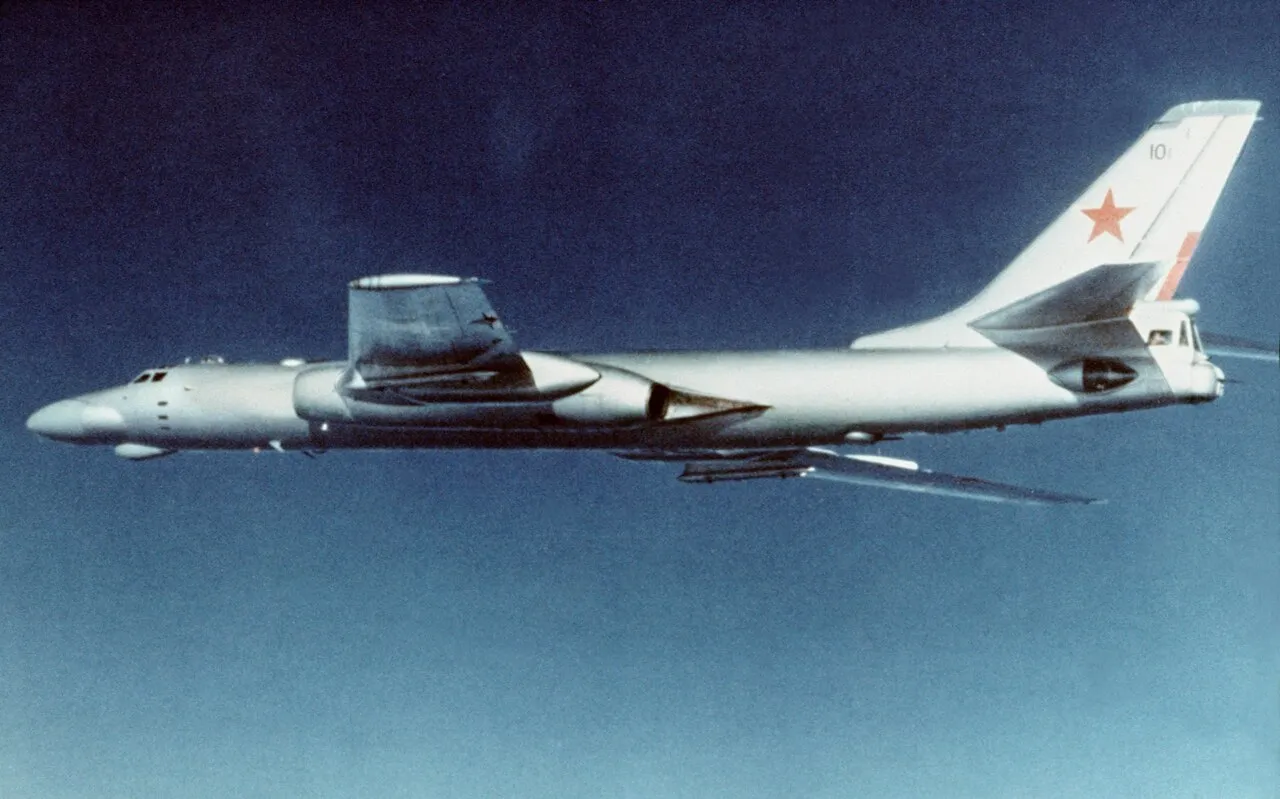
The current frontline version, the Tu-95MS, entered serial production in 1981 as a dedicated cruise-missile carrier able to carry up to 16 Kh-55 missiles, or the newer Kh-101 and Kh-102 stealth cruise missiles. An upgrade introduced in 2020, the Tu-95MSM, adds Kuznetsov NK-12MPM engines and new radar. The airframe also spawned the Tu-142 maritime patrol and anti-submarine aircraft, the civilian Tu-114 airliner, the experimental nuclear-powered Tu-95LAL research aircraft, and the Tu-116, a pair of Tu-95s converted to carry passengers1.
Operators and service
Soviet Air Forces and Navy units operated the Tu-95 from 1956. After the Soviet Union broke up, Ukraine inherited between 23 and 29 Tu-95s but scrapped most of them by 2001 under the US-funded Nunn-Lugar programme. Russia’s Aerospace Forces now operate the Tu-95MS as the sole active variant, from Engels-2, Olenya, Dyagilevo and Ukrainka air bases; Olenya took on aircraft relocated from Engels after Ukrainian attacks. The fleet was put at 55 Tu-95MS in service as of 2020, but that number has fallen: only 36 were estimated to remain airworthy as of September 2026. The Tu-95 first saw combat in November 20151, during Russia’s intervention in Syria, and has flown repeated cruise-missile strikes in Russia’s invasion of Ukraine since 2022.
Safety record
Both accidents and attacks have cost the Tu-95 over its service life: a 1971 crash near Vologda killed all 11 occupants, and the type has had further accidents since, including a 2015 engine fire at Ukrainka air base and a 2015 crash near Khabarovsk. More recently, Ukrainian drone strikes destroyed a Tu-95 at Engels-2 air base on 17 July 2026 and a second aircraft there on 28 August 2026, and a Tu-95MS crashed near Krasnoyarovo on 29 September 2026, killing six of its seven crew1.
Similar aircraft
- Boeing B-52 Stratofortress: the American long-range bomber of the same Cold War generation, though jet- rather than turboprop-powered.
- Tupolev Tu-160: Tupolev’s later, supersonic strategic bomber, which has largely taken over long-range missions alongside the Tu-95 in Russian service.
_Special_Flight_Squadron_Rossiya_(Russian_Government)_VKO_UUWW_(32966735944)_ZM3Jey.webp)