Contents
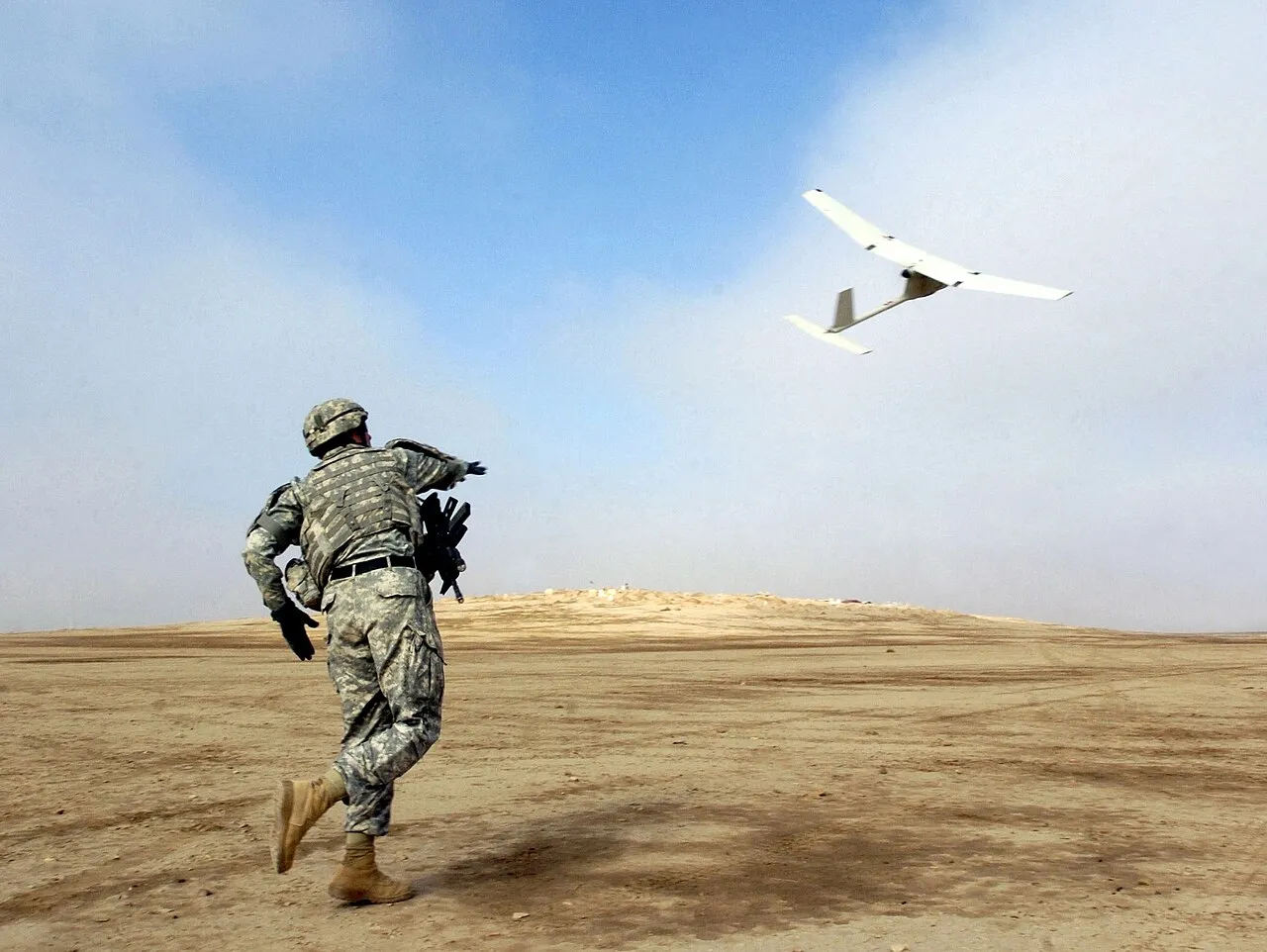
The AeroVironment RQ-11 Raven is a small hand-launched remote-controlled unmanned aerial vehicle developed for the United States military and later adopted by the armed forces of many other countries. AeroVironment describes the Raven B as a lightweight Group 1 hand-launchable uncrewed aircraft system2 that gives ground units and small teams immediate tactical intelligence, surveillance and reconnaissance. The US Army deploys the Raven at company level. As of early 2012, over 19,000 airframes1 had been shipped.
Design and development
The Raven was originally introduced as the FQM-151 in 1999 and developed into its current form in 2002. In general appearance it resembles an enlarged FAI class F1C free flight model aircraft, and it is powered by a pusher electric motor. The RQ-11B won the US Army’s small UAV programme in 2005 and went into full-rate production in 20061. Shortly afterwards the US Marines and the US Air Force adopted it as well.
The Raven is launched by hand, with no runway or catapult2, which AeroVironment says allows rapid deployment by small teams with minimal training. The War Zone notes that troops on the ground control the aircraft and watch its feed using hand-held controls3. It can be flown remotely from the ground station or fly completely autonomous missions using GPS waypoint navigation1, and a single command button orders it to return to its launch point.
To land, the RQ-11B flies itself to a pre-defined landing point and then performs a controlled “Autoland” descent at a 45° slope1. AeroVironment describes the Raven B’s recovery as a deep stall descent2 that needs no specialised gear, so operators can retrieve it in confined or uneven terrain.
Specifications
AeroVironment’s Raven B is battery-powered. The manufacturer lists the Raven B at an aircraft weight of 2.2 kg (4.8 lb) and an operational range of 10 km. AeroVironment also states up to around 90 minutes2 of flight time on a single battery.
The RQ-11B weighs about 1.9 kg (4.2 lb), with 60–90 minutes’ flight endurance1 and an effective operational radius of approximately 10 km. The War Zone gave its weight as just over 4 pounds3.
The Raven flies at altitudes of 100–500 m above ground level, and over 4,200 m above mean sea level, at flying speeds of 32–81 km/h1.
Sensors and weapons
AeroVironment’s Raven B carries a stabilised electro-optical/infrared payload2 that delivers real-time imagery and geolocation data by day and night. On the RQ-11B, The War Zone described either a colour daytime video camera or an infrared night-vision camera3.
In August 20151 selected units began receiving the Raven Gimbal, a rotating camera with a 360-degree gimbal. It replaced the fixed camera, which required the aircraft to be manoeuvred to observe, and it can be switched between day and night settings without landing and swapping sensors.
In mid-20151 the US Marine Corps tested Harris Corporation’s Small Secure Data Link, a radio that fits onto the Raven’s nose to give Marines beyond line-of-sight communications down to squad level.
Operators and combat use
In the US the Raven has been used by the Army, Air Force, Marine Corps and Special Operations Command1. Foreign customers include Australia, Estonia, Italy, Denmark, Spain and the Czech Republic. British forces in Iraq also used Raven equipment.
The Royal Danish Army acquired 12 Raven systems in September 2007. The Netherlands Ministry of Defence acquired 72 operational RQ-11B systems, with a total value of $23.74 million, for its Army reconnaissance units, its Marine Corps and its special forces. In April 2011 the US announced that it would supply 85 Raven B systems to the Pakistan Army. In June 2011 the US announced aid that included four Raven systems for forces from Uganda and Burundi serving in the African Union peacekeeping mission in Somalia. Iran has claimed it captured two RQ-11s1, in 2011 and 2012.
The US government delivered 24 RQ-11B systems4, a package of 72 individual Ravens, to Ukraine as part of the European Reassurance Initiative, according to a statement from the US Embassy. The War Zone dates that delivery to July 2016. In December 2016, Reuters reported that the Ravens were under-performing in Ukraine. Ukraine’s Air Force Command told Reuters that the system was analog, so its command channels and data were not protected from interception and suppression by electronic warfare. An unnamed Ukrainian official told Reuters that troops were no longer using the RQ-11s on the front lines. In March 2017, members of the Oklahoma National Guard were still training Ukrainian troops to fly the RQ-11B at the Yavoriv Combat Training Center3.
In January 20231 the US Marine Corps revealed that it had retired the RQ-11B Raven. Seapower reported that the Corps retired its fixed-wing RQ-11B Raven and RQ-12A Wasp IV5 in favour of vertical take-off and landing drones that are easier to launch and recover.
Variants
- FQM-151 Pointer: the type the Raven was developed from1.
- CU-173 Raven B: the version for the Canadian Armed Forces1.
- Solar Raven: in November 20121 the Air Force Research Laboratory added flexible solar panels to the wing sections, increasing endurance by 60%.
Similar drones
- FLIR R80 SkyRaider: one of the vertical take-off and landing drones replacing the Raven in the Marine Corps, which Seapower says can provide a hover-and-stare surveillance capability5.
- Skydio X2D: another vertical take-off and landing drone replacing the Raven, procured by the Marine Corps as its squad/platoon electro-optical/infrared/full motion video sensor5.
- Teledyne FLIR Black Hornet: listed by Seapower among the Marine Corps’ vertical take-off and landing small drones5, unlike the fixed-wing Raven.