Contents
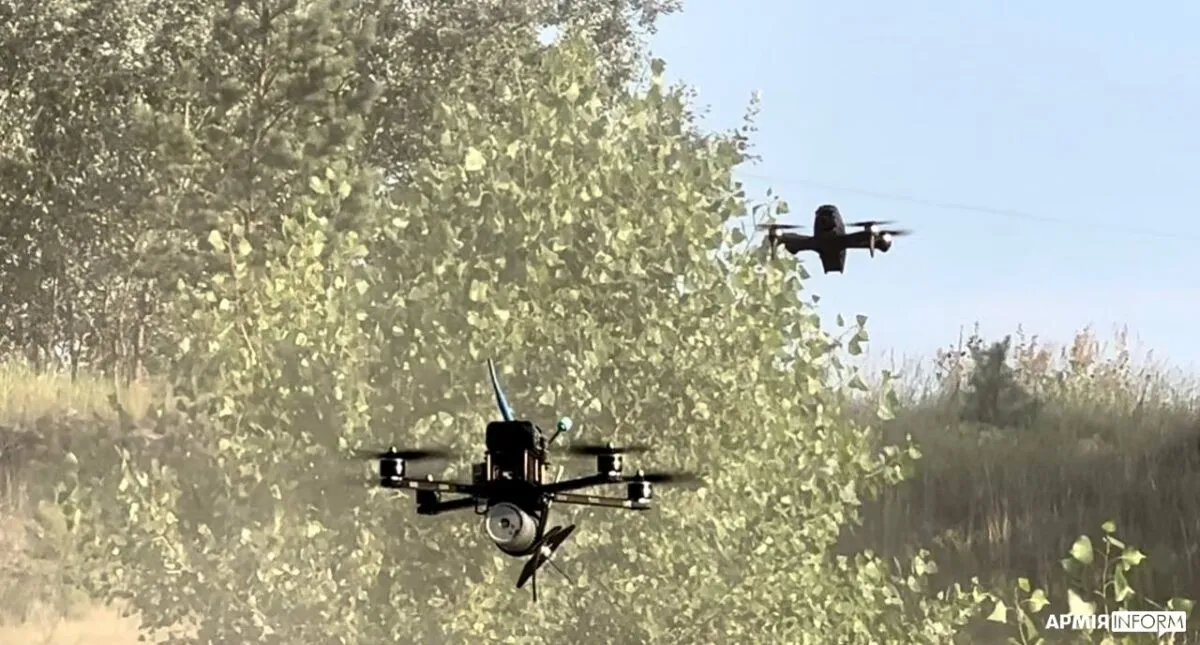
An FPV attack drone is a small multirotor drone that a pilot steers through the live picture from an onboard camera and then flies into its target, a one-way weapon often called a kamikaze drone. First-person view is a method of controlling a remote-controlled vehicle from the pilot’s viewpoint, most commonly a radio-controlled aircraft or another unmanned aerial vehicle. In the Russo-Ukrainian war it has been used by both sides1. There is no single type or maker: Ukraine’s defence ministry says Ukrainian companies produced over 1.5 million2 in 2024, and Russia started its own mass production in the second half of 20233. The UN monitoring mission in Ukraine found in 2025 that FPV drones were the type behind most short-range drone attacks that harmed civilians4.
Design and development
The weapon comes from civilian hobby drone racing5, whose motors and frames are made to survive fast races and repeated crashes. Writing in October 2023, Militarnyi described the wartime versions as high-speed quadcopters controlled by a special headset, and noted that Ukrainian volunteer groups and private makers initially used components bought mainly in China. Ukrainian forces used them almost from the start of the full-scale invasion3; use was mostly Ukrainian at first and later Russian too1.
Ukraine’s defence ministry said in July 2023 that since February 2022 it had approved 28 drone models from Ukrainian makers, six of them FPV types. Yaroslav Oliynyk, an adviser to Ukraine’s Minister of Strategic Industries, said in August 2023 that three state-owned companies had already begun3 producing FPV drones.
The design kept changing. RUSI researchers reported in February 2025 that FPVs had gained autonomous terminal guidance and wire spools, which make them immune to electronic disruption, and that Russian forces used the cable-guided kind more widely than Ukrainian forces6.
Specifications
In a 2025 bulletin the UN Human Rights Monitoring Mission, noting many types and configurations, put their operating range at about 30 km from the operator, limited by signal reach and a battery life of around 60 minutes, and said they can fly faster than 100 km/h7. Militarnyi wrote in 2023 that they could hit targets up to 10 km away, possibly more. One Ukrainian model, the KH-S7, normally carries 1 kg over 7 km3, and its developers said troops had used it at 9.5 km.
Cable-guided versions give up range. Ukrainian operators told RUSI that the wired link limits them to approximately 10 km6 and degrades flight performance, while fibre-optic drones usually carry cables between 5 and 20 km long8.
Low cost is their main appeal. Two executives of RSI Europe, a company that sells FPV drones, wrote in 2024 that a single unit sometimes costs under five hundred US dollars5. Militarnyi cited drones worth up to $1,0003 that can destroy armoured vehicles costing several million. Fibre-optic models cost $300 to $400 to build8, according to The Guardian.
Sensors and weapons
The main sensor is a forward-facing camera whose image goes to the pilot’s goggles or a monitor1. The UN mission noted in 2025 that most short-range drones carry high-resolution cameras, some have infrared cameras, and a few follow pre-programmed GPS routes with no camera at all; most of these drones carry small quantities of explosives7, such as mortar shells, grenades, anti-personnel landmines or improvised devices, and either drop them or dive into the target and detonate. Militarnyi reported in 2023 that Ukrainian forces had begun using airburst warheads3, both high-explosive and fragmentation.
Operators and combat use
In 2023 Militarnyi listed Ukrainian operators including the National Guard, the Security Service and Special Operations Forces3. Ukraine’s defence ministry said in March 2025 that domestic industry could make about 4.5 million FPV drones9 that year and that it planned to buy them all. On the Russian side, Vladimir Putin said in September 2024 that Russia wanted to produce 1.4 million drones10 that year; he said the army had received about 140,000 drones of different types in 2023.
RUSI’s February 2025 field study, based on interviews with Ukrainian officers, found that between 60 and 80% of Ukrainian FPVs fail to reach their target, yet tactical drones accounted for 60–70% of damaged and destroyed Russian systems, a share the authors tied partly to Ukraine’s lack of artillery6, while the officers stressed that drones alone were not enough without it.
The drones have also hit civilians. The UN mission reported in June 2025 that short-range drones killed at least 395 civilians and injured 2,63511 between February 2022 and April 2025, 89% of the casualties in Ukrainian-controlled territory in attacks by Russian forces; it said that in some instances operators appear to have attacked civilians intentionally, which would amount to war crimes.
Ukraine’s General Staff said in its report of 8 November 2026 that Russian forces had used 7,557 kamikaze drones12 on 7 November; that is Ukraine’s count, and it does not separate FPV drones from other types.
Outside Ukraine, Hezbollah has been reported using fibre-optic FPV drones8 against Israeli forces during the 2026 Lebanon war, and the Israel Defense Forces said in May 2026 that Hamas was operating similar drones in Gaza.
Variants
The original radio-controlled form depends on a radio link, and the RSI Europe authors called jamming its “Achilles’ heel”5 in 2024. Fibre-optic FPVs are guided through a thin cable that unspools in flight, which makes them impossible to jam; Russia fielded them first, in spring 2024, and Ukraine soon after. In October 2025 Russian fibre-optic drones struck parts of Kramatorsk more than 19 km behind the front8. One named Russian type is the KVN from the Ushkuynik centre13.
Other named models include the Ukrainian KH-S7 and the Russian Boomerang, an FPV captured in March 2023 that was built with foreign-made components3.
Similar drones
- HESA Shahed 136: a one-way attack drone with a cropped delta wing14 and a nose warhead estimated at 30–50 kg.
- ZALA Lancet: a Russian loitering munition from ZALA Aero Group, part of Kalashnikov Concern15, first shown in June 2019.
- AeroVironment Switchblade 300: a backpack-sized, tube-launched loitering munition16; the United States sent more than 700 to Ukraine.