Contents
The HESA Shahed 136 is an Iranian-designed one-way attack drone, also called a kamikaze or suicide drone. It is designed and manufactured by HESA with Shahed Aviation Industries, and Russia uses it under the name Geran-2. In November 2022 Russia and Iran agreed1 on Russian manufacture of the munition, with Iran exporting key components, at a plant in the Alabuga Special Economic Zone in Tatarstan. An infographic compiled from US Army, UK Ministry of Defence and AFP material2 describes it as an Iranian-made suicide drone that Russia imported for its invasion of Ukraine. Long War Journal noted in October 2022 that, in sufficient numbers, it can overwhelm Ukrainian air defenses3.
Design and development
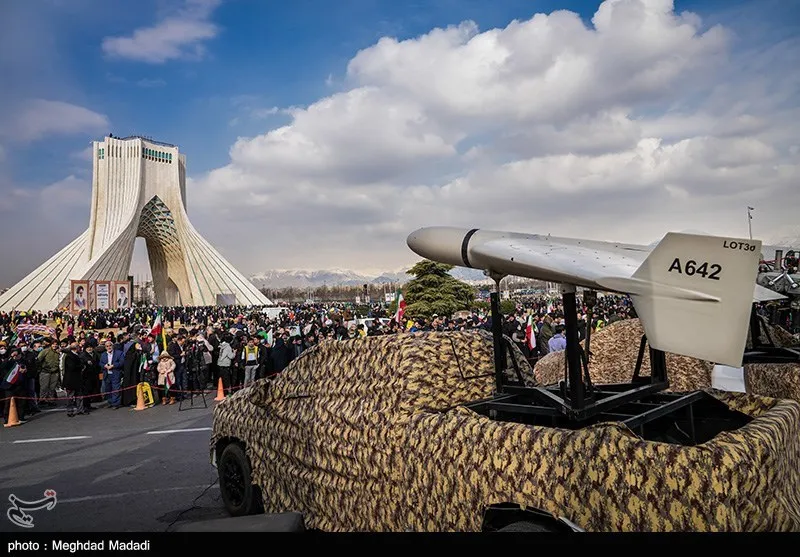
According to the CSIS Missile Defense Project, Shahed Aviation Industries Group copied Israel’s Harpy anti-radiation drone and added satellite navigation to produce the Shahed-131; a more powerful engine and a larger frame then gave the longer-range Shahed-136. The first public footage of the drone1 was released in December 2021, and CSIS says Iran officially unveiled it in 20214 in the Great Prophet 17 exercises. The Russians reportedly began testing it in Ukraine in August 20223, and visual evidence of its use there first surfaced in mid-September.
The airframe has a cropped delta-wing shape with vertical rudders at the wingtips. An MD-550 piston engine, reverse engineered from the Limbach L550E, drives a two-bladed pusher propeller. The drone navigates by a commercial-grade inertial guidance system1 corrected by civilian GPS and GLONASS. Long War Journal reported in 2022 that it communicates with the ground control station via radio3 and can likely receive in-flight targeting updates.
Long War Journal described the drone as costing thousands rather than hundreds of thousands or millions of dollars per munition, far cheaper and therefore more numerous3, and said Russia was using it to compensate for its dwindling supply of cruise missiles.
Specifications
The Shahed 136 is 3.5 metres long with a 2.5-metre wingspan1, weighs about 200 kg and flies at over 185 km/h. CSIS gives slightly wider ranges, a length of about 3.3 to 3.5 metres, a wingspan of 2.5 to 3 metres, and notes that exact dimensions likely vary with design modifications. The Shahed-136 is larger, with greater range and heavier payloads4 than the Shahed-131.
Range estimates differ widely. Long War Journal noted that claims go as high as 2,500 km and as low as several hundred kilometres, while a spokesman for Ukraine’s Air Force Command3 claimed 1,000 km. CSIS reports that the US Defense Intelligence Agency estimates a range of 2,500 km4.
Iran sold Shahed-136s to Russia in 2022 at a unit price of $193,000, according to leaked Iranian documents, while estimates of the domestic production cost range from $10,000 to $50,0001. Analysts cited by CSIS put a Shahed at about $20,000 to $50,0004.
The drone is launched on rails at a slight upward angle1 with a rocket booster that is jettisoned after launch. CSIS describes a tilting truck-mounted container holding several drones4 used in the Great Prophet 17 exercises.
Sensors and weapons
The drone’s warhead is listed at 50 kg, with a 90 kg option in Russia after 2024. Long War Journal reported in 2022 that the Shahed-136 appears to lack a camera3 and that the remains of downed examples offered no proof of an infrared sensor. Its guidance is listed as GNSS and INS with potential automatic target recognition. In June 2025, Ukrainian military intelligence was reported to have examined a new type of Geran-2 with an infrared camera and an Nvidia Jetson-based computer1.
Operators and combat use
As of 2026, CSIS lists the drone as possessed by Iran and Russia, and reports that the Islamic Revolutionary Guard Corps has used Shahed-131 and -136 drones in Yemen, Iraq and Syria since 2021. By early 2024, according to CSIS, the Houthis employed Shahed-136 drones4 against commercial vessels in the Red Sea, calling it the Waid-2.
In Ukraine, CSIS reported in 2026 that Russia has used the drones in structured attacks on Ukrainian air defenses and its energy grid4. Reports from the Ukrainian military cited by Long War Journal said Russia had expended well over 100 and had around 300 left as of 14 October 2022, and President Volodymyr Zelenskyy claimed Moscow hoped to buy 2,400 more. In 2022 Ukrainian forces had some success downing them with surface-to-air missiles and small-arms fire3, according to Long War Journal.
CSIS also reported in 2026 that Iran has used Shahed-131 and -136 drones against Israel, Persian Gulf states and US bases4 in its Operation True Promise attacks.
Variants
In Russia the type is labelled Geran-24, and CSIS reports that by 2023 Russia and Iran had begun setting up Shahed production lines in the Alabuga Special Economic Zone. The Geran-2 has labeling and paint matching Russian munitions, some painted black for night operations, and a version with a heavier 90 kg warhead was reported in May 2024. One Russian upgrade is a scout Geran-2 for electromagnetic spectrum surveys1 to help plan routes for follow-on munitions.
Similar drones
- Shahed-131: the smaller type from which the Shahed-136 was enlarged, with a length of approximately 2.6 metres and a range of 700 to 1,000 km4.
- General Atomics MQ-9 Reaper: a remotely piloted aircraft with an endurance of over 27 hours, offering long-endurance, persistent surveillance and strike5.