Contents
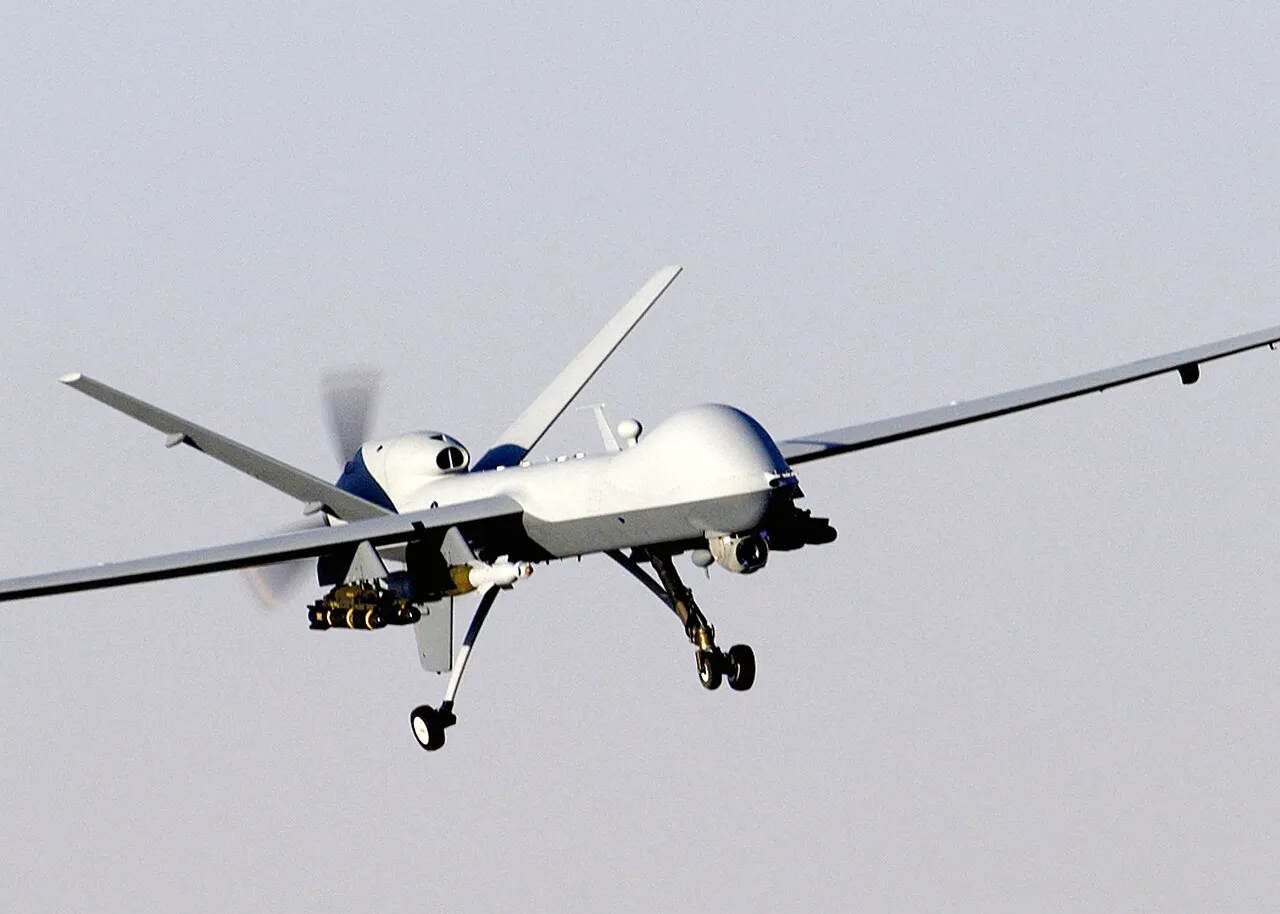
The General Atomics MQ-9 Reaper is an American medium-altitude long-endurance unmanned aerial vehicle, developed by General Atomics Aeronautical Systems (GA-ASI) primarily for the United States Air Force. GA-ASI describes it as a turboprop-powered, multi-mission remotely piloted aircraft that gives long-endurance, persistent surveillance and strike capability. Nobody flies on board: a military flight crew includes a pilot, sensor operator and mission intelligence coordinator1. The US and Royal Air Force named it “Reaper”, which GA-ASI calls the widely used name for any armed Predator B2.
Design and development
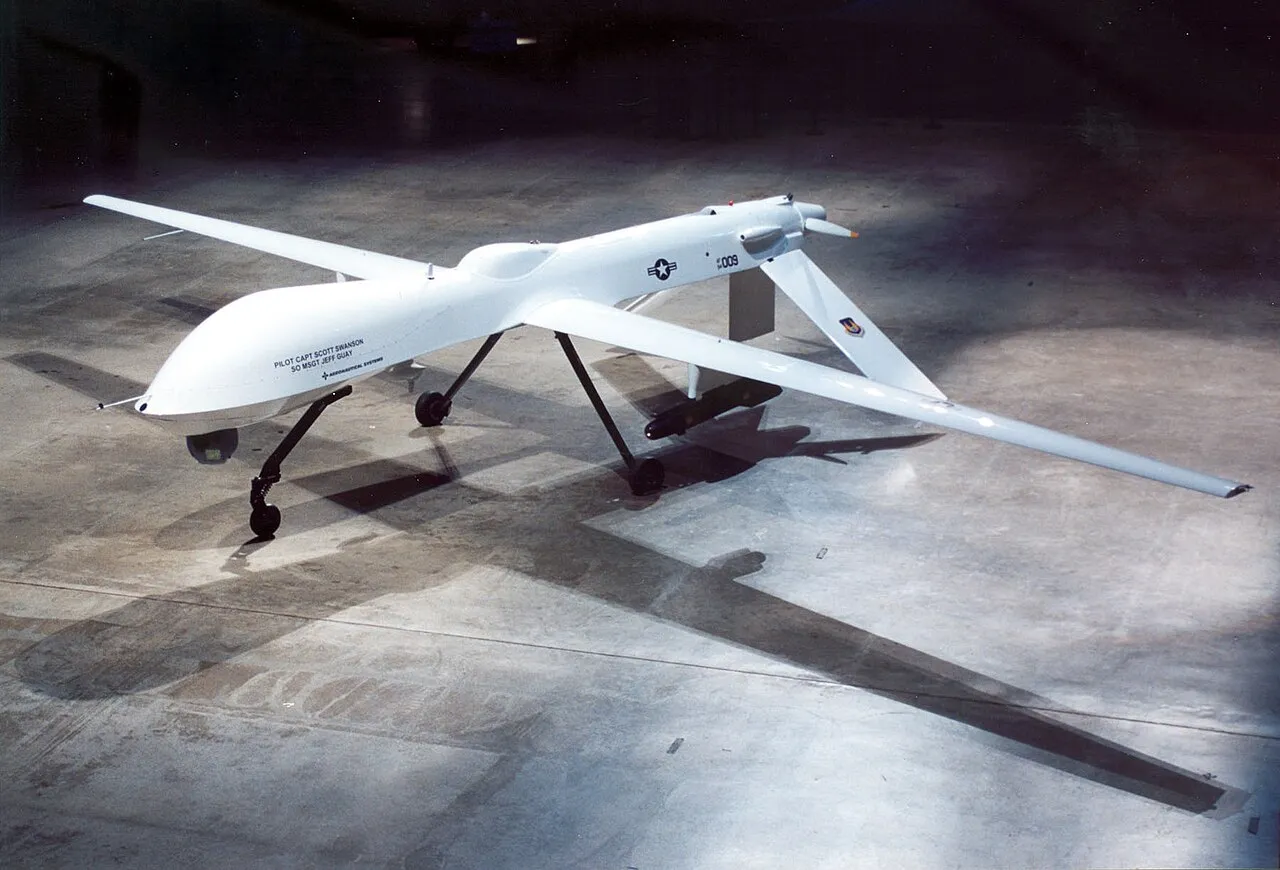
GA-ASI developed the aircraft with its own funding and first flew it in 20012, building on its experience with the Predator. The proof-of-concept Predator B-001 first flew on 2 February 2001. Built on a Predator airframe, it had a 950 shp turboprop and wings lengthened from 15 to 20 metres1.
Against the Predator’s 115 hp piston engine, the Reaper has a 950 shp turboprop1, and GA-ASI says it carries 500% more payload with nine times the horsepower. Production aircraft use a Honeywell TPE331-10 with digital electronic engine control and a fault-tolerant flight control system with triple-redundant avionics2.
Mission payloads include EO/IR sensors, Lynx multi-mode radar, maritime radar and laser designators2. Weapons carried include the GBU-12 Paveway II, AGM-114 Hellfire II and AIM-9 Sidewinder. In January 2012 GA-ASI released a trailing-arm main landing gear raising gross take-off weight by 12%. The upgraded Block 1-plus first flew on 24 May 20121, and follow-on aircraft were designated MQ-9 Block 5.
Specifications
GA-ASI lists the MQ-9A with a 20 m wingspan and 11 m length, a maximum gross take-off weight of 4,763 kg and 1,769 kg of fuel. The maker gives a maximum speed of 240 knots true airspeed, a ceiling of 50,000 feet and an endurance of over 27 hours2. Its cruise speed is 313 km/h and its range 1,000 nautical miles1.
Payload capacity is 1,746 kg, including 1,361 kg of external stores, carried on seven external stations. Endurance falls with weapons aboard: 30 hours on ISR missions, 23 hours with a full weapons load1. The aircraft is C-130 transportable or self-deploys. Control runs over a C-Band line-of-sight data link or a Ku-Band beyond-line-of-sight satellite link, and the aircraft can be remotely piloted or fully autonomous2.
Variants
The MQ-9A Extended Range adds wing-borne fuel pods and reinforced landing gear, which extend endurance from 27 to 34 hours2. The USAF bought 38 Reaper ER aircraft, which cost $56.5 million each1.
US Customs and Border Protection operates two maritime MQ-9s known as Guardians. NASA leased an unarmed variant, Altair, with a 26 m wingspan1.
GA-ASI calls the MQ-9B SkyGuardian the next generation of remotely piloted aircraft systems. It has a 79 ft (24 m) wingspan and is designed to fly for up to 40+ hours via satellite. SkyGuardian has nine hardpoints with a maximum 2,155 kg external payload3. In Royal Air Force service it is designated Protector RG Mk 1, and the first of 16 was delivered on 30 September 20231.
Operators and service
On 1 May 2007 the USAF activated its 432nd Wing at Creech Air Force Base, Nevada, to fly Reapers and Predators. On 28 October 2007 an MQ-9 achieved its first kill with a Hellfire missile against Afghan insurgents. The USAF operated over 300 MQ-9s as of May 2021. The average unit cost is estimated at $34 million in 2024 dollars, and 575 had been built as of 20261.
GA-ASI lists the USAF, DHS, NASA, RAF and the Italian, French and Spanish air forces2 as MQ-9A buyers. The US Marine Corps accepted its first two MQ-9A airframes in September 2021. The UK Ministry of Defence announced on 9 November 2007 that its Reapers had begun operations in Afghanistan. The Netherlands selected the MQ-9 Reaper Block-V in November 2013, and Spain chose the Reaper over the Heron TP1.
Safety record
In 2012 the Reaper, Predator and Global Hawk were described as the most accident-prone aircraft in the Air Force fleet. In 2015 a record 20 USAF drones crashed, and investigators found three starter-generator parts prone to breakdowns. US Central Command stated that Houthi air defences shot down an MQ-9 over Sanaa in October 2017. On 14 March 2023 an intercepting Russian Su-27 collided with an MQ-91 in international airspace over the Black Sea.
Similar aircraft
- General Atomics MQ-1 Predator: the earlier type; the MQ-9 is a larger, heavier, more capable aircraft1.
- Baykar Bayraktar TB2: an armed medium altitude long endurance platform with a 12-metre wingspan4, against the Reaper’s 20 m2.