Contents
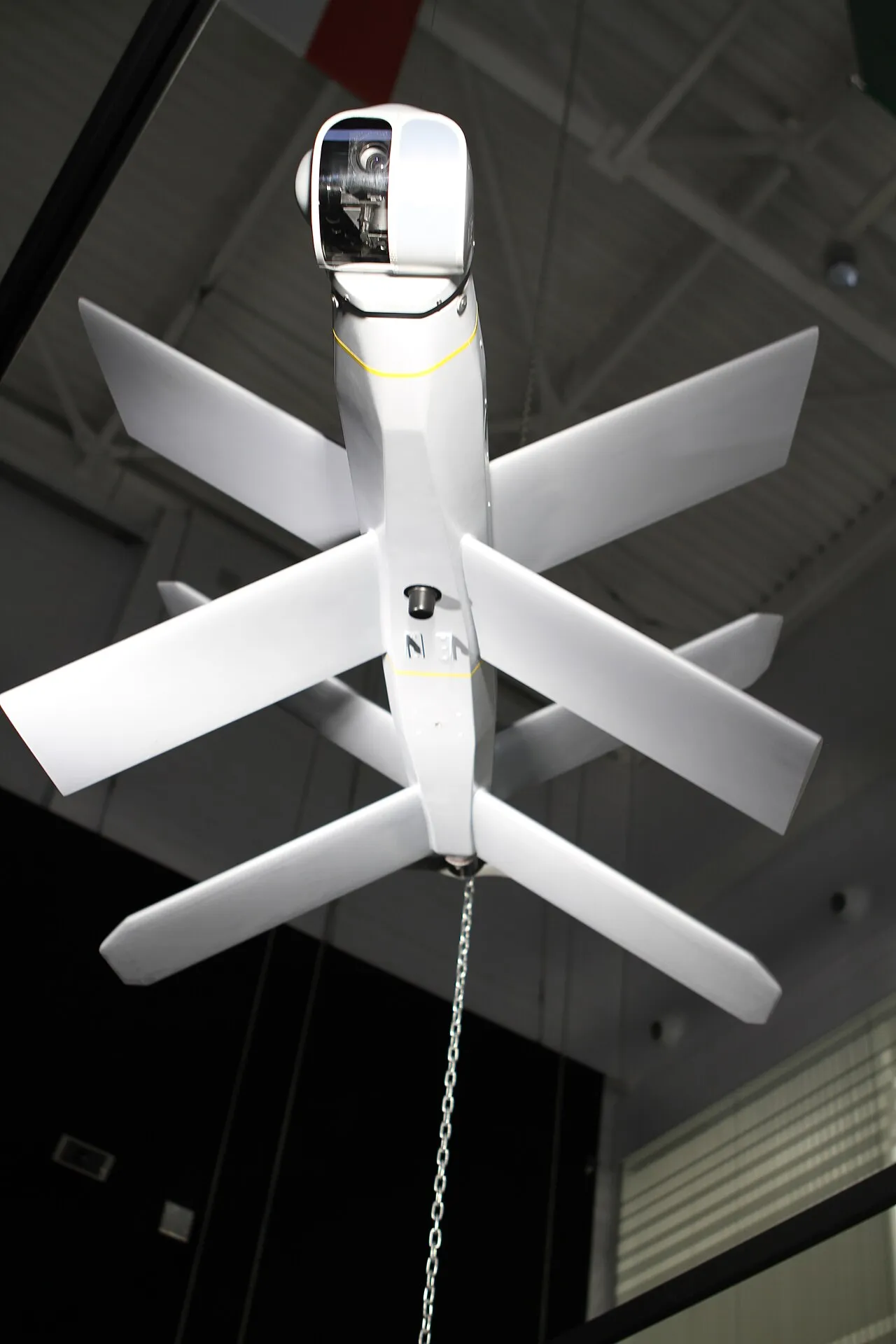
The ZALA Lancet is an unmanned aerial vehicle and loitering munition developed by the Russian company ZALA Aero Group, part of Kalashnikov Concern, for the Russian Armed Forces. The defence journalist David Hambling called it Russia’s first purpose-built loitering munition2. It can be used for both reconnaissance and strike missions. In the war in Ukraine it is employed as a precision battlefield weapon against high-value military targets1, usually located by a reconnaissance drone before it is launched.
Design and development
The Lancet was first unveiled in June 2019 at the ARMY-2019 military expo in Moscow, as a further development of the ZALA Kub-BLA loitering munition. Its official designations are Item 52 and Item 511. According to Hambling, the smaller Izdeliye-52 has two conspicuous X-shaped wings2.
The drone is powered by an electric motor1 and carries intelligence, navigation and communications modules. It can be launched by catapult from ground or sea platforms such as Raptor-class patrol boats. Hambling wrote that the Lancet transmits video back to the operator2 and is reportedly flown with reconnaissance drones that spot targets and relay coordinates. ZALA says that pairing its Z-16 or Z-20 reconnaissance drones with Lancets3 lets the Russian army perform counter-battery work.
The Lancet contains many Western electronic components, including an NVIDIA Jetson TX2 module as its onboard control equipment and a Xilinx Zynq SoC module. ZALA said in 2024 that the munitions had been modified with a thermal imager for use in the dark3, and that its developers had modernised the guidance system and increased the range of the Izdeliye-51. In July 20231, television news footage showed a massive new facility with hundreds of Lancets being manufactured, as the makers claimed that production was being tripled.
Specifications
The Lancet has a maximum range of 40 kilometres and a maximum take-off weight of up to 12 kilograms. The basic Lancet-3 is listed with a 40-minute endurance, a maximum payload of three kilograms and a maximum speed of 80–110 km/h. Hambling put its speed at around 70 miles per hour2, a slow speed that makes it an easier target than a guided missile. ZALA’s chief designer Alexander Zakharov has said the drone can dive at up to 300 kilometres per hour1 to strike enemy combat drones in mid-flight.
ZALA says the longer radius let Lancets hit Ukrainian aircraft at airfields at least 65 kilometres3 from the line of contact. Hambling reported a Lancet destroying a parked Ukrainian MiG-29 at a range of at least 50 miles2, achieved according to Russian media with unspecified design modifications.
Hambling argued that with each Lancet costing perhaps $35,000 and each target costing millions2, the weapon is extremely cost-effective.
Sensors and weapons
In combat mode the Lancet can be armed with high explosive, HE-fragmentation or shaped charge warheads1. It has optical-electronic guidance and a TV guidance unit, which allow the munition to be controlled in the terminal stage of flight. Hambling reported that the Izdeliye-52 carries a 6.5-pound warhead and the Izdeliye-51 an 11-pound one, and that the heavy armour of tanks sometimes shrugs off the Lancet’s relatively small warhead2.
Later reports said Russian troops in Ukraine had begun using upgraded Lancets with a one-hour flight time and a warhead of more than five kilograms1, used with a high-explosive fragmentation or thermobaric warhead against personnel and a HEAT warhead against armoured vehicles. ZALA says its thermal-imaging “Night Lancet” accounted for 5% of hits4 in the first 1,000 published episodes of use.
Operators and combat use
The Lancet has been combat tested in Syria since at least November 20201, and in April 2021 it was used in strikes against Tahrir al-Sham in Idlib Governorate.
On 8 June 2022, the Russian defence corporation Rostec announced that Lancet and KUB drones had been deployed in the invasion of Ukraine. ZALA says the first videos of their use there were published in July 20223. Videos from late 2022 showed Lancets striking targets including S-300 missile systems, a Buk-M1 and Western-supplied M777 howitzers. On 1 November 20231 the British Ministry of Defence said the Lancet was highly likely to be one of the most effective new capabilities Russia had deployed in Ukraine over the previous 12 months.
The Russian open-source analysts LostArmour compiled and classified every known Lancet strike video. By their count, Russia had conducted 667 Lancet strikes by 3 October 20231, of which 210 targets were destroyed and 355 suffered substantial damage. ZALA, citing the same portal, said published combat episodes reached 2,000 on 30 June 20243. A RUSI report quoted by Hambling said the lethality of Lancet is often insufficient2.
In November 2023 the head of the state arms exporter Rosoboronexport said Russia was not exporting the Lancet because of high domestic demand; export authorisation followed in February 2026. ZALA showed the export Lancet-E at Vietnam Defence Expo 20245 in Hanoi, its first appearance in Southeast Asia. Iran claimed in April 20241 that it had manufactured a domestic analogue.
Variants
- Lancet-3: the basic and bigger variant, which Hambling says comes in two varieties2, the Izdeliye-52 and the Izdeliye-51.
- Lancet-1: a smaller version carrying a one-kilogram payload1, with a 5 kg take-off weight and 30 minutes’ endurance.
- Izdeliye-53: an upgrade with a tube launcher holding up to four Lancets1, whose drones can share information and attack autonomously, choosing targets from pre-set categories; its operational deployment began in October 2023.
- Lancet-E: the export system, which combines a ZALA Z-16-E reconnaissance drone with Izdeliye 51-E and 52-E munitions5.
Similar drones
- Italmas: a ZALA design with an internal combustion engine and a claimed range of more than 200 km6.
- HESA Shahed 136: a long-range drone that Russia uses against Ukrainian energy infrastructure1, while the Lancet strikes battlefield targets.
- Perun: a Ukrainian loitering munition very similar to the Russian Lancet7, with a double cross-shaped wing and a length of 1,365 mm.