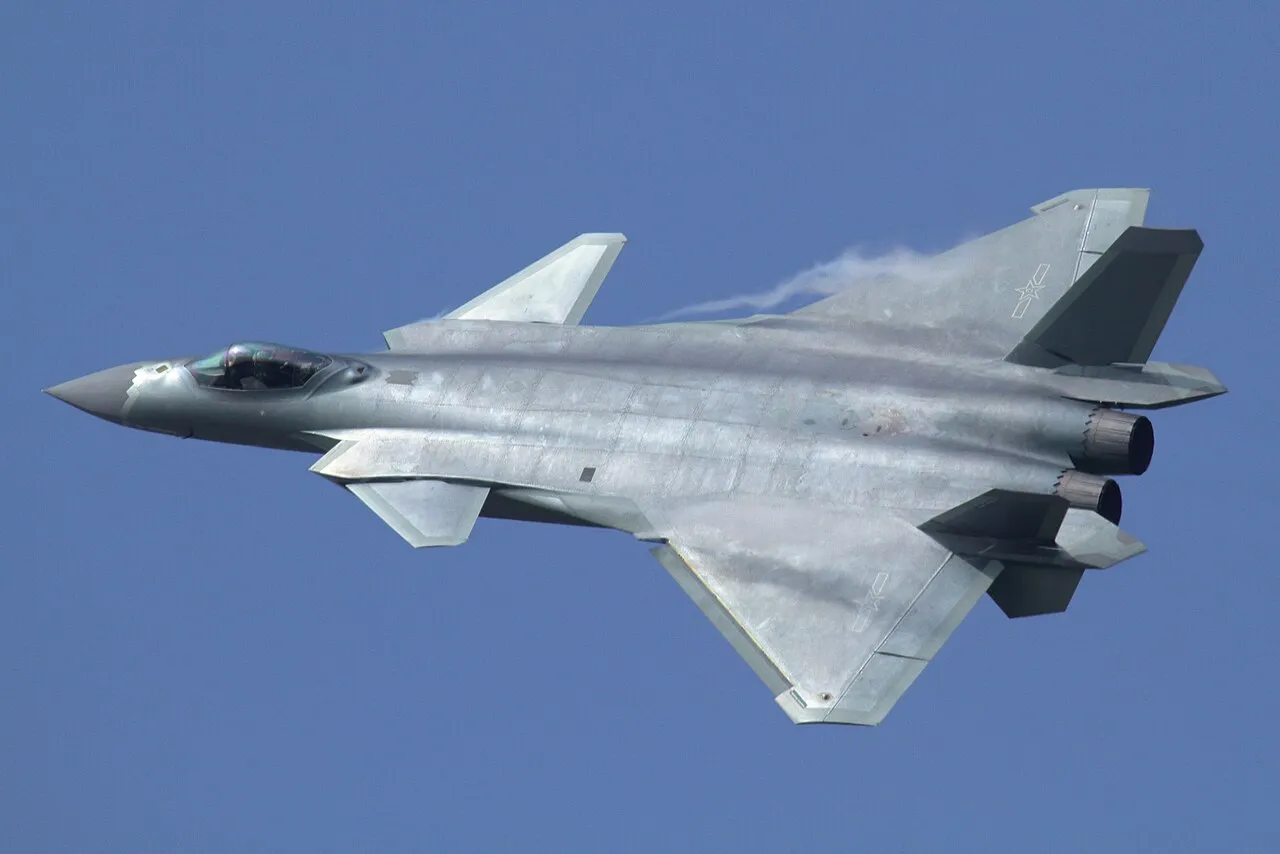
The Chengdu J-20 is a twin-engine all-weather stealth fighter developed by Chengdu Aircraft Corporation for the People’s Liberation Army Air Force (PLAAF). It marks the first entry of a multirole stealth fighter into China’s armed forces, and its service entry in March 2017, with a first combat unit in February 20181, made China the second country in the world to field an operational stealth aircraft. Analysts disagree about its main role: some see its frontal stealth as making it an effective long-range interceptor, while others see a long-range strike aircraft2 best suited to penetrating enemy air defences.
Design and development
In 2008 the PLAAF endorsed1 Chengdu Aircraft Corporation’s proposal, known as Project 718. The J-20 completed its first test flight on 11 January 20112, and it was introduced to the public during a flyby at the Zhuhai airshow in November 20163.
The airframe has a long, blended fuselage with a chiselled nose and frameless canopy. All-moving canards with pronounced dihedral sit behind the intakes, followed by leading-edge extensions that merge into a delta wing. Further low-observable features include sawtooth edges on compartment doors1, mesh coverings on cooling ports at the base of the vertical tails, antennas embedded in the skin and radar-absorbent coatings. Analyst Carlos Kopp concluded that the J-20, like the F-22, has achieved some low-observable design goals. CSIS notes that some aspects, such as the round nozzle of earlier models, may work against its stealth, while advanced versions of the WS-10 engine are reported to have sawtooth serrations around the nozzle edges2 designed to redirect radar.
The J-20’s use of electro-optical sensors resembles the F-35’s1 avionics suite, including its Distributed Aperture System and targeting system. CSIS expects the J-20’s advanced electronic systems to be comparable to those found inside the F-35, and says the jet is likely to field a communications suite able to datalink with friendly platforms2 such as the Divine Eagle airborne early warning drone.
Specifications
The J-20 is 21.2 m long, 13.01 m wingspan, 37,000 kg maximum take-off weight. Prototype and early production models were equipped with Russian AL-31 engines. The PLAAF developed the domestic WS-10 to replace the Russian engines, and J-20s with indigenous WS-10C engines began production in 20191; the pair that flew at Airshow China in Zhuhai in September 20213 were equipped with the WS-10. Reports cited by CSIS say the planned WS-15 engine would give the J-20 sustained supersonic travel2. In September 20254 The Aviationist reported that the J-20A and J-20S were still noted with a variant of the WS-10C, although a J-20A prototype had been photographed with the WS-15 in September 2024.
Maximum speed is given as Mach 2.0 at altitude. Range is 5,500 km with two external fuel tanks, combat range 2,000 km1.
Internally, a larger bay under the fuselage2 takes a variety of missiles and surface-attack weapons, flanked by two lateral bays for small air-to-air missiles. The main bay may carry four medium or long-range missiles, with each lateral bay carrying a short-range missile, and the jet can also carry eight PL-15 missiles externally on hardpoints that each take two rail launchers. The J-20 reportedly lacks an internal autocannon1, suggesting a preference for long-range missile engagements over short-range dogfights.
Variants
In an October 2017 broadcast, Chinese state television reported that the baseline J-20 had entered “stable” mass production; Chengdu planned to build up to 100 J-20s by the end of 20205.
The J-20A is an improved single-seater with a slightly raised cockpit, enlarged spine and reshaped nosecone1, and engine intakes optimised for the WS-15. The Aviationist describes its longer “nape” as space meant for additional fuel, avionics and electronic warfare4.
The J-20S twin-seater was first spotted in October 2021, making it the first twin-seat stealth fighter in the world. Its design allows the possibility for the second operator to coordinate attacks and reconnaissance missions from other friendly aircraft via networking, or from unmanned combat aircraft linked as “loyal wingmen”. The J-20A and J-20S officially debuted in the PLAAF fleet on 3 September 20251.
A J-20B with dual WS-15 engines was speculated to have made its maiden flight on 29 June 20231.
Operators and service
Reports indicated in March 2017 that the J-20 had entered service, and on 28 September 20172 a Chinese defence ministry spokesperson said it had been officially commissioned into military service. The type joined the 9th Fighter Brigade at Wuhu Air Base in Anhui province between late 2018 and March 2019. In June 20213 the state-run Global Times said a J-20 unit with domestic engines had been activated in China’s northeast. By 2022 J-20s were deployed in combat units in all five theatre commands. In March 20221 US Air Force general Kenneth Wilsbach confirmed that American F-35s had encountered J-20s over the East China Sea.
In September 20254 The Aviationist reported a fleet of at least 300 J-20s, with at least 50 delivered since June 2024, and by mid-2026 around 500 had been delivered to the PLAAF. The first test flight coincided with a visit to China by US Secretary of Defense Robert Gates, who questioned how stealthy the J-20 might be but said it would “put some of our capabilities at risk”1.
Similar aircraft
- Lockheed Martin F-22 Raptor: its weapons bays are similar in configuration to the J-20’s, but its F119 engines have square nozzles2, which greatly improve stealth.
- Lockheed Martin F-35 Lightning II: an American single-seat, single-engine6 stealth strike fighter, where the J-20 has two engines.
- Sukhoi Su-57: Sukhoi’s internal designation for it is T-507, and CSIS notes the T-50 holds two small and two large weapons bays2, unlike the J-20’s one main and two lateral bays.
- Shenyang FC-31: a smaller multirole stealth fighter from Shenyang Aircraft Corporation; the CSIS profile of 2017, updated 2020, described it as developed alongside the J-20 and said it could potentially be exported2.