Contents
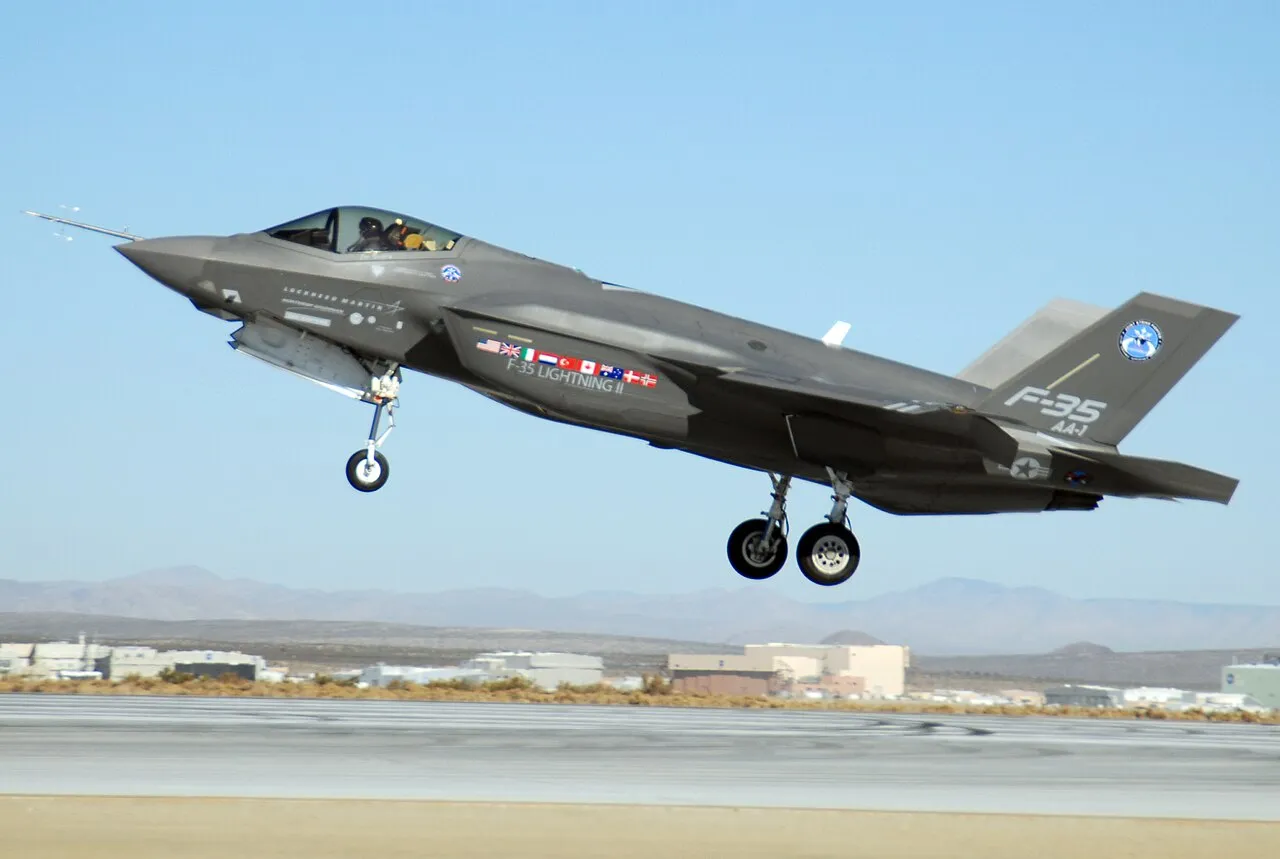
The F-35 Lightning II is a single-engine stealth fighter built by Lockheed Martin, with Northrop Grumman and BAE Systems as partners, built in three variants to replace older fighters and strike aircraft across the US military and a group of allied air forces. It grew out of the Joint Strike Fighter program, which merged several 1980s and 1990s combat-aircraft initiatives, including a DARPA effort to find a Harrier replacement for the US Marine Corps and Royal Navy. More than two decades after its first flight, it is the world’s most-numerous stealth aircraft1.
Design and development
Boeing and Lockheed Martin were selected in early 1997 to build rival prototypes for the Joint Strike Fighter program, the Boeing X-32 and the Lockheed X-35. The X-35A first flew on 24 October 2000 and, after 28 test flights, was converted into the X-35B to demonstrate short take-offs in under 500 ft (150 m) and vertical landings. On 26 October 2001, Lockheed Martin was declared the winner and awarded the development contract, with Pratt & Whitney separately contracted for the F135 engine. The first F-35A made its first flight on 15 December 20061.
Testing then exposed serious problems: early F-35B airframes cracked prematurely, the F-35C’s arrestor hook design proved unreliable, fuel tanks were too vulnerable to lightning strikes, and the pilot’s helmet display had issues. The three variants, meant to share about 70 percent of their parts, ended up sharing only around 25 percent. Lockheed’s decision to test, fix defects and build production aircraft all at once drew sustained criticism; in 2014 the Pentagon’s then-acquisition chief Frank Kendall called it “acquisition malpractice”. Costs climbed accordingly, from an expected $200 billion in base-year 2002 dollars when the development contract was signed to a 2024 estimate of $2.1 trillion in lifetime program cost through 2088, about half of that rise attributed to inflation; by August 2023 the program was running 80 percent over its original budget and 10 years late1.
Specifications
All three variants share a top speed of Mach 1.6 (1,220 mph; 1,960 km/h) with a full internal payload and can dash at Mach 1.2 for 150 miles (240 km) on afterburner. The lightest variant has an empty weight of 29,300 lb (13,300 kg), rising to a maximum take-off weight of 65,918 lb (29,900 kg) for the F-35A. Its 35 ft wingspan on the A and B models is set by the need to fit the parking areas and elevators of US Navy amphibious assault ships; the C model’s wing is larger and more fuel-efficient. On internal fuel alone, the F-35A’s interdiction combat radius is about 669 nautical miles (1,239 km)1.
Stealth comes from more than shape: Lockheed Martin cites the alignment of edges, continuous curvature of surfaces, serrated skin panels, and masking of the engine face and turbine, giving a radar cross-section described as lower than a metal golf ball at some frequencies and angles. The sensor suite centres on the AN/APG-81 AESA radar, which tracks multiple targets beyond 80 nautical miles (150 km) and the AN/AAQ-37 Distributed Aperture System’s six infrared sensors, which track targets and warn of incoming missiles all around the aircraft, backed by an electronic-warfare and an electro-optical targeting system. Running it all takes 8.6 million lines of code in the Block 3F software. All three variants are designed for an 8,000-flight-hour service life1.
Variants
The F-35A is the conventional take-off and landing version built for air forces, and the only variant with an internal 25 mm GAU-22/A cannon; a 2020 USAF report found the gun’s accuracy “unacceptable” because of mount misalignments that also left it prone to cracking, issues resolved by 2024. The F-35B is the short-take-off/vertical-landing version, using a shaft-driven lift fan, built for the US Marine Corps and allies that fly from short runways or amphibious ships. The F-35C is the carrier-based version, with a larger wing for lower landing speeds and catapult launch and arrested recovery gear, built for the US Navy1. Both the B and C carry their gun in an external pod rather than internally.
Operators and service
The United States is the type’s primary customer and financial backer, planning to buy 1,763 F-35As for the Air Force, 353 F-35Bs and 67 F-35Cs for the Marine Corps, and 273 F-35Cs for the Navy. Partner nations the United Kingdom, Italy, the Netherlands, Turkey, Australia, Norway, Denmark and Canada agreed to contribute $4.375 billion toward development, with the UK paying about 10 percent of that as the sole Tier 1 partner; Turkey, however, was removed from the program in July 2019 over security concerns after buying the Russian S-400 air-defence system. Operators flying the type include the UK, Italy, Japan, Australia, Belgium, Denmark, the Netherlands, Norway, Poland and South Korea, plus Israel, which flies a customised F-35A it calls the F-35I; several more NATO members plus Switzerland and Singapore have orders outstanding. With 883 aircraft in service as of 2025, it is the world’s fourth-most-numerous military aircraft and the most-numerous stealth aircraft, and more than 1,345 had been built as of 5 August 2026; Lockheed Martin delivered a record 191 aircraft in 2025, bringing the global fleet to about 1,3001.
Each variant has seen combat: the F-35A first flew in Israeli strikes over Syria in 2018, the F-35B in US strikes in Afghanistan the same year, and the F-35C in US strikes in Yemen in 2024. Production has had recent trouble too: difficulties with new TR-3 hardware delayed the Block 4 upgrade and halted deliveries from July 2023 to July 20241.
Safety record
Fleet readiness has slipped as the program has grown. A US government report found that fleetwide Full Mission Capable rates fell from 38 percent in fiscal year 2021 to about 25 percent in fiscal year 2025, while Mission Capable rates fell from 67 percent to 44 percent over the same period1.
Similar aircraft
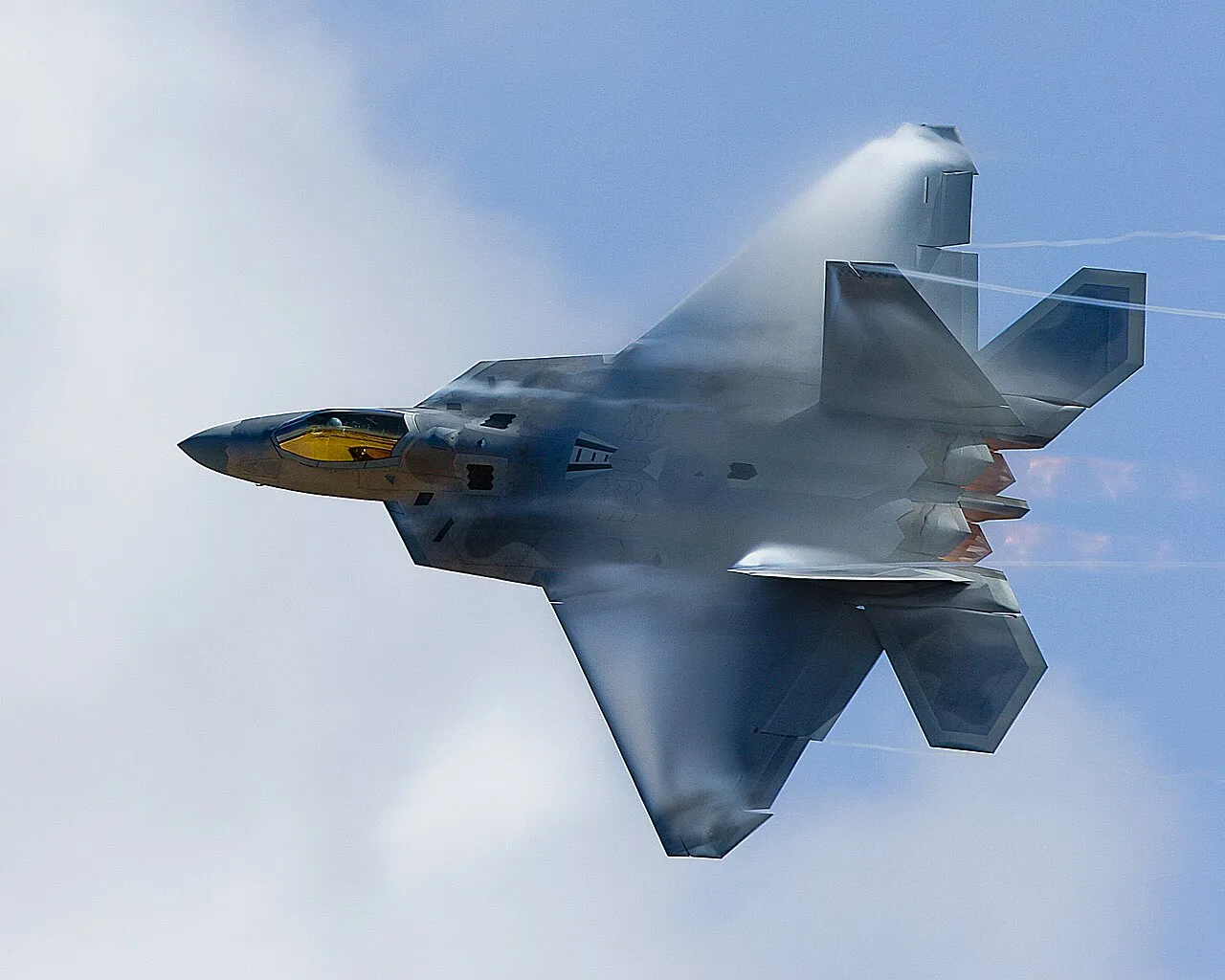
- Lockheed Martin F-22 Raptor: the larger, twin-engine, air-superiority-focused stealth fighter the F-35 complements in US service; unlike the F-35, the F-22 was never exported.
- General Dynamics F-16 Fighting Falcon: the lightweight fighter the F-35A replaces in many of the same air forces, without stealth or the F-35’s sensor fusion.
- Sukhoi Su-57: Russia’s rival fifth-generation stealth fighter, built in far smaller numbers and without the F-35’s network of export customers.