Contents
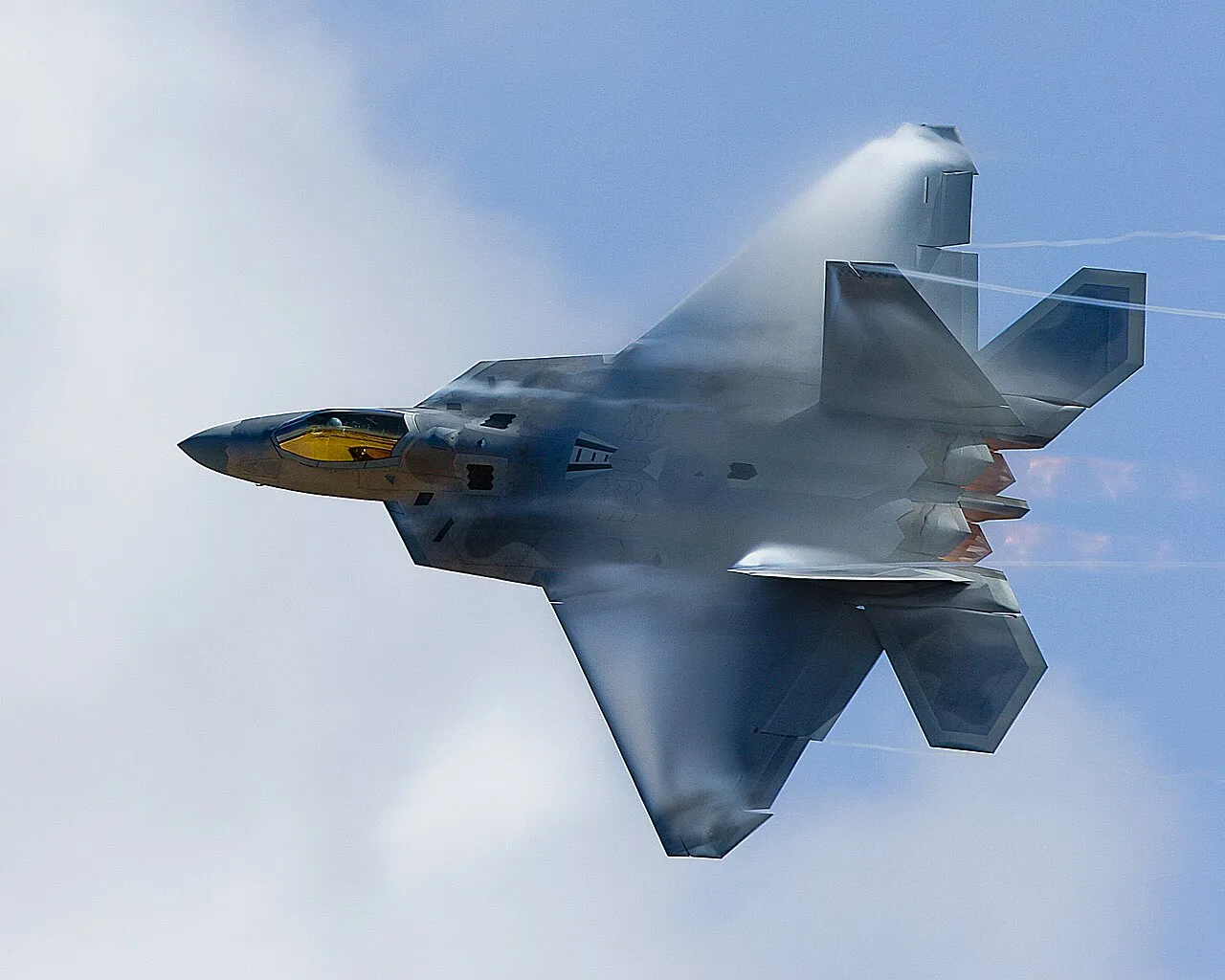
The F-22 Raptor is a twin-engine stealth fighter built by Lockheed Martin, with Boeing as the principal subcontractor, for the United States Air Force. It was designed as an air-superiority fighter and replaced the F-15 Eagle in most active-duty USAF squadrons, though it also carries ground-attack, electronic-warfare and signals-intelligence capabilities1. Lockheed Martin still markets the type around its air-dominance role2 more than two decades after it entered service.
Design and development
The Raptor grew out of the Advanced Tactical Fighter program the US Air Force launched in 1981 to replace the F-15 and F-16. A Lockheed-led team, flying the YF-22 prototype that first flew on 29 September 1990, beat a Northrop-led team in the competition, and on 23 April 1991 the Secretary of the Air Force announced Lockheed and engine maker Pratt & Whitney as the winners. The production design moved into full-scale development in August 1991, and the first F-22A, unveiled at Marietta, Georgia, on 9 April 1997, made its first flight on 7 September 1997. The aircraft entered service in December 20051.
Three contractors built the airframe: Lockheed Martin the forward fuselage and control surfaces, Boeing the aft fuselage and wings, and General Dynamics the center fuselage. Its stealth comes from airframe shaping, internal weapons carriage and fixed-geometry serpentine inlet ducts, and its rectangular, two-dimensional thrust-vectoring nozzles swivel up to ±20 degrees, giving it extreme agility alongside its stealth shape. The engines also let it cruise supersonically without afterburner, known as supercruise. Its avionics software runs to 1.7 million lines of code written in Ada1.
Specifications
The Raptor is 18.92 m long with a wingspan of 13.56 m and a maximum take-off weight of 38,000 kg. It is powered by two Pratt & Whitney F119-PW-100 augmented turbofans, which let it supercruise at about 1,870 km/h (Mach 1.76) without afterburner. Fitted with external fuel tanks it has a ferry range of about 3,222 km, though its clean combat radius is far shorter, around 850 km. It carries a crew of one, since the planned two-seat F-22B trainer was cancelled1.
Development and production were expensive. The per-aircraft program unit cost stood at about $360 million when production ended in 2011, though the estimated cost of building one additional aircraft was put at $138 million in 20091.
Variants
Only one combat version, the F-22A, reached production; its designation was briefly changed to F/A-22 from September 2002 to highlight a planned ground-attack role before reverting to F-22A. Lockheed Martin also proposed an X-44 thrust-vectoring research aircraft and an FB-22 medium-range regional bomber in the late 1990s and early 2000s, but both were abandoned1. No two-seat trainer or naval version was built.
US law has kept the Raptor a US-only fighter: annual defense appropriations acts since fiscal year 1998 have barred funds for approving or licensing an F-22 export sale, a ban Congress upheld in September 2006. Australia, Japan and Israel each looked at the type and went elsewhere: Japan’s air force chose the F-35 in December 2011 and Israel concluded it could not afford the aircraft1.
Operators and service
The sole operator is the United States Air Force. Budget cuts ended production well short of the original plan: the Air Force had wanted 750 aircraft but received 195, built from 1996 to 2011, made up of 8 test aircraft and 187 operational models. The last F-22 was completed in December 2011 and delivered on 2 May 2012; the shortfall forced the Air Force to keep 179 older F-15C/D fighters flying into the late 2020s1.
The Raptor first saw combat in 2014, flying airstrikes during the US intervention in Syria, and has since supported strikes in Afghanistan. The Air Force plans to keep it as a frontline fighter until its successor, the Boeing F-47, enters service around 2030. Keeping the fleet flying has proven demanding: for missions that call for full stealth, the mission-capable rate runs at 62-70 percent1.
Safety record
The F-22 has had five known Class A accidents. On 20 December 2004 a brief power interruption during an engine shutdown caused a flight-control malfunction at Nellis Air Force Base, and the pilot ejected safely. On 25 March 2009, a test pilot lost consciousness during a high-g maneuver near Edwards Air Force Base and ejected too low to survive; David P. Cooley was killed. On 16 November 2010, a bleed-air system malfunction over Alaska shut down the environmental control and oxygen-generation systems, and Captain Jeffrey Haney was killed; the accident fed into wider concern about oxygen deprivation in the cockpit, which the Air Force addressed from 2012 by fitting an automatic backup oxygen system. On 15 November 2012, a chafed electrical wire started a hydraulic fire east of Tyndall Air Force Base that damaged the flight controls, and the pilot ejected safely. On 15 May 2020, a maintenance error after a wash gave faulty air-data readings at Eglin Air Force Base, and the pilot ejected safely. Separately, the Air Force ran a $350 million structural repair program, completed fleet-wide by January 2021, after finding improperly heat-treated titanium parts and tail-fin buffeting in some flight conditions1.
Similar aircraft
- General Dynamics F-16 Fighting Falcon: the lightweight fighter the F-22 was designed to complement in a high-low mix, though the Raptor adds stealth and supercruise the F-16 lacks.
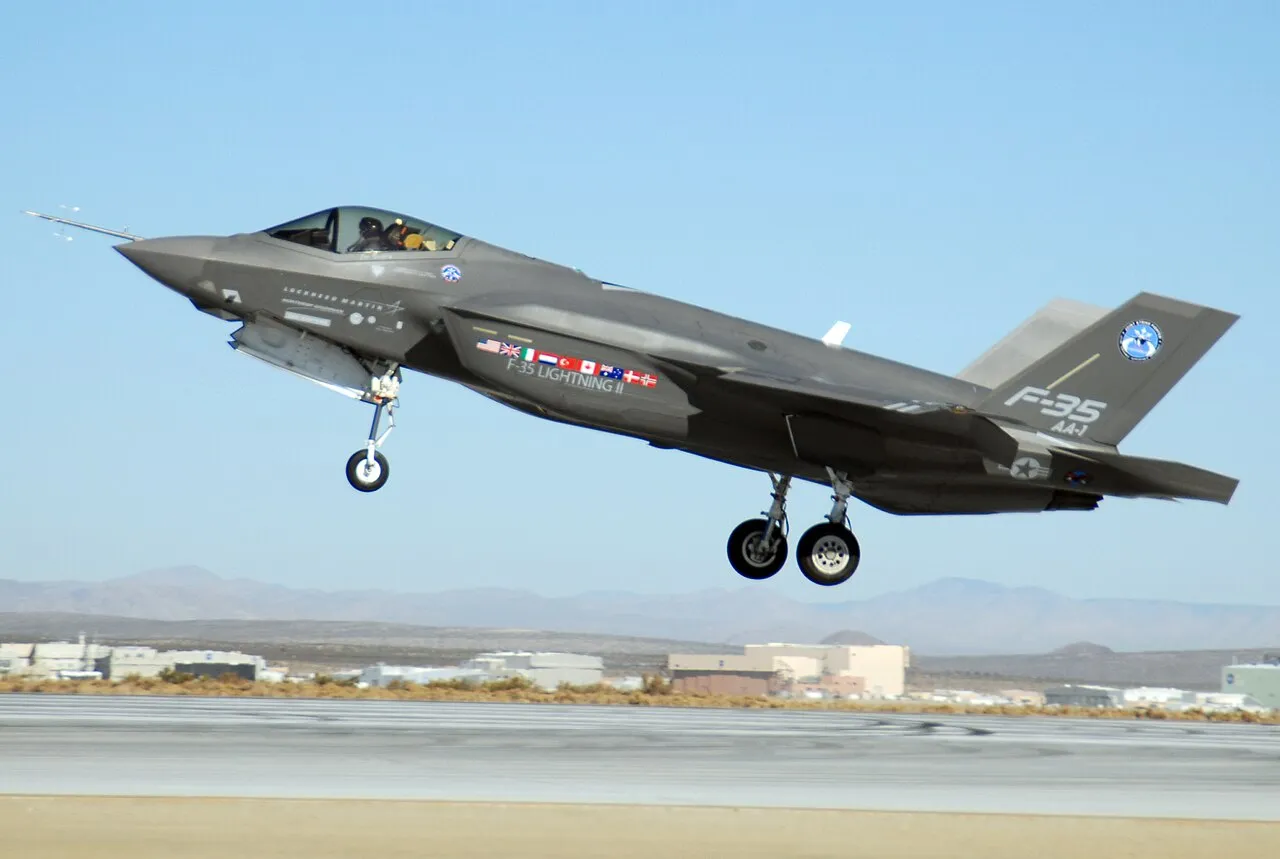
- Lockheed Martin F-35 Lightning II: the smaller, multirole stealth fighter that several countries bought instead of the export-banned F-22, including Japan.
- Sukhoi Su-57: Russia’s comparable stealth air-superiority fighter, built to the same fifth-generation concept decades later.