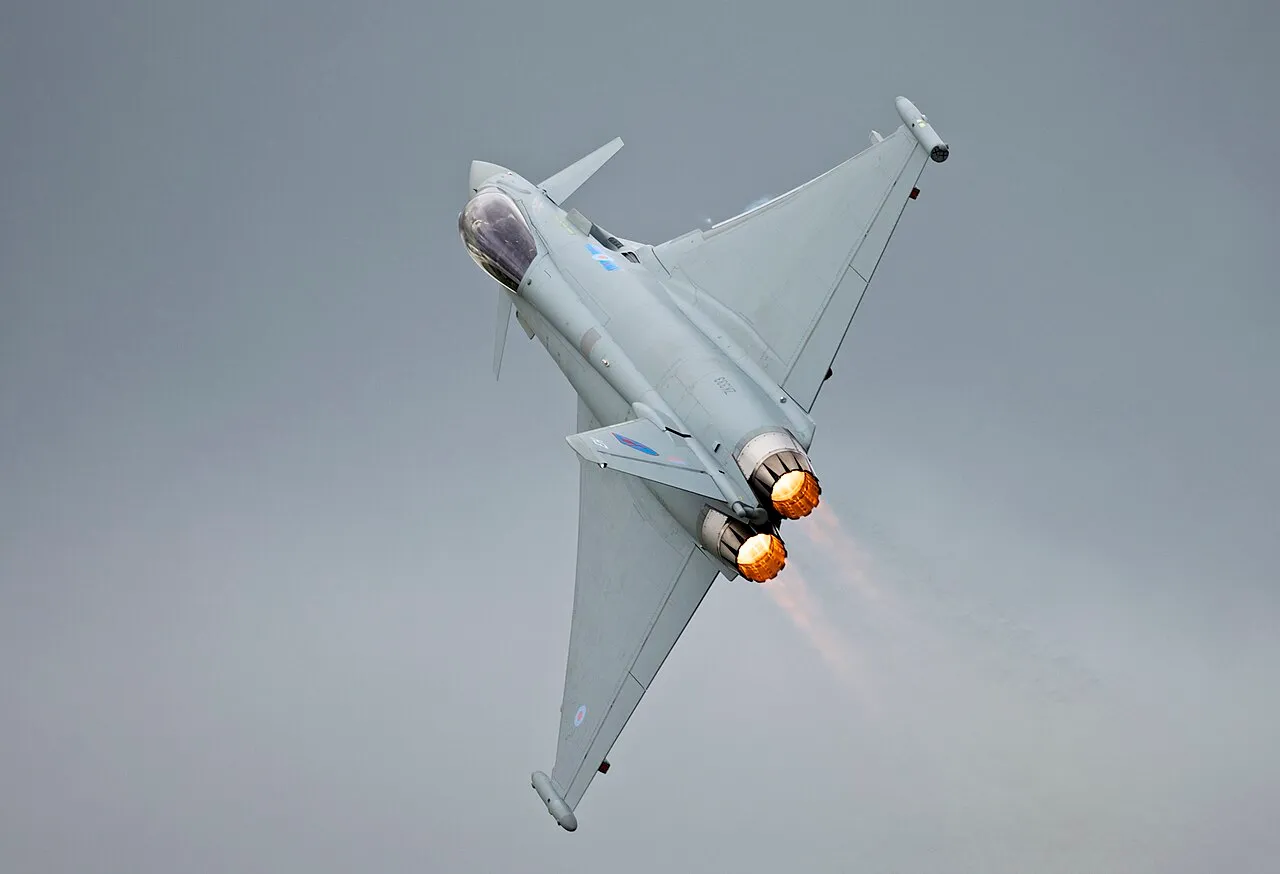
The Eurofighter Typhoon is a twin-engine, canard-delta multirole fighter built by Eurofighter GmbH, a joint venture of Airbus, BAE Systems and Leonardo. It was designed primarily for air superiority, though it has grown into a true multirole aircraft flying strike and ground-attack missions alongside air policing and interception. The type has been in service since 20031 and today equips the air forces of the UK, Germany, Italy, Spain, Austria, Saudi Arabia, Oman, Kuwait and Qatar.
Design and development
The Typhoon’s roots lie in separate UK, German and Italian studies of the early 1980s that converged into the multinational Future European Fighter Aircraft project. France withdrew to pursue its own Rafale, but the UK, Germany, Italy and Spain continued, launching the Eurofighter programme and building seven flying prototypes. The first of these flew from Manching, Bavaria, on 27 March 1994. Development was delayed for years by disagreements among the partner nations over workshare, cost and systems before the first production aircraft reached squadrons. The airframes were built to three successive standards during this test phase — Development Aircraft, Instrumented Production Aircraft and a Series Production Aircraft1, each adding more of the systems that would equip the production jet.
Aerodynamically, the Typhoon combines a delta wing with foreplanes (canards) and relaxed static stability, controlled by a digital fly-by-wire system, giving it high manoeuvrability across its speed range. The airframe makes extensive use of carbon-fibre composites, glass-reinforced plastic and titanium to keep weight down while retaining strength1.
Specifications
The Typhoon is 15.96 m long with a 10.95 m wingspan, close in size to its French rival the Dassault Rafale. Maximum take-off weight is 23,500 kg, and the aircraft is powered by two Eurojet EJ200 afterburning turbofans. Top speed is about 2,495 km/h, roughly Mach 2.35, at altitude, and Eurofighter states that it can supercruise at Mach 1.5 without using afterburner, though independent measurements have come in lower: Air Forces Monthly recorded a maximum supercruise speed of Mach 1.1 for an RAF FGR4, and a Singapore evaluation reached Mach 1.21 on a hot day with a combat load. With three external drop tanks the ferry range reaches about 3,790 km, though on a hi-lo-hi ground attack profile the combat radius is closer to 1,389 km1.
Single-seat and two-seat cockpits are both built: most Typhoons fly with one pilot, though a second seat is fitted for training and some operational variants. By June 2026, 611 production aircraft had been delivered, plus the seven prototypes built during development, and the type remains in production1.
Variants
Production has moved through five successive standards, each adding capability over the last: Tranche 1, Tranche 2 and Tranche 3 (split into 3A and sub-batch 3B, though 3B did not go ahead) were followed by Tranche 4, approved for Germany in November 2020 and for Spain’s 20-aircraft Halcón I order signed in June 2022. The latest standard is Tranche 5, ordered by Spain as the 25-aircraft Halcón II buy in 2023 and by Germany for a further 20 aircraft in 2025, bringing more sophisticated avionics, an electronic warfare suite and new weapon integrations. Most partner air forces fly both single-seat and twin-seat versions, with the twin-seat aircraft retaining full combat capability rather than serving only as trainers1. Export customers have generally taken the same production standards rather than distinct variants.
Beyond the production tranches, two separate upgrade tracks have added capability to in-service aircraft. Weapons integration has come through staged software packages: the Phase 2 Enhancements (P2E) added the Meteor air-to-air missile and Storm Shadow cruise missile, and the Phase 3 Enhancements (P3E) added the Brimstone air-to-surface missile, first fired live in July 2017. Separately, the Typhoon is being fitted with an active electronically scanned array radar, the European Common Radar System (ECRS), developed in three versions: ECRS Mk0 is fitted to aircraft delivered to Kuwait and Qatar, ECRS Mk1 is being developed for Germany and Spain, for retrofit to their Tranche 2 and 3 jets and fitment to their new Tranche 4 aircraft, and ECRS Mk2 is being developed for the RAF’s Tranche 3 fleet, with Italy joining the programme1.
Operators and service
The four partner nations — the United Kingdom, Germany, Italy and Spain — remain the largest Typhoon operators, flying the type for air defence and, for the UK and Italy, carrier-capable strike roles from land bases. Export sales have taken the Typhoon beyond Europe: Austria, Saudi Arabia, Oman, Kuwait and Qatar1 all fly the type, with Saudi Arabia operating the largest export fleet.
Royal Air Force and Italian Air Force Typhoons have flown combat missions over Libya since 2011, and the RAF has also used the type in strikes against Islamic State in Iraq and Syria. Saudi Arabia has flown Typhoons in the Saudi-led intervention in Yemen since 2015. The type remains in production for both partner-nation and export orders1, with Eurofighter GmbH continuing to offer it against newer fifth-generation designs.
Similar aircraft
- Dassault Rafale: France’s twin-engine delta-canard multirole fighter, the rival design France pursued after leaving the Eurofighter programme in the 1980s.
- Saab JAS 39 Gripen: a lighter, single-engine multirole fighter that competes with the Typhoon in export markets.
- General Dynamics F-16 Fighting Falcon: an older single-engine American multirole fighter flown by several Typhoon partner and export nations alongside their Typhoon fleets.