Contents
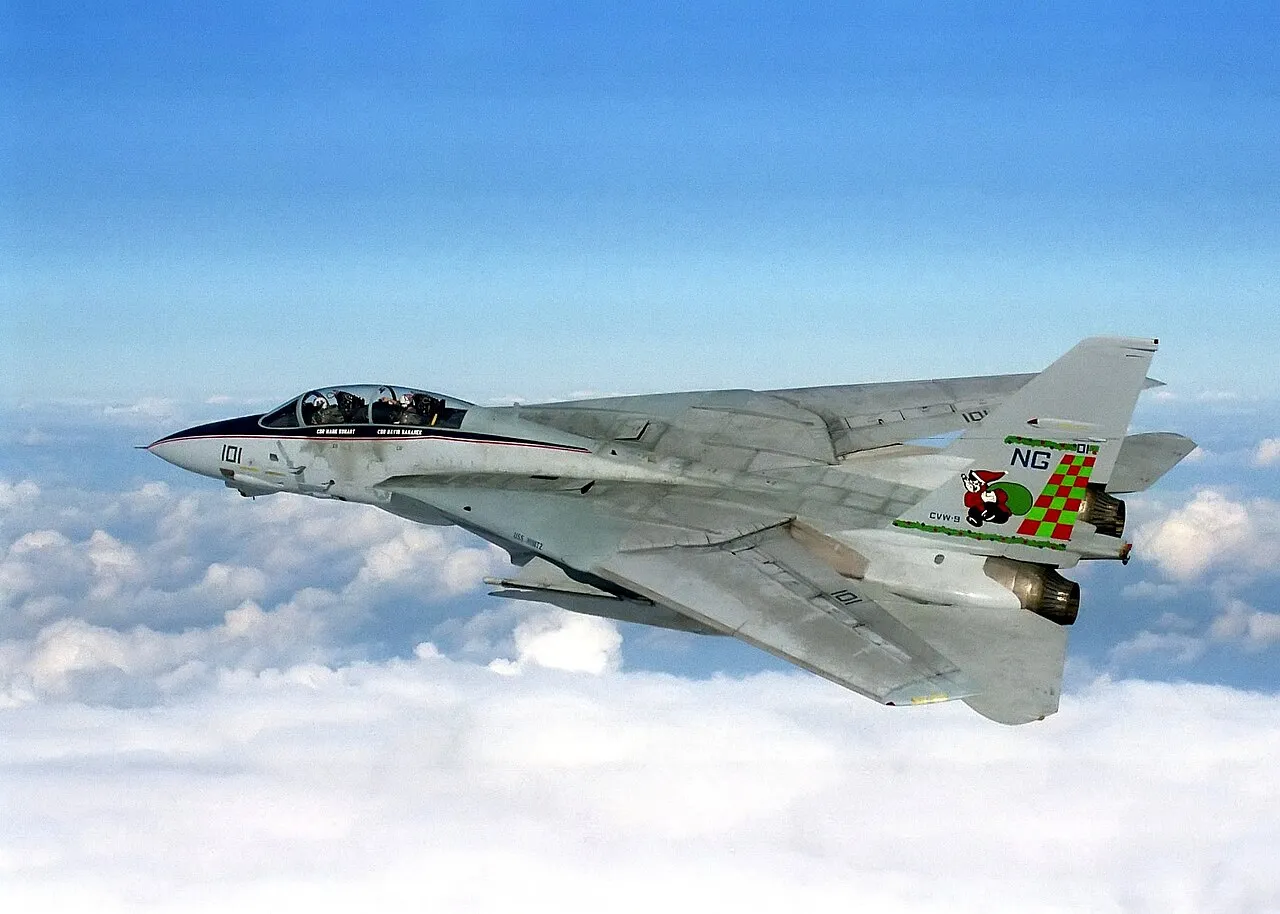
The Grumman F-14 Tomcat is a carrier-capable, twin-engine, variable-sweep-wing fighter that the US Navy flew to defend its carrier battle groups from long range. Grumman built it for fleet air defence, pairing a powerful radar with long-range missiles to intercept bombers and fighters well before they reached the carrier. The US Navy retired the type in 2006, and by the mid-2020s Iran was its only remaining operator1.
Design and development
The Tomcat grew out of the Naval Fighter Experimental (VFX) programme, launched after the US Navy’s version of the troubled General Dynamics-Grumman F-111B was cancelled. Grumman kept the F-111B’s long-range AIM-54 Phoenix missiles and Hughes AN/AWG-9 radar, the combination the Navy wanted to pick off threats at distance, but built a smaller, far more manoeuvrable airframe around them. The design kept the variable-sweep wing, which the pilot can sweep between 20° and 68° in flight1: swept back for high-speed dashes and interception, spread forward for the slow, controllable approach a carrier landing demands.
The prototype first flew on 21 December 1970, and the type began replacing the F-4 Phantom II in US Navy service from September 19741.
Specifications
The F-14 is 19.13 metres long, with a wingspan of 19.55 metres unswept, folding to 11.65 metres when swept fully back to 68°. Maximum take-off weight is 33,725 kg, and it carries a crew of two, a pilot and a radar intercept officer who operates the AWG-9 radar and missiles from the rear seat. Cruise speed is 778 km/h, and maximum ferry range is about 2,963 km, falling to roughly 932 km of combat radius on a fighter-escort mission carrying external fuel and weapons. Later aircraft were powered by two General Electric F110-GE-400 afterburning turbofans, replacing the two Pratt & Whitney TF30-P-412A/414A turbofans fitted to the original F-14A1.
Variants
The baseline F-14A used the TF30 engine throughout its production run. Grumman then re-engined the type: the F-14B added the more powerful General Electric F110 engine, with 38 built new and a further 43 converted from F-14As. The F-14D went further, pairing the F110 engine with digital avionics and a digital version of the AWG-9 radar; 37 were built new and another 18 converted from F-14As. In all, Grumman built 712 Tomcats between 1969 and 19911.
Operators and service
The F-14 flew almost exclusively for the US Navy and, from the 1970s, the Imperial Iranian Air Force, later the Islamic Republic of Iran Air Force, which ordered 80 F-14As, up from an initial order of 30, before the 1979 revolution halted further deliveries. In US Navy service, the type scored its first air-to-air kills on 19 August 1981, when two F-14s from VF-41 shot down two Libyan Su-22s with Sidewinder missiles over the Gulf of Sidra. It went on to fly strike-escort and fleet-defence missions over the Gulf War, the Balkans and Iraq and Afghanistan in the 2000s before the Boeing F/A-18E/F Super Hornet replaced it; the Navy flew its last F-14 combat mission on 8 February 2006 and retired the type on 22 September 20061.
Iran flew its Tomcats far more intensively, using them for both air defence and strike missions throughout the 1980-1988 Iran-Iraq War. By the mid-2020s, Iran was the type’s only operator. In the United States, meanwhile, a Senate bill named the Maverick Act, approved on 28 April 2026 but not yet law as of May 2026, proposes transferring three retired F-14Ds to the U.S. Space & Rocket Center in Huntsville, Alabama, for restoration to flying condition for airshows1.
Safety record
The TF30 engine fitted to the F-14A was a persistent weak point: it was prone to compressor stalls at high angles of attack, and accounted for 28% of all F-14 accidents. Then-Secretary of the Navy John Lehman told Congress it was one of the worst engine and airframe mismatches the Navy had seen; the later switch to the F110 engine in the F-14B and F-14D addressed the problem. In Iranian service, Iran has claimed its F-14s shot down at least 160 Iraqi aircraft during the Iran-Iraq War, with 55 of those kills independently confirmed, while losing 16 Tomcats, seven of them to accidents rather than combat1.
Similar aircraft
- Sukhoi Su-27: a Soviet long-range air-superiority fighter designed in part to counter large American fourth-generation fighters such as the F-142.
- McDonnell Douglas F/A-18 Hornet: the smaller, lower-cost carrier fighter the US Navy bought to complement the F-14 and that eventually replaced it on carrier decks.
_ZIsOcP.webp)