_10Vvmy.webp)
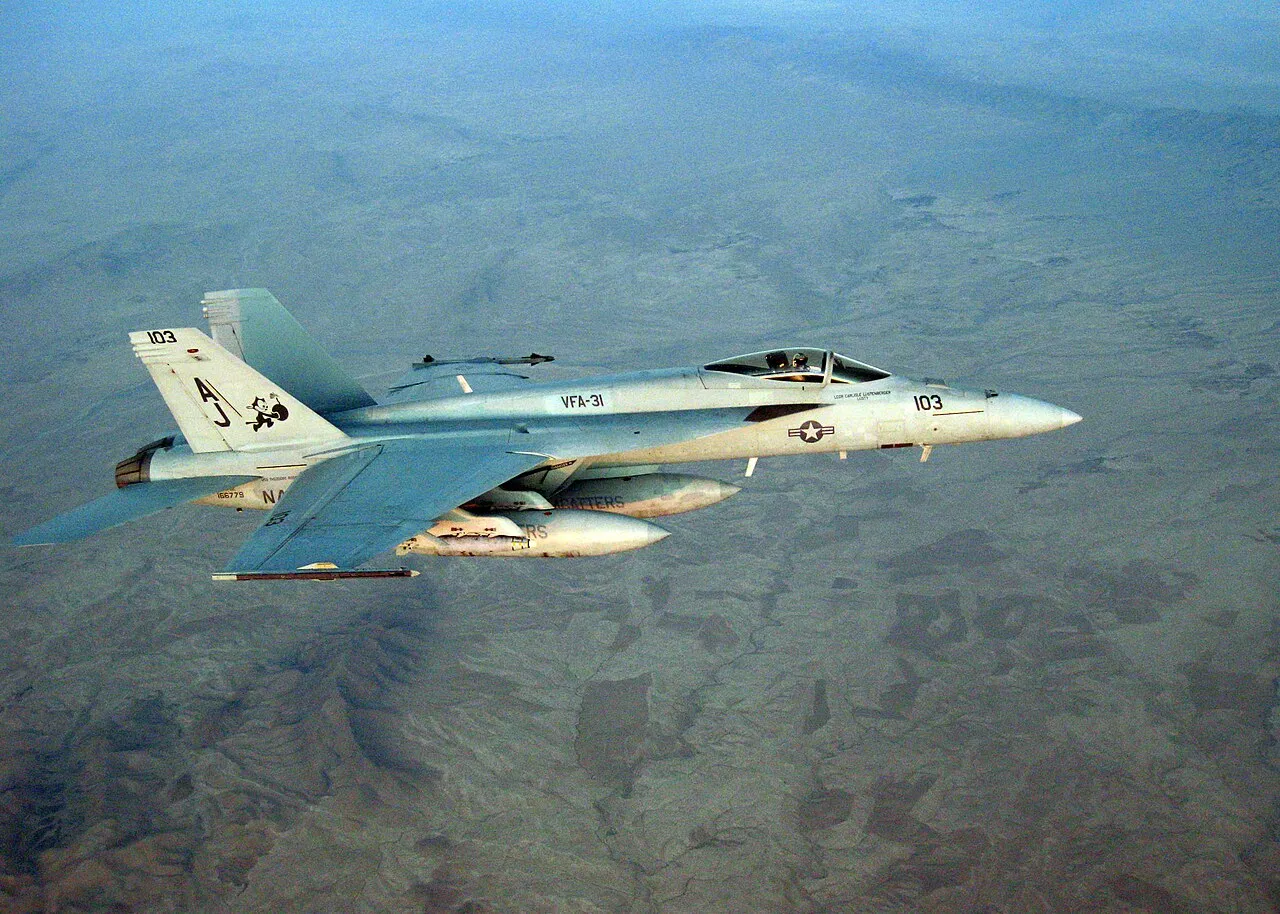
The McDonnell Douglas F/A-18 Hornet is a twin-engine, carrier-capable strike fighter built to handle both air-to-air combat and ground attack in a single airframe, which is why its designation carries both the fighter prefix “F” and the attack prefix “A.” It was built by McDonnell Douglas, working with Northrop, from 1974 until McDonnell Douglas merged into Boeing in 1997, after which Boeing continued production until 20001. The US Navy and Marine Corps have flown it as their main carrier-based fighter and attack jet for decades, and a long list of export customers still fly it today.
Design and development
The Hornet grew out of the Northrop YF-17 Cobra, the aircraft that lost the US Air Force’s Lightweight Fighter competition to General Dynamics’ YF-16. When the Navy went looking for a lower-cost, lighter fighter to complement its Grumman F-14 Tomcat and to replace the Vought F-4 Phantom II and Douglas A-4 Skyhawk, it turned to the YF-17 design rather than the land-based YF-16, since the YF-17’s twin engines and twin tails suited carrier operations better. McDonnell Douglas was brought in as prime contractor, with Northrop as the principal subcontractor, to navalise and enlarge the design for the stresses of catapult launches and arrested landings. The resulting aircraft first flew on 18 November 19781.
Unlike most fighters of its generation, the Hornet was designed from the outset to combine the fighter and attack roles that the Navy had previously split between separate aircraft types1, letting a single jet switch between an air-to-air loadout and a strike loadout by changing its software mode and weapons rather than its airframe.
Specifications
The F/A-18A/C Hornet is 17.1 m long with a wingspan of 12.3 m when carrying wingtip-mounted AIM-9 Sidewinder missiles, and it has a maximum take-off weight of 23,541 kg. It is powered by two General Electric F404-GE-402 afterburning turbofans, cruises at around 889 km/h, and can cover a ferry range of about 3,334 km with three external fuel tanks fitted. The jet seats one pilot in the single-seat F/A-18A and F/A-18C, or a pilot and a weapon systems officer in the two-seat F/A-18B and F/A-18D1.
Variants
The baseline F/A-18A (single-seat) and F/A-18B (two-seat trainer) were followed by the upgraded F/A-18C and F/A-18D, which added improved avionics and the ability to carry newer precision weapons. In all, 1,480 F/A-18A/B/C/D Hornets were built between 1974 and 2000. Boeing later developed the much larger F/A-18E/F Super Hornet as a separate, heavier aircraft that shares the Hornet’s name and general layout but has a different airframe1; it is not covered on this page.
Operators and service
The type is still in service, having been retired from the US Navy’s front-line squadrons in 2019 and from the Royal Australian Air Force in 2021, while the US Marine Corps and several export operators continue to fly it1. Export customers who bought the original Hornet, rather than the later Super Hornet, include Canada, Australia, Spain, Kuwait, Finland, Switzerland and Malaysia, each of which has used it as its principal multirole fighter.
Similar aircraft
- General Dynamics F-16 Fighting Falcon: the land-based fighter built from the YF-16, the Hornet’s rival design in the same Lightweight Fighter competition that produced the YF-171.
- Dassault Rafale: a French twin-engine, carrier-capable multirole fighter built for a similar mix of air-to-air and strike missions.