Contents
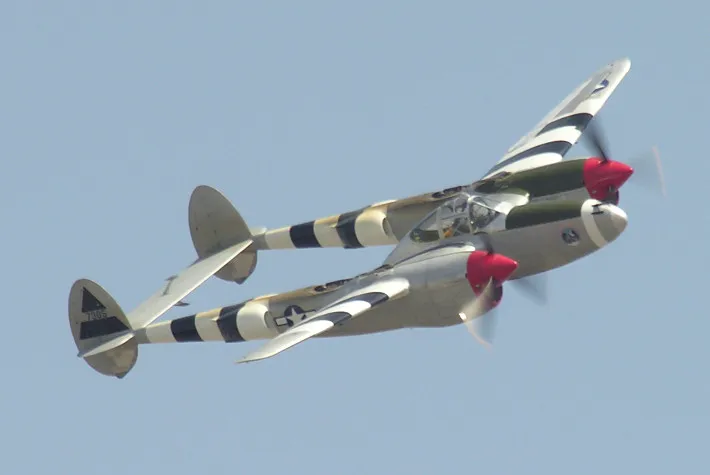
The Lockheed P-38 Lightning is a twin-engine, twin-boom fighter built by the Lockheed Corporation and flown by the United States Army Air Forces in the Second World War. It served as a long-range escort fighter, a fighter-bomber and a photo-reconnaissance aircraft, and it carried America’s two top-scoring fighter pilots of the war, Richard Bong and Thomas McGuire1, to their victories in the Pacific.
Design and development
Lockheed designed the type for Circular Proposal X-608, a February 1937 United States Army Air Corps specification calling for a maximum airspeed of at least 360 mph (580 km/h) at altitude and a climb to 20,000 ft (6,100 m) within six minutes. Designers Benjamin S. Kelsey and Gordon P. Saville wanted an aircraft carrying more firepower than the single engine, single seat limit the Army otherwise imposed, and Kelsey was looking for a minimum of 1,000 lb (450 kg) of armament. Lockheed’s answer used twin booms to carry the tail, the engines and their turbosuperchargers, leaving a central nacelle for the pilot and armament, fitted with counter-rotating propellers, driven by engines whose crankshafts turned in opposite directions, to cancel out engine torque. Concentrating four machine guns and a cannon in the nose, rather than spreading guns across the wings as on most contemporaries, meant a Lightning could reliably hit targets at any range up to 1,000 yd (900 m)1.
High-speed dives exposed a serious flaw: approaching Mach 0.68 the tail would shake violently, the nose would tuck under and the controls would lock up. Test pilot Ralph Virden was killed on 4 November 1941 when the tail unit failed at about 3,500 ft (1,000 m) during a high-speed dive recovery. The fix came in February 1943 with quick-acting dive flaps that extended downward 35 degrees in 1.5 seconds1, restoring control before pilots lost the aircraft.
Specifications
The production P-38L was 11.53 m long with a wingspan of 15.85 m and a maximum take-off weight of 9,798 kg. It was powered by two Allison V-1710 turbosupercharged, liquid-cooled V-12 piston engines rated at 1,600 hp each, giving a cruise speed of about 443 km/h. Combat range was about 2,092 km, extending to roughly 5,311 km on ferry flights with external drop tanks1. The P-38 carried a single pilot and no other crew.
Variants
The sole prototype, the XP-38, first flew on 27 January 1939 and was wrecked in a landing accident near Mitchel Field after carburetor icing brought it down short of the runway. Lockheed followed it with 13 YP-38 service test aircraft, ordered on 27 April 1939, then a line of combat variants: 36 P-38Ds with self-sealing fuel tanks and added armour, the P-38E, the first variant armed for combat, and the improved P-38F and P-38G, the version flown on the Yamamoto interception. The late-war P-38J and P-38L added better engine cooling and, from the J onward, the dive flaps that cured the compressibility problem. Unarmed photo-reconnaissance versions, designated F-4 and F-5, accounted for about 1,200 of the roughly 10,037 Lightnings built between 1941 and 19451, close to one in nine.
Operators and service
The P-38 flew with the United States Army Air Forces, the Free French Air Force, and in small numbers with the Royal Air Force, which transferred most of its order back to the USAAF. It entered service in July 1941 and flew in every major American theatre: the Pacific and China Burma India, North Africa and Italy, Western Europe, and the Aleutian Islands. Its longest range made it the aircraft for distant interceptions: on 18 April 1943, 16 P-38Gs flew 435 miles (700 km) from Guadalcanal at 10 to 50 ft (3 to 20 m) above the ocean to shoot down the transport carrying Admiral Isoroku Yamamoto. It was the aircraft of America’s top-scoring aces of the war, Richard Bong with 40 victories, Thomas McGuire with 38 and Charles H. MacDonald with 27, all flying in the Pacific. Over Europe it flew 130,000 sorties for an overall loss rate of 1.3%. The type was retired by the United States Air Force in 1949 and by its last military operator, the Honduran Air Force, in 19651.
Safety record
Beyond the compressibility crashes that the dive flaps cured, the twin-engine layout carried its own hazard: because the Lightning had no centreline thrust, losing one engine on takeoff produced a sudden, uncontrollable yawing roll that could flip the aircraft over, regardless of which engine failed. Pilots also reported poor cockpit temperature regulation, too hot in the tropical Pacific and too cold over Northern Europe and at high altitude1.
Similar aircraft
- North American P-51 Mustang: the single-engine American long-range escort fighter that eventually took over much of the P-38’s role over Europe.
- Republic P-47 Thunderbolt: another American single-seat fighter of the same war, flown alongside the P-38 as an escort and fighter-bomber.
- Messerschmitt Bf 110: a contemporary German twin-engine fighter, though without the P-38’s twin-boom layout.
_Z1OEC2T.webp)