Contents
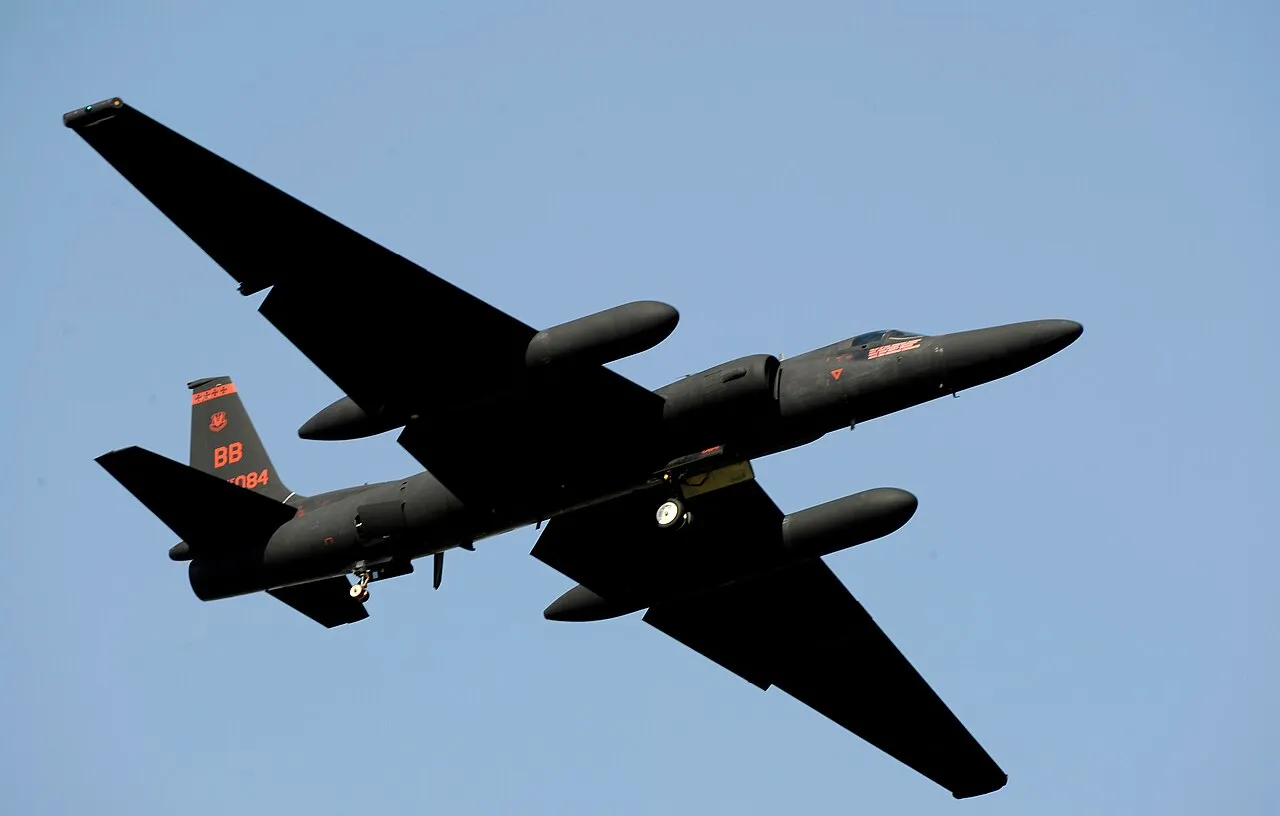
The Lockheed U-2 is a single-engine, high-altitude reconnaissance aircraft built by Lockheed’s Skunk Works for the Central Intelligence Agency in the early years of the Cold War. Designed to overfly the Soviet Union and photograph military sites from altitudes Soviet fighters and missiles could not reach, it has since flown reconnaissance and scientific missions for decades. Despite its age, the type remains in US Air Force service today1, repeatedly outliving plans to retire it.
Design and development
Lockheed’s Skunk Works division, led by Kelly Johnson, designed the U-2 around a simple idea: a glider-like airframe with very long, slender wings, married to a powerful jet engine, could cruise far above the altitude any contemporary interceptor or surface-to-air missile could reach. The aircraft first flew on 1 August 1955, from the secret test site at Groom Lake, Nevada that later became known as Area 51. The CIA used early U-2s to photograph Soviet military and industrial sites from the mid-1950s, a programme that ended abruptly when a U-2 flown by Francis Gary Powers was shot down over the Soviet Union on 1 May 1960, an incident that became a major Cold War crisis. U-2s later photographed Soviet missile sites in Cuba in October 1962, providing key evidence during the Cuban Missile Crisis; a U-2 flown by Major Rudolf Anderson was shot down over Cuba during the crisis1.
Lockheed kept developing the airframe long after its Cold War origins. A substantially enlarged version, the U-2R, flew in 1967 with a bigger fuselage and wings to carry more fuel and sensors, and later airframes were re-engined with the General Electric F118 turbofan to become the U-2S1, the version that makes up the fleet still flying today.
Specifications
The current U-2S variant is 19.2 m long with a wingspan of 31.4 m, proportions closer to a glider than a typical jet aircraft, and gives the U-2 its distinctive long, narrow silhouette. Its maximum take-off weight is 18,144 kg. It is flown by a single pilot, who wears a full pressure suit similar to those used by astronauts, since the aircraft cruises far above the altitude where a sudden loss of cabin pressure would be survivable without one; a small number of two-seat TU-2S trainers1 also exist for training.
Power comes from one General Electric F118-101 turbofan in the U-2S; earlier variants used Pratt & Whitney J57 or J75 turbojets. The U-2S cruises at about 765 km/h and has a range of about 11,279 km, enough for long-duration missions deep inside a target area. Lockheed built 104 U-2s between 1955 and 1989; the first 20 aircraft were covered by a 1955 contract worth about $22.5 million, roughly $1.125 million per aircraft, not adjusted for inflation1.
Variants
The type evolved considerably over its service life. Early aircraft included the original U-2A and the U-2C, an upgraded version with a more powerful engine. The U-2R of 1967 was significantly larger than the original design, with room for more fuel and sensor equipment. A tactical reconnaissance version flown by the US Air Force in Europe during the 1980s was designated the TR-1A, essentially the same airframe under a different name chosen for political reasons. Surviving airframes were later upgraded with the F118 turbofan and digital avionics to become the U-2S1, the version still in service, alongside the two-seat TU-2S trainer.
Operators and service
The U-2 has flown for both the CIA and the US Air Force since the 1950s, and the US Air Force’s 9th Reconnaissance Wing at Beale Air Force Base, California, operates the current fleet. The aircraft has also served allied air arms: in the 1960s and 1970s, Taiwan’s Republic of China Air Force flew U-2s on reconnaissance missions over mainland China, under a covert programme with the United States. NASA has also used the design, flying a civilian-operated variant called the ER-2 for high-altitude scientific research1.
The type’s expected retirement has repeatedly slipped. The US Air Force has proposed retiring the U-2 multiple times in favour of unmanned platforms such as the RQ-4 Global Hawk, only to keep flying it instead, and the aircraft remains in active service today1, more than seven decades after it first flew.
Safety record
High-altitude flight in a pressure suit, at the edge of the aircraft’s performance envelope, has made the U-2 one of the more demanding aircraft to fly, and the programme has lost a number of aircraft and pilots to training accidents and physiological hazards over its service life, in addition to the Cold War shoot-downs over the Soviet Union and Cuba1.
Similar aircraft
- Lockheed SR-71 Blackbird: a later Skunk Works reconnaissance design that traded the U-2’s high altitude for very high speed to evade interception.
- Northrop Grumman RQ-4 Global Hawk: the unmanned reconnaissance aircraft repeatedly proposed as the U-2’s replacement.
- Boeing B-52 Stratofortress: another Cold War-era US military aircraft that, like the U-2, has remained in service for decades past its original expected retirement.
_Z1OEC2T.webp)