Contents
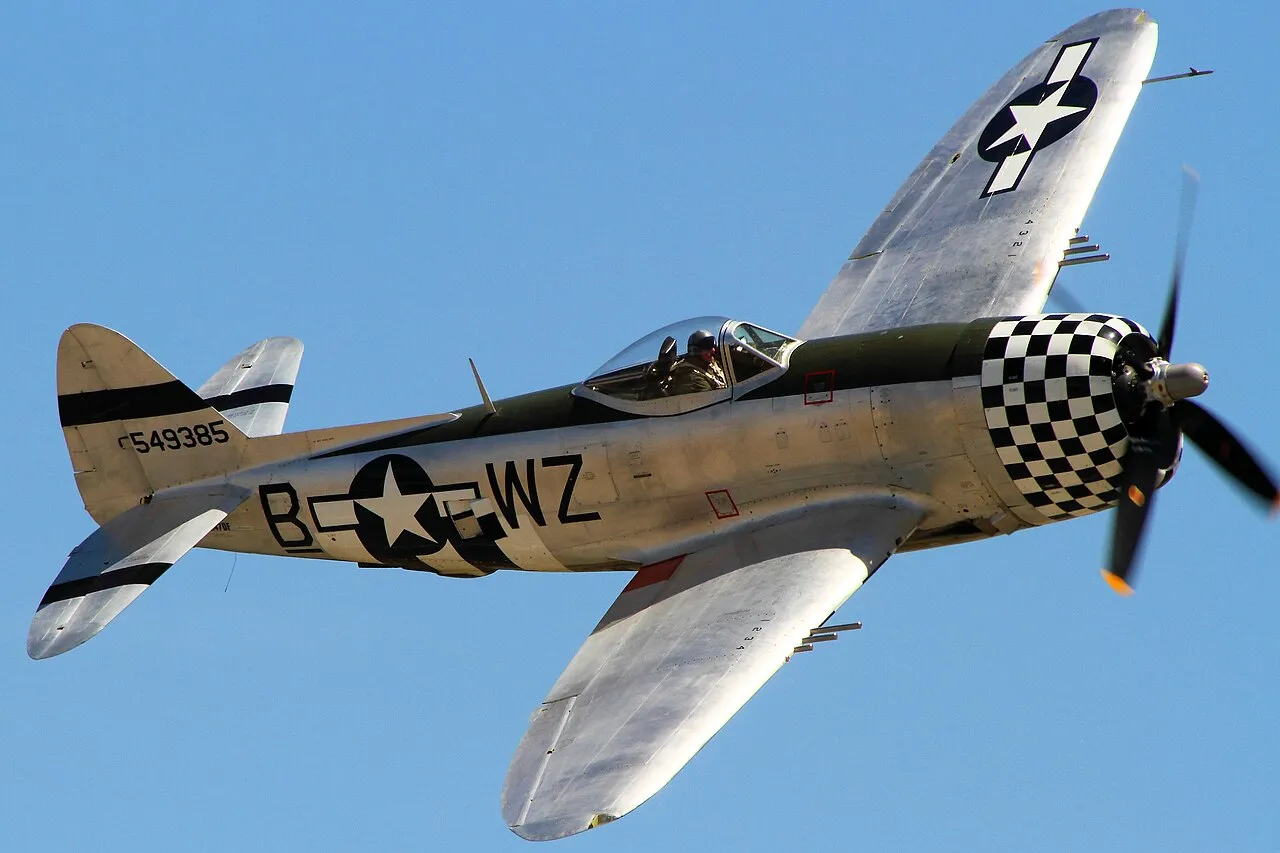
The Republic P-47 Thunderbolt is a single-seat, single-engine fighter built by Republic Aviation and flown by the United States Army Air Forces from December 1941. It served as a long-range escort fighter over Europe and, loaded with bombs and rockets, as a ground-attack aircraft against rail, armour and troop targets. Pilots called it the “Jug,” because its bulky profile reminded them of a milk jug of the era1.
Design and development
The Thunderbolt was designed by engineer Alexander Kartveli at Republic Aviation as a successor to the earlier Seversky P-35 and the P-43 Lancer. Republic built it around the Pratt & Whitney R-2800 Double Wasp, an 18-cylinder radial engine capable of up to 2,000 hp, fitted with a turbosupercharger for high-altitude power. That turbosupercharger system drove the aircraft’s shape: its ductwork took up roughly half of the fuselage’s internal volume, forcing the deep, barrel-like fuselage that gave the type its nickname. The prototype, the XP-47B, made its first flight on 6 May 1941 with test pilot Lowry P. Brabham at the controls. It carried eight .50-calibre machine guns and a cockpit Kartveli himself called roomy, reportedly describing the design as “a dinosaur, but a dinosaur with good proportions”1.
The aircraft’s size and weight made it heavier than contemporary single-engine fighters, but that bulk proved an asset in combat. Luftwaffe ace Heinz Bär noted that the Thunderbolt could absorb an astounding amount of gunfire and had to be handled very carefully in a dogfight1. RAF pilots who had flown the lighter Spitfire were initially skeptical of the type, but came to value its dive speed and high-altitude performance once they flew it in combat.
Specifications
The production P-47D-40 is 11.02 m long with a wingspan of 12.43 m. It has a maximum take-off weight of 7,938 kg, heavy for a single-engine fighter of its day. It is powered by one Pratt & Whitney R-2800-59 Double Wasp 18-cylinder air-cooled radial piston engine rated at 2,000 hp, giving a cruise speed of about 560 km/h. With external drop tanks, its ferry range reached about 2,897 km, long enough to escort bombers deep into Germany and back. As a fighter-bomber, the D-series could carry up to 2,500 lb (1,100 kg) of bombs or 5-inch (130 mm) high-velocity aircraft rockets1 on top of its eight machine guns.
Variants
The early P-47B and P-47C had a hinged, “razorback” canopy that limited rearward visibility, and lacked paddle-blade propellers, which hurt low-altitude climb performance. The P-47D became the type’s workhorse and was built in both razorback and, from the D-25 block, bubble-canopy configurations that gave the pilot an unobstructed view around the aircraft. Another variant, the P-47N, saw postwar service abroad: the Chinese Nationalists flew 42 P-47Ns alongside 70 P-47Ds, brought to Taiwan in 1952. In all, Republic built 15,636 Thunderbolts between 1941 and 19451, making it the most-produced American fighter of the war.
Operators and service
The US Army Air Forces flew the Thunderbolt from both the European and Pacific theatres as a high-altitude escort fighter and, increasingly, as a ground-attack aircraft. The 56th Fighter Group was its best-known unit, producing aces such as Francis S. Gabreski, with 28 victories, and Robert S. Johnson, with 27. In the ground-attack role over occupied Europe, P-47 pilots claimed to have destroyed roughly 86,000 railroad cars, 9,000 locomotives, 6,000 armoured fighting vehicles and 68,000 trucks between D-Day and VE Day1, often using skip-bombing tactics against hardened targets such as rail tunnels.
The type also flew for several Allied air forces. The Royal Air Force received 240 razorback P-47Ds and 590 bubble-top P-47D-25s, which it used mainly for ground attack over Burma. Free French units flew 446 P-47Ds from 1943, later also in the Algerian War of Independence. Brazil’s 1º Grupo de Caça flew 48 P-47Ds on 445 combat missions over northern Italy and Central Europe between November 1944 and May 1945. Mexico’s Escuadrón Aéreo de Pelea 201 flew 791 combat sorties against Japanese forces from March 1945 without losing a pilot or aircraft to enemy action. The Soviet Union received about 200 Thunderbolts in mid-1944, though it rarely used them in combat1.
After the war, orders for 5,934 further Thunderbolts were cancelled. The surviving fleet was redesignated F-47 in 1947 and flew on with the US Air Force, Strategic Air Command and the Air National Guard into the early 1950s. The last operator, the Peruvian Air Force, retired its P-47s in 19661, a quarter-century after the type’s first flight.
Safety record
The Thunderbolt was prized in service for surviving damage that destroyed lighter fighters; one Brazilian P-47, after destroying a German tank, clipped a factory chimney and lost the wing outboard of the landing gear but still returned to base. Two P-47 pilots were awarded the Medal of Honor: Col. Neel E. Kearby, for shooting down six Japanese aircraft over Wewak, New Guinea, on 11 October 1943 despite being outnumbered roughly seven to one (he was killed in action the following March), and 1st Lt. Raymond L. Knight, posthumously, for a ground-attack mission over Italy’s Po Valley on 24–25 April 1945 in which he chose to try to fly his damaged P-47 home rather than bail out, and was killed when it crashed1.
Similar aircraft
- North American P-51 Mustang: the other long-range American escort fighter of the war, lighter and faster but less able to absorb battle damage, flying alongside the Thunderbolt.
- Supermarine Spitfire: the RAF’s own front-line fighter through the war, which British pilots compared the heavier Thunderbolt against when the type entered RAF service, linked here.
- Fairchild Republic A-10 Thunderbolt II: a later Republic attack aircraft that took its name from the P-47 in tribute to its ground-attack record.