Contents
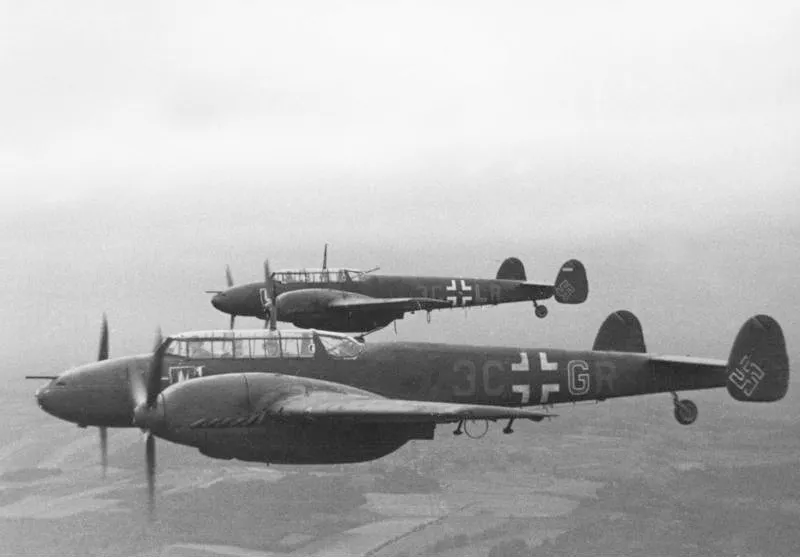
The Messerschmitt Bf 110 was a twin-engine heavy fighter built by Bayerische Flugzeugwerke, later renamed Messerschmitt AG, flown by the German Luftwaffe through the Second World War. It was designed as a long-range escort and bomber-destroyer, a role that failed in daylight combat but found a second life after dark: by the war’s later years it had become the Luftwaffe’s main night fighter. Production ran from 1937 to 1945 and reached about 6,170 aircraft across all variants1.
Design and development
The Bf 110 grew out of a 1930s requirement from the German Air Ministry for a Kampfzerstörer, a multipurpose twin-engined “battle destroyer” that Hermann Göring championed as a heavily armed, fast, long-range offensive fighter. Of several manufacturers approached, Bayerische Flugzeugwerke’s design beat submissions from Focke-Wulf and Henschel by dropping the internal bomb load to maximise firepower and speed. The prototype first flew on 12 May 19361, piloted by Rudolf Opitz from Augsburg, with all-metal construction, twin vertical stabilisers and Handley-Page wing slots.
Early production aircraft used Junkers Jumo 210 engines, which limited top speed to about 431 km/h because the intended Daimler-Benz DB 600 engines were not yet available in numbers. The type reached its intended performance only with the C-series from late 1938, which switched to Daimler-Benz DB 601 engines and raised maximum speed to about 541 km/h1.
Variants
The Bf 110 went through several major production series. The Bf 110 B, of which 45 were built, kept the underpowered Jumo 210G engines and four MG 17 machine guns. The Bf 110 C became the first major production series once DB 601 engines were fitted, arming it with two 20 mm MG FF cannon and four 7.92 mm MG 17 machine guns; the aircraft described in this profile’s specifications is a C-1. A long-range Bf 110 D variant added a 1,050-litre ventral fuel tank nicknamed the “Dackelbauch” (dachshund’s belly), and two 900-litre underwing drop tanks, bringing the fully equipped total fuel capacity to 4,120 litres1.
The Bf 110 E, built in 856 examples between August 1940 and January 1942, was a fighter-bomber version with extra armour that pilots found slow and unresponsive. The Bf 110 F followed with 512 built between December 1941 and December 1942, fitted with more powerful DB 601F engines producing 993 kW (1,350 PS) and was rated by pilots as the best-handling of the line. The final and largest series, the Bf 110 G, accounted for about 3,262 aircraft with DB 605B engines producing 1,085 kW (1,475 PS) at emergency power, built in fighter-bomber (G-2), reconnaissance (G-3) and night fighter (G-4, 2,293 built) subvariants1.
Specifications
The C-1 variant was 12.07 m long with a 16.25 m wingspan and a maximum take-off weight of 6,749 kg. It was powered by two Daimler-Benz DB 601A-1 V-12 liquid-cooled piston engines, each rated at 780 kW (1,050 hp) for take-off, giving a maximum continuous cruise speed of about 489 km/h at 5,000 m and a range of about 1,094 km at economical cruise speed and 4,200 m altitude. It carried a crew of two or three1, a pilot and radio operator/gunner, with a third crew position for a radar operator added on night-fighter variants.
Operational history
The Bf 110 performed well in the early campaigns over Poland, Norway and France, where its speed and firepower outmatched lighter opposition. The Battle of Britain exposed its central weakness: it lacked the manoeuvrability to dogfight with RAF Spitfires and Hurricanes, and loss rates among Bf 110 units escorting bombers over England were heavy.
The aircraft found a far more successful role as a night fighter from the winter of 1940–41. Fitted with airborne radar from mid-1941, it became an effective interceptor of RAF night bombers, and the Bf 110 F-4, introduced in July 1942, was the first version designed specifically for night fighting. The type remained the Luftwaffe’s principal night fighter through 1944, with the G-series prized by crews for its visibility and stability as a gun platform. The top-scoring night fighter pilot of the war, Heinz-Wolfgang Schnaufer, flew the Bf 110 exclusively and claimed 121 victories in 164 sorties1. Away from the night sky, the Bf 110 also flew fighter-bomber and ground-attack missions on the Eastern Front and in North Africa, though by 1944 improving Allied fighter tactics made daylight operations increasingly costly.
Operators and service
The Bf 110’s main operator was the German Luftwaffe, which flew it from its 1936 first flight until Germany’s defeat in 1945. Smaller numbers went to Axis allies: the Royal Hungarian Air Force received 12 to 14 Bf 110 G-4s in December 1944, the Romanian Air Force operated 23 aircraft across the C, E and F variants, and smaller batches went to Italy’s Regia Aeronautica and the Croatian Air Force. Captured examples were also flown by the Soviet Air Force and a single aircraft by the RAF’s 1426 Flight, which evaluated enemy aircraft. Two intact Bf 110s survive today: a G-4 at the Royal Air Force Museum in Hendon and an F-2 at the Deutsches Technikmuseum Berlin. A G-4 owned by a private foundation in Denmark is a restoration assembled from worldwide spare parts rather than an original survivor, and wing sections and other parts recovered from a Swedish lake are held at the Technik Museum Speyer1.
Similar aircraft
- Messerschmitt Bf 109: the Luftwaffe’s single-seat fighter from the same manufacturer, built in far greater numbers and flown throughout the same war.
- Junkers Ju 88: another German twin-engine type adapted to night fighting alongside the Bf 110 later in the war.
- de Havilland Mosquito: the RAF’s twin-engine multirole aircraft, its closest equivalent on the Allied side.