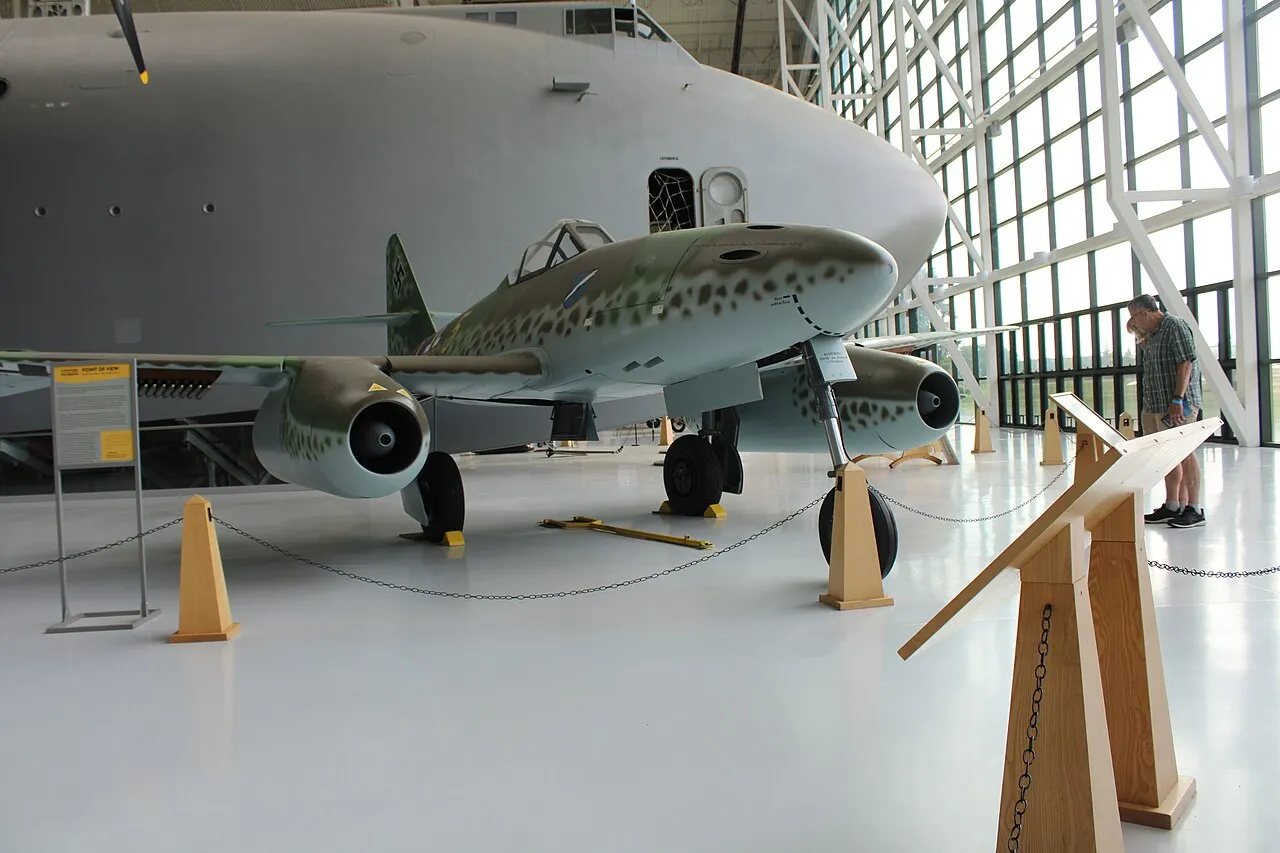
The Messerschmitt Me 262 was a single-seat jet fighter built by Messerschmitt, and it was the world’s first operational jet fighter aircraft. Nazi Germany rushed it into Luftwaffe service in the closing year of the Second World War, where it flew mainly as a bomber interceptor against Allied air raids. About 1,430 were built between 1944 and 19451, but production problems, fuel shortages and Allied bombing of German industry kept the type from ever flying in numbers large enough to change the course of the air war.
Design and development
Messerschmitt began work on a jet-powered fighter in the late 1930s, well before suitable engines existed. The airframe first flew on 18 April 1941 under piston power, standing in for the jet engines that were still under development; the aircraft made its first flight under jet power on 18 July 19422, powered by a pair of Junkers Jumo 004B turbojets1. Those early axial-flow turbojets were unreliable and short-lived, and their immaturity, combined with Allied bombing of German aircraft and engine factories, delayed the type’s entry into frontline service by roughly two years after its jet-powered debut.
Engineers swept the wing of the production aircraft mainly to keep the centre of gravity correct once the heavy jet engines were slung under it, a practical fix that also happened to help the aircraft handle the onset of compressibility at high speed. The result was an airframe that could outrun and outclimb every Allied piston-engined fighter it met1, but one that reached the front only in small numbers and too late to affect the outcome of the war.
Specifications
The Me 262 A-1a production fighter was 10.6 m long with a wingspan of 12.6 m, and it had a maximum take-off weight of 7,130 kg. It was powered by two Junkers Jumo 004B turbojets and carried a single pilot. Its combat range was about 1,050 km1, short even by the standards of wartime piston fighters, a consequence of the early jet engines’ heavy fuel consumption.
Variants
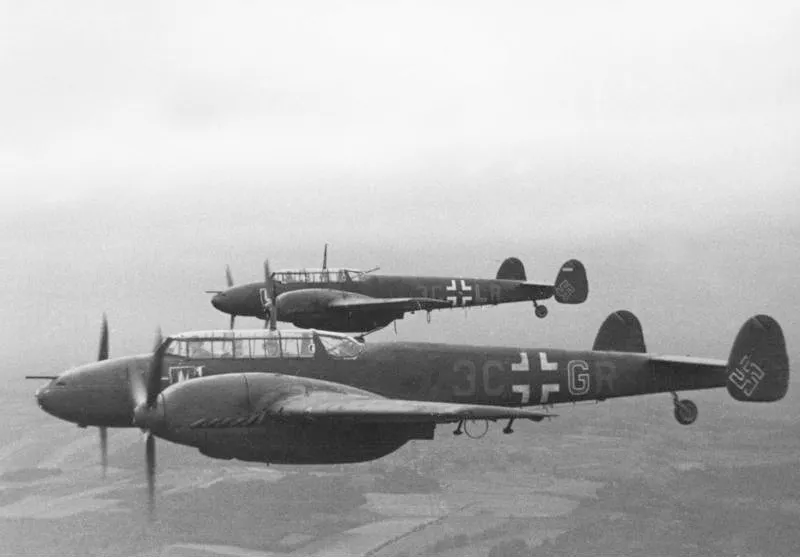
The baseline fighter was the single-seat A-1a; Messerschmitt and the Luftwaffe adapted the airframe to several other roles as the war went on, including a two-seat trainer and night-fighter version, the Me 262 B-1a, which carried a second crew member. After the war, Czechoslovakia continued production under licence as the Avia S-921, using existing German tooling and components.
Operators and service
The Luftwaffe flew the Me 262 in its final year of the war, chiefly as an interceptor against Allied heavy-bomber formations, though some units also used it for reconnaissance and ground attack. Wartime German production is put at about 1,430 aircraft, built in 1944 and 1945. The type was withdrawn from German service with Germany’s surrender in 1945, but it did not disappear immediately: the Czechoslovak Air Force flew its licence-built Avia S-92 derivatives until 19511. No Me 262 is in service today.
Similar aircraft
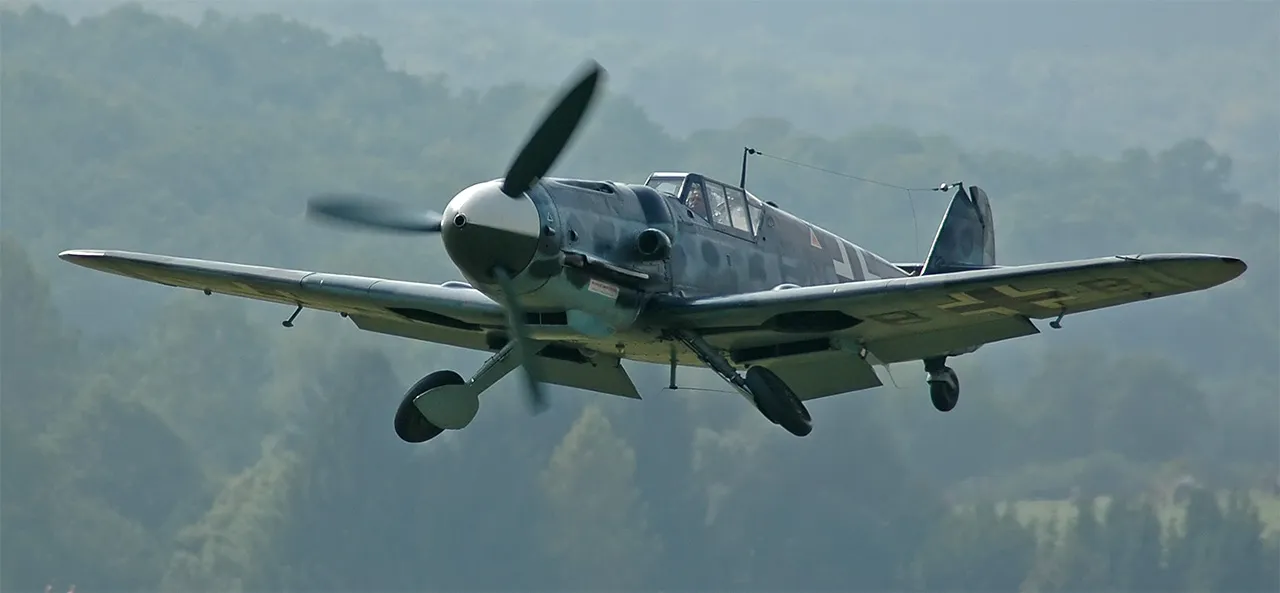
- Messerschmitt Bf 109: the same manufacturer’s piston-engined wartime fighter, built in far greater numbers and flown throughout the war.
- Gloster Meteor: the only other jet fighter to see combat in the Second World War, flown by the British Royal Air Force.