Contents
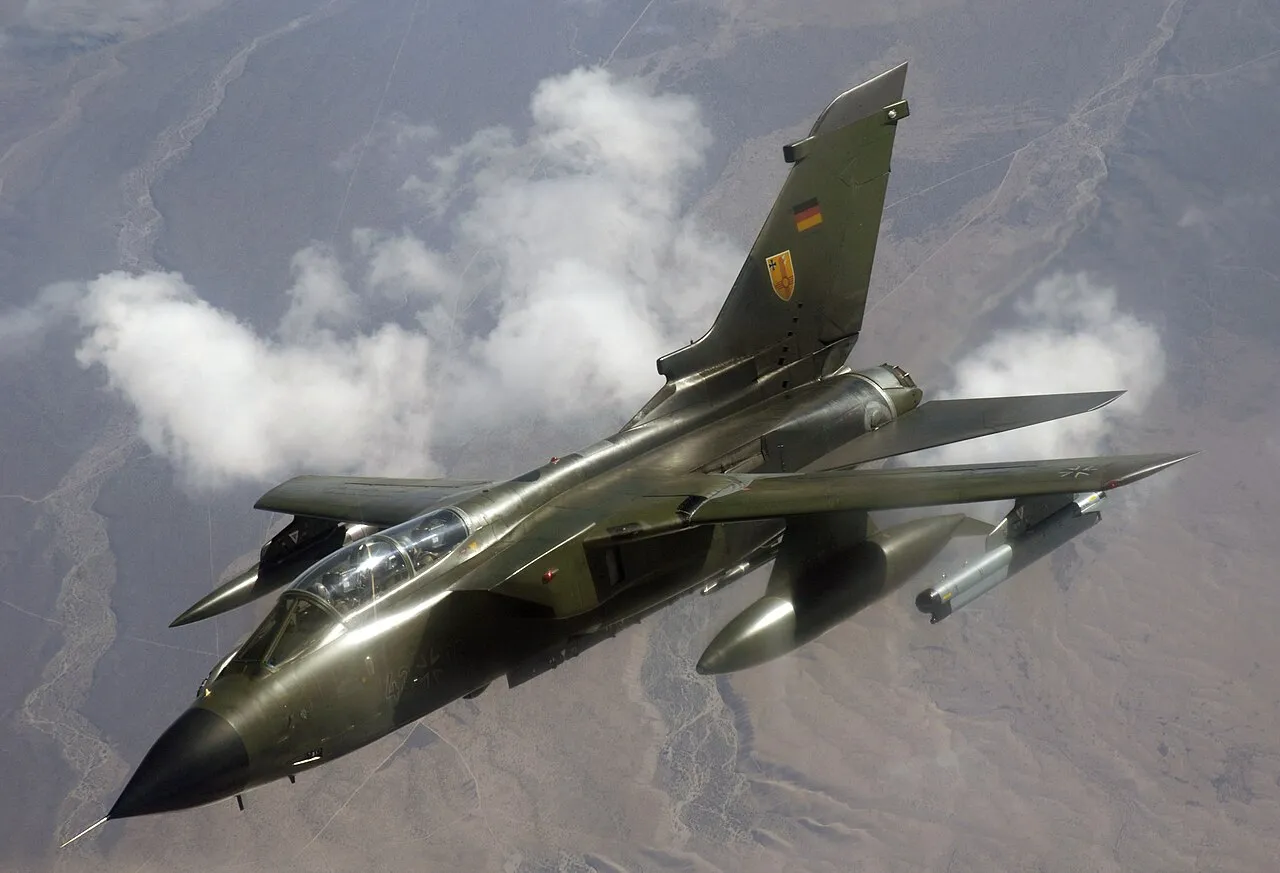
The Panavia Tornado is a twin-engine, variable-sweep combat aircraft built jointly by the United Kingdom, West Germany and Italy. The three countries’ manufacturers formed Panavia Aircraft GmbH to build it, with British Aerospace, Messerschmitt-Bölkow-Blohm (MBB) of West Germany and Aeritalia of Italy as partners. Designed during the Cold War, it was intended to deliver conventional and nuclear weapons against invading Warsaw Pact forces1 at low level and high speed, and it went on to serve as a strike, reconnaissance and air-defence aircraft for four decades.
Design and development
The programme began after Britain cancelled the BAC TSR-2 in 1965 and rejected the American F-111K in 1967, leaving it without a planned Cold War strike aircraft. In 1968, West Germany, the Netherlands, Belgium, Italy and Canada formed a working group to study a replacement for the ageing Lockheed F-104G Starfighter, first called the Multi Role Aircraft and then the Multi Role Combat Aircraft; Britain joined the same year. On 26 March 1969, the UK, West Germany, Italy and the Netherlands agreed to form the joint company Panavia Aircraft GmbH, though the Netherlands withdrew in 1970 over the aircraft’s complexity. In the final split, British Aerospace built the front fuselage and tail, MBB the centre fuselage, and Aeritalia the wings, with shares of 42.5%, 42.5% and 15%. The engine, the afterburning RB199 turbofan, came from the separate Turbo-Union consortium of Rolls-Royce, MTU and Fiat1.
The aircraft’s defining feature is its variable-sweep, or “swing”, wing, adjustable between 25 and 67 degrees, which let it combine stable low-speed handling for short take-offs with a swept-back shape for fast, low-level penetration of enemy airspace. The first prototype flew on 14 August 1974 at Manching in West Germany, and the first production aircraft flew on 10 July 1979, with service entry following in 1979-1980. Production ran until 1998, by which time 990 aircraft had been built: 745 IDS strike variants, 194 ADV interceptors and 51 ECR electronic-combat aircraft1.
Specifications
The baseline IDS/GR4 version is 16.72 m long with a wingspan that varies from 13.91 m with the wings spread at 25 degrees to 8.60 m fully swept at 67 degrees. It has a maximum take-off weight of 27,215 kg and is powered by two Turbo-Union RB199 afterburning turbofans. Ferry range with external tanks is about 3,890 km, though its hi-lo-hi combat radius on a strike mission is closer to 1,574 km. It carries a crew of two, a pilot and a navigator/weapons officer seated in tandem1.
Variants
The Tornado IDS (Interdictor/Strike) was the original fighter-bomber version, built for low-level penetration strikes and ground attack and the most numerous of the three main types. The Tornado ECR (Electronic Combat Reconnaissance) added emitter-locator systems to find enemy radars and carried AGM-88 HARM anti-radiation missiles for suppressing air defences. The Tornado ADV (Air Defence Variant) used a stretched fuselage and carried beyond-visual-range missiles, first Skyflash and later AIM-120 AMRAAM, as a dedicated interceptor. The Royal Air Force flew its own strike designations: the original GR1, and the GR4, an extensive upgrade with forward-looking infrared, improved avionics, GPS and night-vision compatibility that first flew in April 1997 and finished deliveries in 2003; reconnaissance versions of each were the GR1A and GR4A, fitted with the Tornado Infrared Reconnaissance System1.
Operators and service
West Germany’s Luftwaffe took delivery of 247 aircraft and deployed them over Kosovo in 1999 and Afghanistan from 2007 to 2010, keeping 85 in service with a plan to fly them until 2025. The German Navy separately flew 112 IDS aircraft in anti-ship and reconnaissance roles before disbanding its Tornado wings in 1994 and 2005. Italy’s Aeronautica Militare operated 100 IDS aircraft, designated A-200, plus 24 ADVs leased from the RAF between 1995 and 2004, and later converted 16 of its A-200s into EA-200 electronic-combat aircraft; Italian Tornados flew in the Gulf War, the Kosovo War and the 2011 Libya campaign. The Royal Air Force took delivery of 385 Tornados in total (230 GR1, 18 F2 and 147 F3) before retiring the type on 1 April 2019, the 101st anniversary of the RAF, when No. IX (B) Squadron and No. 31 Squadron stood the aircraft down together after more than 40 years of British service. Saudi Arabia was the only export customer, ordering 96 IDS aircraft, with the final one delivered in 19981.
The type saw sustained combat use. In the 1991 Gulf War, the RAF deployed 49 GR1s and lost six aircraft, while an Italian Tornado was also lost to anti-aircraft fire. During the 1999 Kosovo War, German Tornados flew 446 sorties and fired 236 HARM missiles, and Italian EA-200s fired a further 115. In the 2003 Iraq War, RAF GR4s launched Storm Shadow cruise missiles, with 85% of Britain’s air-launched weapons in that conflict being precision-guided, up from 25% in Kosovo. Italian Tornados returned to combat over Libya in 2011, where Aeronautica Militare Tornados and AMX fighter-bombers together released some 550 guided bombs and missiles, including 20 to 30 Storm Shadows, during no-fly-zone enforcement. The Tornado also remains the only non-American-built aircraft cleared to carry United States nuclear weapons under NATO’s Nuclear Planning Group1, reflecting its original Cold War role.
Safety record
The clearest sourced figures on Tornado losses come from the 1991 Gulf War, where the RAF lost six GR1s, four to unguided bomb attacks, one delivering a JP233 runway-denial weapon and one dropping laser-guided bombs1, and Italy lost a single aircraft to Iraqi anti-aircraft fire in the same conflict.
Similar aircraft
- Sukhoi Su-24: a Soviet-built, twin-engine variable-sweep strike aircraft of the same Cold War generation, designed for a similar low-level penetration role.
- SEPECAT Jaguar: an earlier Anglo-French strike aircraft that the Tornado was intended to complement and partly replace in European air forces.
- Eurofighter Typhoon: the later multinational European fighter that succeeded the Tornado in RAF, German and Italian service.